
You have walked through one hundreds of times — at the office lobby, the hospital entrance, the metro station, the IT park gate. You tap your card or look at a camera, two slim panels slide open, you walk through, and they close silently behind you in under a second.
That device is called a flap barrier.
Most people use flap barriers every single day without knowing the name, how they work, or why businesses invest in them. This guide covers all of it — what a flap barrier is, what the term means, exactly how it works, where it is used, and why thousands of businesses across India are installing them right now.
💡 Raise Solutions supplies, installs, and provides AMC for flap barriers across Vijayawada, Hyderabad, Bangalore, Pune and Mumbai. Call +91 8522959096 for a free site survey.
Flap Barrier Meaning — What Does the Term Mean?
The term flap barrier comes from two words:
Flap — the slim, wing-shaped retractable panels that extend horizontally across the lane to block or allow passage. These panels “flap” open and closed — hence the name.
Barrier — something that blocks passage. In security terminology, a barrier is any physical device that controls or restricts movement through a checkpoint.
Put together: a flap barrier is a device with retractable flap panels that forms a barrier — controlling who passes through a pedestrian entry point.
Other names for the same device:
Flap barriers go by several names depending on the brand, country, or industry context. All of these refer to the same or very similar device:
- Optical flap barrier
- Optical turnstile
- Swing barrier (when the panel swings rather than retracts)
- Speed gate
- Flap gate
- Pedestrian barrier
- Access control barrier
- Lane barrier
- Turnstile flap barrier
In India, the most commonly used terms are flap barrier and optical turnstile — used interchangeably across the security industry.
What is a Flap Barrier?
A flap barrier is an electromechanical pedestrian access control device that uses retractable wing-shaped panels to allow or deny entry to one person at a time at a controlled entry point.
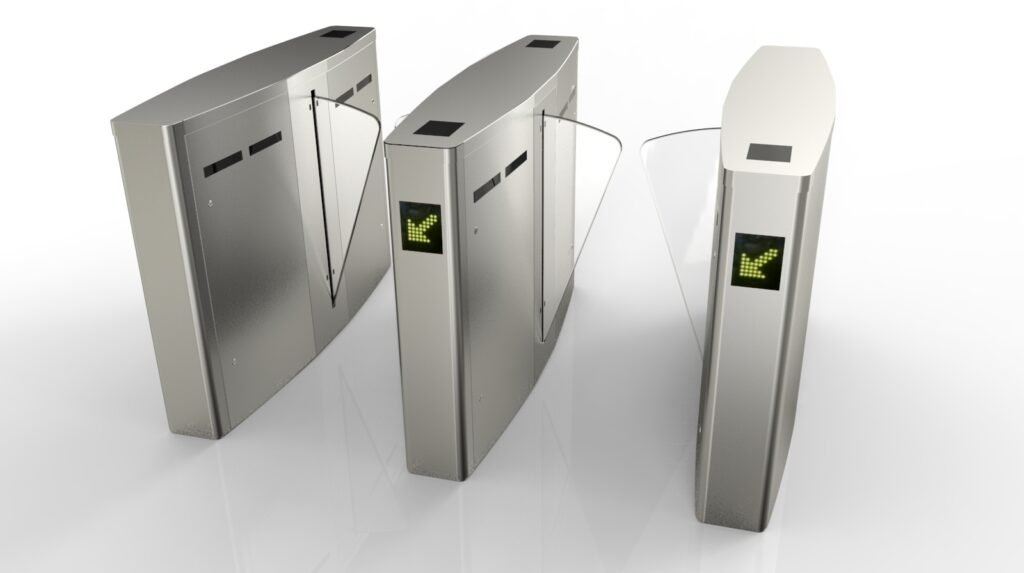
The device consists of:
The Housing / Pedestal — a stainless steel cabinet, typically 90 to 120 centimetres tall, that contains all the mechanical and electronic components. Two pedestals face each other across the lane, forming the entry channel a person walks through.
The Flap Panels — slim, retractable wings made of acrylic, tempered glass, or polycarbonate that extend horizontally across the lane when closed, physically blocking passage. When a valid credential is presented, the panels retract into the housing, opening the lane.
The Motor and Drive System — a precision electric motor inside the housing that drives the flap panels open and closed. The motor determines the speed and smoothness of operation.
The Infrared Sensor Array — multiple IR sensors positioned across the lane create an invisible detection grid. These sensors track each person as they pass through, detect tailgating attempts, and ensure the panels do not close on someone mid-passage.
The Control Unit — the electronic brain of the device that receives credential signals, communicates with the access control server, and commands the motor to open or close.
The Credential Reader — mounted on top of the pedestal, this is where the person presents their RFID card, looks at the face recognition camera, places their finger on the fingerprint sensor, or scans their QR code.
How Does a Flap Barrier Work? — Step by Step
Step 1 — Person Approaches
The person walks toward the flap barrier lane. The flap panels are in the closed (horizontal) position, physically blocking the lane.
Step 2 — Credential Presented
The person presents their credential at the reader:
- RFID card — tapped against the reader
- Face recognition — person looks at the camera, face is identified in 0.3 seconds
- Fingerprint — finger placed on the sensor
- QR code — scanned from phone or printed pass
- Mobile credential — phone held near the reader via Bluetooth or NFC
Step 3 — Verification
The credential reader sends the identity information to the access control controller. The controller checks the central database in milliseconds — is this credential valid? Does this person have permission to enter this zone at this time?
Step 4 — Decision
If the credential is valid and access is permitted — the controller signals the motor to open the flaps.
If the credential is invalid, expired, or the person does not have access permission — the flaps stay closed, an alert sounds, and the guard is notified.
Step 5 — Flaps Open
The motor drives the flap panels to retract into the housing in under 0.5 seconds. The lane is now open. A green light and a soft beep signal the person to walk through.
Step 6 — Person Passes Through
The IR sensor array tracks the person as they move through the lane. The sensors confirm that exactly one person is passing — and that nobody is attempting to tailgate (follow immediately behind the credential holder without their own valid credential).
Step 7 — Flaps Close
Once the sensors confirm the person has fully cleared the lane, the motor drives the flap panels back to the closed position in under 0.5 seconds. The system resets and is ready for the next person.
Step 8 — Event Logged
Every passage — whether granted or denied — is automatically recorded in the access control software with a timestamp. This creates a complete audit trail of every entry and exit at every lane.
⏱️ The entire cycle — from credential presentation to flap closed — takes under 1.5 seconds in standard models and under 0.8 seconds in high-speed models.
Flap Barrier vs Other Entry Control Devices
Understanding what a flap barrier is becomes clearer when you compare it with related devices.
Flap Barrier vs Boom Barrier
A boom barrier controls vehicle entry — a horizontal arm rises and falls to allow or stop cars, trucks, and motorcycles. A flap barrier controls pedestrian entry — retractable panels open and close to allow or stop people on foot.
They serve the same purpose — controlling entry at a checkpoint — but for completely different users. Most secured premises need both: a boom barrier at the vehicle gate and a flap barrier at the pedestrian entry. Read our detailed boom barrier vs flap barrier comparison for a full breakdown.
Flap Barrier vs Turnstile
A turnstile uses rotating arms or a rotating cage to control one-at-a-time pedestrian entry. A tripod turnstile has three rotating arms at waist height. A full-height turnstile is a floor-to-ceiling rotating cage.
The key differences:
| Feature | Flap Barrier | Turnstile |
|---|---|---|
| Appearance | Sleek, professional | Industrial |
| Speed | Very fast — under 1 second | Slower — 3 to 5 seconds |
| Lane width | 550 to 900mm — comfortable | 400 to 550mm — narrow |
| Aesthetics | Premium — suits offices, hotels | Basic — suits factories |
| Cost | Higher | Lower |
| Physical security | High — IR detection | Very high — physical stop |
For corporate offices, IT parks, hospitals, and hotels — flap barrier. For factories, warehouses, construction sites — turnstile. Read our complete guide on types of flap barriers for all variants explained in detail.
Flap Barrier vs Security Guard
A security guard at the door manually checks every person’s identity before allowing entry. A flap barrier does the same thing — automatically, 24 hours a day, without rest breaks, without human error, and without the recurring monthly cost of a salary.
One flap barrier lane handles 600 to 800 persons per hour. A security guard handles 30 to 40 persons per hour on a good day. The comparison on both cost and performance strongly favours the flap barrier for any medium to high footfall environment. Read the full analysis in our flap barrier vs security guard cost guide.
Why Do Businesses Install Flap Barriers?
Reason 1 — Prevent Unauthorised Entry
The primary purpose of any flap barrier is to ensure that only authorised people enter a controlled space. Without a physical barrier, a reception desk or guard post relies entirely on human vigilance — which is inconsistent, fatigable, and easily bypassed through social engineering.
A flap barrier enforces access control physically and electronically — every single time, without exception, 24 hours a day.
Reason 2 — Eliminate Proxy Attendance
In organisations without physical entry control, employees can manipulate attendance — signing in for absent colleagues, marking each other present, or exploiting gaps in manual registers. A flap barrier with face recognition or fingerprint makes proxy attendance physically impossible. The face or finger must be physically present to open the gate.
Reason 3 — Automate Attendance Recording
Every time an employee passes through a flap barrier, the event is automatically recorded — credential ID, timestamp, entry or exit direction. This data feeds directly into HR and payroll software, eliminating manual attendance registers entirely.
The accuracy improvement is significant. Manual attendance systems in a 300-person organisation typically have 3 to 5% monthly errors from transcription mistakes, proxy entries, and calculation errors — all of which translate to payroll discrepancies and potential labour law liability.
Reason 4 — Control Zone Access Within Premises
A flap barrier at the main entrance is one layer. But large organisations also need internal access control — ensuring that the accounts team cannot walk into the server room, or that a contractor cannot access the executive floor.
Multiple flap barriers at different internal checkpoints, each with different access rules configured in the software, enforce zone-based access automatically without requiring a guard at every internal door.
Reason 5 — Visitor and Contractor Management
IT parks, hospitals, corporate offices, and government buildings receive hundreds of visitors and contractors daily. A flap barrier integrated with visitor management software allows these organisations to:
- Issue time-limited credentials to visitors that expire automatically
- Restrict visitors to specific floors or zones only
- Maintain a complete log of every visitor entry and exit
- Prevent visitors from accessing restricted areas even if unescorted
Reason 6 — Emergency Headcount
In a fire, evacuation, or security incident — knowing exactly how many people are in the building and where they are is critical for emergency response. A flap barrier system provides this in real time. One click generates a complete list of everyone currently inside.
Reason 7 — Cost Saving Over Time
A flap barrier system has a one-time capital cost. A security guard has a recurring monthly salary cost — for years. In most corporate environments, the flap barrier system pays back its full cost within 18 to 24 months purely on saved manpower costs, and then continues to save money for the next 8 to 12 years of its operational life.
Where Are Flap Barriers Used in India?
Corporate Offices and IT Parks
The largest deployment segment in India. Every major IT campus in Hyderabad, Bangalore, Pune, and Mumbai uses optical flap barriers at all employee entry points — integrated with RFID or face recognition and linked to the HR attendance system.
Hospitals and Healthcare
Flap barriers control staff entry, restrict visitors to authorised zones, and manage contractor access in large multi-specialty hospitals. Face recognition systems allow contactless entry — important in healthcare hygiene environments.
Government Offices and Secretariats
State secretariats, PSU offices, and government department buildings across Andhra Pradesh use flap barriers as part of their employee attendance and access control infrastructure.
Schools, Colleges and Universities
Educational institutions use flap barriers at staff entrances for attendance management and at student entry gates to prevent unauthorised exit during school hours.
Metro Stations
All metro systems in India — Hyderabad, Delhi, Bangalore, Mumbai, Chennai — use optical flap barrier systems at every station entry point, integrated with their ticketing and smart card systems.
Hotels and Hospitality
Five-star hotels use premium glass flap barriers at staff entrances and access-restricted amenity areas — gym, spa, executive lounge — ensuring only eligible guests can enter.
Banks and Financial Institutions
Banks use flap barriers at branch staff entrances, data centre access points, and vault corridors — integrated with dual-credential systems (card plus PIN or card plus biometric) for high-security zones.
Factories and Manufacturing Units
Flap barriers manage worker attendance at factory gates, separate contractor entry from permanent employee entry, and control access to restricted production zones.
Types of Flap Barriers — Quick Overview
Not all flap barriers are the same. The main types vary in appearance, speed, lane width, and use case. Our complete guide on types of flap barriers covers each in detail — but here is a quick summary:
Optical Flap Barrier — the standard choice for offices, IT parks, hospitals. Slim stainless steel pedestals, acrylic or glass wings, IR sensors. Most common type in India.
Speed Gate / Drop Arm — ultra-slim, premium aesthetic, fastest operation. Chosen for luxury hotel lobbies and MNC headquarters where aesthetics match security.
Swing Barrier — wide lane (900 to 1200mm) for wheelchair users, trolleys, and accessible access. Typically installed alongside standard flap barriers as the accessible lane.
Tripod Turnstile — industrial grade, budget option for factories and warehouses.
Full-Height Turnstile — floor-to-ceiling physical containment for maximum security environments.
Flap Barrier Price in India — 2026
| Type | Price Per Lane | Total Installed (3 Lanes) |
|---|---|---|
| Optical Flap Barrier (Acrylic) | ₹80,000 – ₹1,40,000 | ₹3,00,000 – ₹5,00,000 |
| Optical Flap Barrier (Glass) | ₹1,40,000 – ₹2,50,000 | ₹5,00,000 – ₹9,00,000 |
| Speed Gate / Drop Arm | ₹1,50,000 – ₹4,00,000 | ₹5,50,000 – ₹14,00,000 |
| Swing Barrier (Accessible Lane) | ₹60,000 – ₹1,80,000 | Single unit typically |
| Tripod Turnstile | ₹15,000 – ₹45,000 | ₹50,000 – ₹1,50,000 |
⚠️ Prices are per lane unit only. RFID readers, face recognition terminals, software, installation, cabling and AMC are additional. Always request an all-inclusive quote.
For a complete, detailed price breakdown by brand, lane count, and credential type — read our flap barrier price guide India 2026.
What to Look for When Buying a Flap Barrier
Lane Width
Standard lanes are 550 to 750mm. Always include at least one wider swing barrier lane (900mm+) for accessibility compliance — mandatory in any public-facing installation.
Flap Material
Acrylic is lighter and quieter. Tempered glass looks premium and lasts longer. For offices and hotels — glass. For factories and schools — acrylic is fine and more economical.
Speed
Measured in cycles per second. For high-footfall environments — look for sub-0.5 second open-close cycle. For lower footfall — standard 0.5 to 1 second is sufficient.
Credential Type
RFID is fastest and most common. Face recognition is contactless and increasingly preferred post-COVID. Some environments need both — RFID for daily employees, face recognition for management zones.
Anti-Tailgating
Confirm IR sensor count and coverage. Cheap systems have minimal sensors and can be fooled. Quality systems have dense IR arrays and some use camera-based AI detection.
Failsafe Mode
All flaps must open automatically during fire alarm or power failure — mandatory safety requirement. Confirm this is standard, not optional.
Brand and After-Sales
The brand determines long-term reliability. After-sales service in your city determines what happens when something goes wrong. Raise Solutions is an authorised dealer for ZKTeco and ESSL with a local service team in Vijayawada and branches in Hyderabad, Bangalore, Pune and Mumbai.
AMC
A flap barrier maintenance and AMC plan is not optional for any serious deployment. A flap barrier running 10 hours a day, 365 days a year needs scheduled maintenance to avoid breakdowns at your main entry point.
Top Flap Barrier Brands in India
For a detailed comparison of every major brand available in India with honest pros and cons — read our guide on top 10 flap barrier manufacturers and suppliers in India.
Raise Solutions is an authorised dealer for ZKTeco and ESSL — two of the most widely deployed flap barrier brands across Indian corporate and institutional environments. Genuine products, full manufacturer warranty, proper GST invoice.
Flap Barrier Installation — What to Expect
Step 1 — Free Site Survey
Our engineer visits your entry point, measures the lane width, checks power availability, assesses peak-hour footfall, and recommends the right type, quantity, and configuration.
Step 2 — Lane Design and Proposal
Detailed layout of exactly where each unit sits, credential reader positions, cable routes, and integration points. You approve before any work starts.
Step 3 — Civil Work
Floor anchor bolts set, cable channels cut, power connections established.
Step 4 — Installation
Units positioned, anchored, and wired. Credential readers mounted and connected.
Step 5 — Configuration
Access rules, zone permissions, shift schedules, and visitor protocols configured in the software.
Step 6 — Training and Handover
Security team and HR team trained. Documentation and warranty cards handed over.
🔧 Raise Solutions completes standard 3 to 4 lane flap barrier installations in 1 working day from order confirmation.
For a local installation: Book a free flap barrier site survey in Vijayawada.
Frequently Asked Questions
Q: What is the full meaning of flap barrier?
A flap barrier is a pedestrian access control device — “flap” refers to the retractable wing panels that open and close, and “barrier” refers to the physical obstruction they create to block unauthorised passage. Together, a flap barrier is a device that uses retractable flap panels as a barrier to control who passes through a pedestrian entry point.
Q: Is a flap barrier the same as a turnstile?
Not exactly. Both control pedestrian access — but a flap barrier uses retractable panels and is faster, wider, and more aesthetically refined than a turnstile. A turnstile uses rotating arms or a cage. In India, optical flap barriers and optical turnstiles are used interchangeably as terms, but technically refer to the same device. Classic rotating turnstiles (tripod turnstiles) are a different, older type.
Q: What is the difference between a flap barrier and a boom barrier?
A boom barrier controls vehicle entry — a horizontal arm rises and falls for cars and trucks. A flap barrier controls pedestrian entry — retractable panels open and close for people on foot. Different devices for different users at different entry points. Read our boom barrier vs flap barrier guide for a complete comparison.
Q: Can a flap barrier be installed outdoors?
Yes with the right specifications. For outdoor or semi-outdoor installation, look for IP54 minimum rating (IP65 for fully exposed locations), stainless steel SUS316 housing for coastal or high-humidity environments, and operating temperature rated for Indian summer conditions (up to 55°C).
Q: How long does a flap barrier last?
With regular maintenance, a quality flap barrier lasts 8 to 12 years. The flap panels and motor are the first components to show wear — typically after 5 to 7 years at high duty cycle. An AMC plan ensures these are caught and replaced before causing failures.
Q: Does a flap barrier work during a power cut?
All quality flap barriers have failsafe open mode — flaps retract automatically during power failure for safe evacuation. A UPS connection ensures controlled credential-based operation continues during brief outages. Never install a flap barrier without UPS backup in India.
Q: How many people can pass through one flap barrier lane per hour?
600 to 800 persons per hour at RFID card speed. 400 to 600 per hour at face recognition speed (0.3 second recognition time). High-speed models with fast RFID can exceed 1,000 per hour per lane.
Q: What credentials can a flap barrier work with?
RFID card, face recognition, fingerprint, QR code, mobile credential (Bluetooth or NFC), PIN code, and combinations of two (dual-factor authentication). Most corporate deployments use RFID for regular employees and face recognition for management zones.
Why Choose Raise Solutions for Your Flap Barrier?
Since flap barriers are the primary revenue product for premises security across IT parks, hospitals, government offices, and institutions — choosing the right installation partner matters as much as choosing the right product.
Raise Solutions has been deploying integrated security and access control systems across Andhra Pradesh since 2012. Every flap barrier we install is properly site-surveyed, correctly specified, professionally calibrated, and backed by local after-sales support.
- ✅ Authorised ZKTeco and ESSL dealer — genuine hardware, full warranty
- ✅ Free site survey and lane configuration design — no commitment
- ✅ Complete service — supply, civil work, installation, software, training, AMC
- ✅ All credential types — RFID, face recognition, fingerprint, QR, mobile
- ✅ Zone-based access control for multi-floor and multi-building campuses
- ✅ Payroll and HR software integration
- ✅ Comprehensive AMC packages
- ✅ ISO Certified | MSME Registered | NSIC Recognised
- ✅ Head office Vijayawada · Branches in Hyderabad, Bangalore, Pune, Mumbai
📞 Book Your Free Site Survey Today
Call: +91 8522959096
Email: info@raisesolutions.in
Website: raisesolutions.in
Visit: Nidamanuru Road, Poranki, Vijayawada, Andhra Pradesh – 521137
Tell us your premises type, number of entry lanes, and peak daily footfall — we will recommend the right flap barrier with full all-inclusive pricing within 24 hours.
© 2026 Raise Solutions | All Rights Reserved | ISO Certified | MSME Registered | NSIC Recognised