
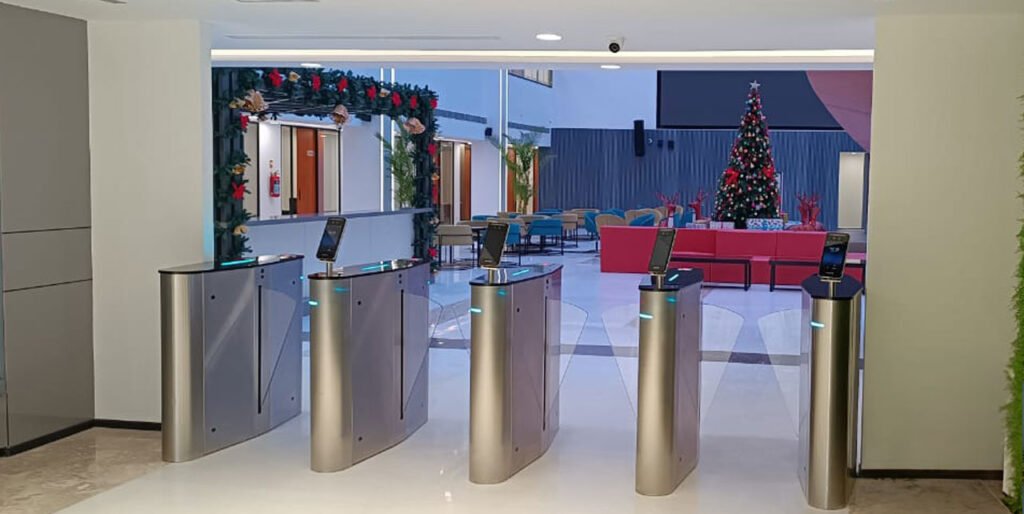
A flap barrier is one of the hardest-working pieces of equipment in any office, campus, or institutional building. It opens and closes hundreds — sometimes thousands — of times every single day, in all weather conditions, handling everything from a gentle tap of an RFID card to the occasional frustrated shove from someone running late.
Most organisations install a flap barrier, forget about it, and then wonder why it breaks down at the worst possible moment — during a peak-hour rush, during a client visit, or during a security incident that needed the system to work perfectly.
The truth is simple. Flap barriers do not fail randomly. They fail predictably, for well-understood reasons, most of which are entirely preventable with a structured maintenance programme. This guide covers everything that commonly goes wrong with flap barriers in Indian installations — and exactly how to prevent each problem before it becomes an expensive breakdown.
Why Flap Barrier Maintenance Is Not Optional
Before getting into what goes wrong, it helps to understand the scale of what a flap barrier actually does.
A mid-size corporate office with 300 employees might see 600 barrier operations per day — 300 entries and 300 exits. Over a year, that is 219,000 operations. Over five years, that is more than one million open-and-close cycles on the motor, flap mechanism, sensors, and control board.
Now consider a hospital or a large IT park where the barrier handles 1,500 to 2,000 operations per day. At that rate, a quality barrier rated for 3 million cycles reaches its mechanical life in less than five years — and that is under ideal conditions, with clean power, moderate temperatures, and no physical abuse.
In Indian conditions — with voltage fluctuations, monsoon humidity, dust ingress, and the occasional vehicle or trolley clipping the housing — the mechanical stress is considerably higher.
Regular maintenance does three things. First, it catches small problems before they become large ones. A worn bearing that costs ₹800 to replace today becomes a failed motor that costs ₹15,000 to replace in six months. Second, it extends the operational life of the equipment significantly — a well-maintained barrier routinely outlasts a neglected one by three to five years. Third, it keeps your warranty valid. Most manufacturers, including ZKTeco and Essl, require evidence of regular maintenance to honour warranty claims on parts and components.
The 8 Most Common Flap Barrier Problems in India — And How to Prevent Each One
Problem 1: Flap Arm Slowing Down or Stopping Mid-Cycle
What it looks like: The flap starts opening or closing but slows noticeably before reaching the fully open or fully closed position. In more advanced cases, it stops partway and reverses, or stops completely and requires a manual reset.
Why it happens: This is almost always a motor or drive belt issue. The most common cause in Indian installations is heat-related motor degradation — when a barrier is installed in a location with poor ventilation and operates continuously in ambient temperatures above 40°C (common in Andhra Pradesh from March to June), the motor’s thermal protection triggers and reduces power output. Over time, repeated thermal cycling degrades the motor windings.
The second most common cause is a worn or stretched drive belt or gear. As the drive mechanism ages, it loses efficiency, placing more load on the motor for the same output movement.
How to prevent it:
- Ensure the barrier cabinet has adequate ventilation clearance — at least 20cm on all sides. Never install a cabinet directly against a wall or inside an enclosed kiosk without ventilation.
- During summer months, check the motor temperature monthly by touching the cabinet housing briefly. If it is too hot to keep your hand on for 5 seconds, ventilation is inadequate.
- Have the drive belt or gear transmission inspected and lubricated every six months by a qualified engineer.
- Check and clean the motor cooling vents quarterly — dust accumulation in the vents is one of the leading causes of motor overheating in Indian installations.
Problem 2: Flap Arm Not Closing Fully or Leaving a Gap
What it looks like: After a person passes through, the flap arm returns but stops 5–15 centimetres short of the fully closed position. The lane appears open, defeating the entire purpose of the barrier.
Why it happens: This problem has three common causes. The first is a misaligned limit switch — the switch that tells the control board the flap has reached its home position. If the switch moves or its sensitivity drifts, the system thinks the flap is closed when it is not. The second cause is accumulated dirt and debris in the flap guide rails, which creates mechanical resistance that prevents full closure. The third is a warped or physically damaged flap panel — common when trolleys, bags, or vehicles make contact with the arm repeatedly.
How to prevent it:
- Clean the flap guide rails and pivot points monthly using a dry cloth and compressed air. Never use water or liquid cleaners directly inside the mechanism.
- Check the limit switch calibration every six months as part of a scheduled service visit.
- Inspect the flap panels quarterly for warping, cracks, or physical damage. Acrylic panels are particularly vulnerable to impact damage in high-footfall environments. Replace damaged panels immediately — a cracked panel is a safety hazard as well as a security failure.
- Train security staff to report any instance of a person or object making contact with the flap arm, so it can be inspected before the damage compounds.
Problem 3: False Alarm or Constant Alarm Triggering
What it looks like: The barrier’s alarm sounds repeatedly even when no tailgating or unauthorised entry is occurring. The alarm triggers for single authorised users passing through normally. In some cases, the alarm sounds continuously even when the lane is empty.
Why it happens: This is almost always an infrared sensor problem. The barrier uses multiple infrared beams across the lane to detect the presence and passage of individuals. When these sensors become dirty — covered in dust, fingerprints, or the film that builds up in polluted urban environments — they begin misreading the lane occupancy. A partially blocked sensor sees a phantom obstruction and triggers the alarm accordingly.
The second cause is sensor misalignment. If the barrier cabinet is moved, knocked, or if the floor settles unevenly, the transmitter and receiver sensors can drift out of alignment, causing unreliable detection.
How to prevent it:
- Clean all infrared sensor lenses monthly using a dry microfibre cloth. This is the single most impactful maintenance action for false alarm prevention and takes less than five minutes.
- After any physical disturbance to the barrier — a vehicle impact, a building cleaning exercise, or a floor repair — have the sensor alignment checked and recalibrated by a qualified engineer.
- During the monsoon season, check sensors weekly, as humidity and condensation accelerate the film buildup on sensor lenses.
- If false alarms persist after cleaning and alignment, test each sensor pair individually by blocking and unblocking with a sheet of paper. A sensor that does not respond consistently needs replacement.
Problem 4: RFID Reader Not Detecting Cards Reliably
What it looks like: Users have to tap their RFID card multiple times before the barrier opens. Some users’ cards work intermittently. New cards do not work even after being registered in the system. In some cases, the reader works for certain card types but not others.
Why it happens: RFID reader problems in Indian installations generally fall into two categories. The first is physical — the reader face is dirty, scratched, or has been sprayed with cleaning chemicals that interfere with the antenna. The second is interference — nearby electrical equipment, metal surfaces, or recently installed wiring creates electromagnetic interference that disrupts the reader’s signal.
Additionally, many Indian offices use cards from multiple generations or multiple manufacturers. Card compatibility issues are common when a reader firmware update changes the supported card types, or when the reader hardware is not configured for the card standard being used.
How to prevent it:
- Clean the RFID reader face monthly using a dry cloth. Never use alcohol-based cleaners on RFID reader faces — they damage the antenna coating over time.
- When planning any electrical installation near a flap barrier — new wiring, junction boxes, or UPS units — have a technician check for interference before and after the installation.
- Keep a record of all card types and standards currently in use (HF 13.56MHz, UHF 860–960MHz, Mifare, EM4100, and so on) and confirm compatibility whenever the reader firmware is updated.
- Test 5–10 cards from different users monthly as a quick functional check. If more than one card fails, it indicates a system issue rather than an individual card problem.
Problem 5: Control Board Errors and Unexplained Resets
What it looks like: The barrier displays an error code on its panel, resets itself spontaneously, or loses its configuration settings after a power fluctuation. In some cases, the barrier operates normally for several hours then suddenly stops responding to credentials until it is manually powered off and on.
Why it happens: This is one of the most frustrating problems in Indian flap barrier installations and almost always traces back to power quality. India’s power supply — particularly in industrial areas and older commercial buildings — commonly experiences voltage fluctuations, spikes, and brownouts that fall outside the operating tolerances of sensitive control board electronics.
The ZKTeco and Essl control boards used in quality barriers are designed to handle a normal operating range, but repeated exposure to voltage outside this range degrades the capacitors and other components on the board over time, leading to erratic behaviour long before visible failure.
How to prevent it:
- Install a quality Online UPS (not an offline UPS) between the building power supply and the flap barrier. An online UPS conditions the power continuously rather than switching to battery only after a failure. This single investment prevents the vast majority of control board problems in Indian installations.
- Ensure the barrier is connected to a dedicated circuit rather than sharing a circuit with heavy electrical loads like air conditioners, water heaters, or motors.
- Have the control board inspected annually by a qualified engineer. Look for bulging capacitors, burn marks, or corrosion — early signs of impending failure that can be addressed before complete breakdown.
- Keep a log of every spontaneous reset or error code. A pattern of resets at specific times often points to a predictable power event — such as a heavy load switching on elsewhere in the building — that can be identified and addressed.
Problem 6: Flap Arm Making Noise During Operation
What it looks like: The barrier develops a grinding, squeaking, clicking, or rattling sound during operation that was not present when it was new. The noise may be constant or may occur only at certain points in the open or close cycle.
Why it happens: Mechanical noise in a flap barrier almost always indicates insufficient lubrication, worn components, or loose fasteners. The drive mechanism — whether it uses a belt, gear, or cam system — requires periodic lubrication to operate silently and efficiently. As the lubricant dries out or becomes contaminated with dust, friction increases, producing noise and accelerating wear.
Loose fasteners are the second common cause. The repeated vibration of thousands of open-and-close cycles gradually loosens the bolts and screws holding the mechanism together. A slightly loose component that produces a minor click today becomes a damaged component that produces a loud grind in three months.
How to prevent it:
- Lubricate all specified lubrication points in the drive mechanism every six months using the lubricant type recommended by the manufacturer. Using the wrong lubricant type — particularly petroleum-based lubricants on plastic gears — causes accelerated wear rather than reducing it.
- Check and tighten all accessible fasteners annually. Pay particular attention to the hinge points, mounting bolts, and motor mounting screws.
- Never ignore a new noise. Any new mechanical sound in a barrier that was previously silent is a warning sign. Have it inspected within one week rather than waiting for the next scheduled service visit.
Problem 7: Barrier Opening for Unauthorised Users or Not Opening for Authorised Ones
What it looks like: Either the barrier opens for people who should not have access, or it refuses access to people whose credentials are valid and registered. In some cases, it does both simultaneously on different users.
Why it happens: This is a software and database problem rather than a mechanical one, but it is one of the most common issues in Indian corporate installations and therefore deserves inclusion in any maintenance guide.
The most frequent cause is database synchronisation failure — when the access control software is updated or when new credentials are added, the data does not correctly synchronise to the barrier’s local controller. The barrier then operates on stale data — granting access based on old permissions or denying access to newly registered users.
The second cause is time synchronisation failure. Access control systems that grant time-specific access — for example, allowing staff entry only during working hours — rely on the barrier’s internal clock being correctly synchronised. If the clock drifts, the time windows misalign and access decisions become incorrect.
How to prevent it:
- Run a database synchronisation between the central access control software and all connected barriers after every batch of credential changes. Do not assume synchronisation happens automatically without verifying it.
- Check and synchronise the internal clock on all barrier controllers monthly. Most quality systems support automatic NTP time synchronisation — enable this feature if it is not already active.
- Conduct a quarterly access audit — generate a report of who has access to what, compare it against your current staff list, and revoke credentials for former employees, contractors, or visitors who should no longer have access.
- Test 10 random credentials from both the authorised and unauthorised lists monthly to confirm the system is operating as configured.
Problem 8: Physical Damage to Housing or Flap Panels
What it looks like: The outer stainless steel housing develops dents, scratches, or rust spots. The flap panels develop cracks or chips. The cabinet door no longer closes flush. The barrier’s overall appearance deteriorates visibly.
Why it happens: Physical damage is the most visible maintenance issue and the most preventable. In Indian installations, the most common causes are luggage and trolleys clipping the flap panels in transit, cleaning staff spraying water or chemical cleaners directly onto the housing, and vehicles making contact with the cabinet when manoeuvring near the barrier.
Rust spots on stainless steel housings — which should not rust under normal conditions — indicate that the protective surface layer has been scratched or chemically damaged, typically by harsh cleaning agents or exposure to salt air in coastal areas like Vijayawada.
How to prevent it:
- Brief all security and cleaning staff on correct barrier care at the time of installation. Specifically instruct cleaning staff never to spray liquid cleaners directly onto the barrier housing or reader face.
- For barriers in lanes where trolleys or luggage regularly pass through, install rubber bumper guards on the housing sides.
- Inspect the housing exterior quarterly. Address surface scratches on the stainless steel immediately using a stainless steel restorer product to prevent rust initiation.
- Repaint or refinish the cabinet base annually in outdoor installations, particularly in humid or coastal environments.
The Recommended Flap Barrier Maintenance Schedule
Based on all of the above, here is a practical maintenance schedule that covers every common failure mode:
Every Month
- Clean all infrared sensor lenses with a dry microfibre cloth
- Clean the RFID reader face with a dry cloth
- Check and synchronise the system clock
- Test 10 random credentials for correct access behaviour
- Visually inspect flap panels for cracks or physical damage
- Check the drive mechanism for any new noise during operation
Every 3 Months
- Clean the flap guide rails and pivot points with compressed air
- Check motor ventilation vents for dust accumulation
- Inspect the outer housing for surface damage or rust spots
- Run a full database synchronisation and verify access permissions
- Check power quality at the barrier supply point with a multimeter
Every 6 Months
- Lubricate all specified drive mechanism points with correct lubricant
- Inspect and tighten all accessible fasteners
- Check limit switch calibration and adjust if necessary
- Inspect drive belt or gear for wear and replace if needed
- Conduct a full sensor alignment test across all infrared beams
- Test the battery backup under load and verify runtime
Every 12 Months — Annual Service
- Full professional inspection by a qualified engineer
- Control board inspection for capacitor and component health
- Motor winding resistance test
- Complete software and firmware update
- Full access audit — review all user credentials and permissions
- Lubricate all mechanical points including internal hinge mechanisms
- Test all integration points — CCTV link, HR software, alarm panel
- Issue a written service report with findings and recommendations
Signs Your Flap Barrier Needs Immediate Attention
Do not wait for the next scheduled service if you notice any of the following:
- The flap arm is visibly bent, warped, or cracked
- The barrier produces a burning smell during operation
- The control board displays a persistent error code that does not clear on reset
- The barrier spontaneously opens without a credential being presented
- The barrier fails to open for more than 20% of valid credentials in a single day
- Any visible sparking or scorch marks near the power supply or control board
- The barrier housing feels unusually hot to the touch
- Water has entered the cabinet during heavy rain
Each of these is a signal to take the barrier offline, call your service provider, and not restore it to service until a qualified engineer has inspected and cleared it.
Why an AMC Is the Smartest Investment for Your Flap Barrier
An Annual Maintenance Contract from a qualified local provider is, by far, the most cost-effective way to manage flap barrier maintenance. Here is why.
A reactive maintenance approach — where you call a technician only when something breaks — consistently costs more than a proactive AMC. The reasons are straightforward. Emergency call-out rates are higher than scheduled visit rates. Parts that fail catastrophically because a warning sign was missed are more expensive to replace than parts caught early. Downtime during a breakdown — with staff queuing at a non-functional barrier — has a real operational cost that a scheduled maintenance visit never creates.
A good AMC from a local provider includes four scheduled service visits per year, priority response to breakdowns, discounted spare parts, software and firmware updates, and a written service report after every visit. Over a five-year period, an AMC typically costs 15–20% of the original equipment cost and extends the operational life of the barrier by 30–50% compared to unmanaged operation.
Why Raise Solutions Is the Right Maintenance Partner for Your Flap Barrier
Raise Solutions is Vijayawada’s most trusted partner for access control installation and maintenance. Our AMC service covers all major flap barrier brands — ZKTeco, Essl, Autozone, and others — with trained in-house engineers who understand the specific failure modes and maintenance requirements of each platform.
When you sign an AMC with Raise Solutions, you get:
- Four scheduled service visits per year covering all items in the maintenance schedule above
- 24-hour response to breakdown calls — from a local team, not a national call centre
- Priority spare parts sourcing with manufacturer-genuine components
- Software and firmware updates included
- Written service reports after every visit with findings and recommendations
- Proactive alerts when components show early signs of wear before failure occurs
- Integration support for RFID, biometric, CCTV, and HR software connected to your barrier
Ready to Protect Your Flap Barrier Investment?
Whether you need an AMC for an existing installation or are planning a new flap barrier system with maintenance built in from day one — Raise Solutions has the right programme for your site and your budget.
Contact us today for a free assessment of your existing flap barrier system and a no-obligation AMC quotation.
📞 Call: +91 85229 59096 📧 Email: info@raisesolutions.in 🌐 Website: www.raisesolutions.in 📍 Location: Poranki, Vijayawada, Andhra Pradesh
Protect your barrier. Protect your access. Protect your investment.