
Every apartment complex and gated community in India faces the same challenge. Residents want smooth, effortless entry. Management wants complete security. The RWA wants documented records. And nobody wants to pay for three security guards standing at the gate around the clock.
A flap barrier system for apartments solves all four problems simultaneously — and does it at a cost that most housing societies recover within 2 years purely on saved guard salaries.
This guide covers everything an apartment committee, RWA, or builder needs to know before installing a flap barrier at a residential complex — types, configuration, integration with visitor management, price, and what the complete installation looks like.
💡 Raise Solutions designs and installs flap barrier access control systems for apartment complexes and gated communities across Vijayawada, Hyderabad, Bangalore, Pune and Mumbai. Call +91 8522959096 for a free site survey.
Why Apartments Need a Flap Barrier — The Real Problem
Most residential complexes in India rely on a security guard at the pedestrian gate manually checking every person who enters. On paper this seems sufficient. In practice it creates four serious problems that compound over time.
Problem 1 — Inconsistent Security
A human guard is attentive for the first hour of a shift, moderately attentive for the next two, and significantly less attentive by hour eight. Late at night, on holidays, during shift changeovers, and when the guard is occupied with another task — the gate is effectively unmanned. Unauthorised entry happens precisely at these moments.
Problem 2 — No Entry Records
A guard who waves a familiar face through without logging them creates zero documentation. If something goes wrong — a theft, an incident, an unauthorised visitor — there is no record of who entered, when, or how long they stayed.
Problem 3 — Recurring Guard Cost
A security guard at a residential complex costs ₹12,000 to ₹18,000 per month. To cover a pedestrian gate 24 hours a day with proper shift coverage, a complex typically needs 3 guards (morning, afternoon, night). That is ₹36,000 to ₹54,000 per month — ₹4,32,000 to ₹6,48,000 per year — every year, indefinitely.
Problem 4 — Domestic Help and Service Staff Tracking
Most RWAs struggle to track domestic helpers, delivery personnel, plumbers, electricians, and service staff who enter the complex daily. A guard cannot reliably remember or log every such entry, creating a security gap that is particularly significant in large complexes with hundreds of flats.
A flap barrier system eliminates all four problems — consistent 24/7 access control, complete digital entry logs, reduced guard dependence, and automatic tracking of every person who enters or exits.
What is a Flap Barrier for Apartments?
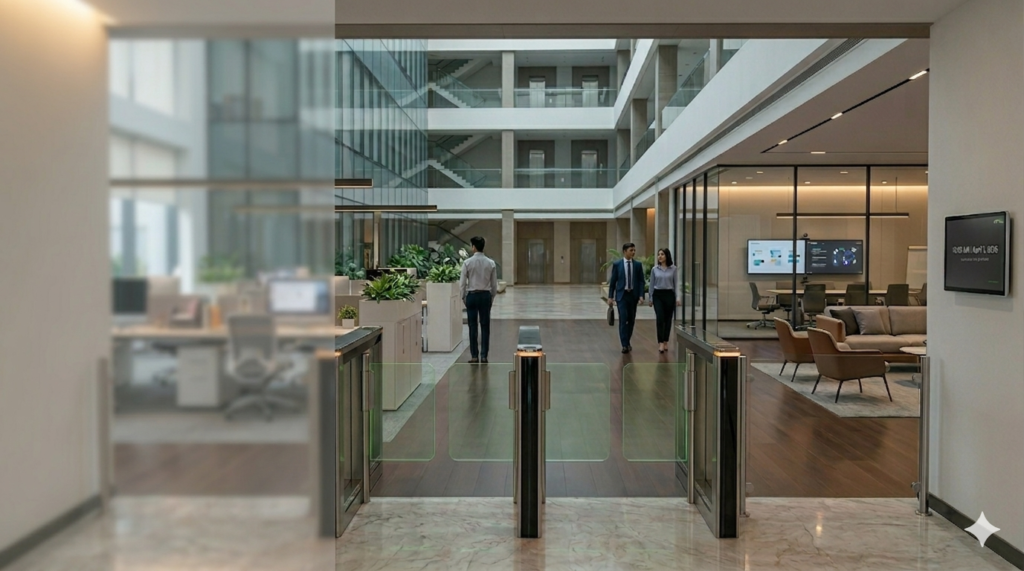
A flap barrier for apartments is a pedestrian access control system installed at the main entry point of a residential complex. It uses retractable wing panels that open only when a valid credential is presented — a resident’s RFID card, face recognition, or a visitor’s temporary QR code.
Unlike the flap barriers used in IT parks and corporate offices — which are purely employee-focused — a residential flap barrier system has to manage a much more complex set of users:
- Permanent residents — always have access, 24/7
- Domestic helpers — access during permitted hours only
- Regular service vendors — plumber, electrician, carpenter — access on specific days or pre-approved windows
- Delivery personnel — one-time or recurring limited access
- Visitors — access only when a resident confirms and approves the visit
- Guests staying overnight — temporary extended access
- New residents — credential created on move-in, deactivated on move-out
A well-configured residential flap barrier system handles all of these user types automatically — with different access rules for each, all managed from a simple dashboard by the RWA or building manager.
How It Works — A Resident’s Daily Experience
Morning — Resident Leaves for Work
The resident approaches the exit lane of the flap barrier. They tap their RFID card on the reader (or the face recognition camera identifies them automatically). The flap opens in 0.5 seconds. They walk through. The flap closes. Their exit is logged — time, identity, date.
Mid-Morning — Domestic Helper Arrives
The maid arrives at 9 AM as usual. She taps her assigned RFID card. The system checks — is this credential valid for today? Is the time within the permitted window (9 AM to 5 PM, Monday to Saturday as configured by the resident)? Both checks pass — the flap opens. She enters. Her entry is logged.
If she arrives at 8 PM — outside her permitted window — the flap stays closed. An alert is sent to the resident’s phone. The resident can remotely approve or deny the entry from their phone.
Afternoon — Delivery Arrives
A Swiggy delivery person arrives at the gate. The guard (now doing one round of monitoring rather than standing at the gate full-time) calls the resident on the intercom. The resident issues a one-time QR code to the delivery person through the resident app. The delivery person scans the QR at the flap barrier reader. The flap opens for one entry only — the code expires after use.
Evening — Visitor Arrives
A friend arrives to visit. The resident was notified of the visit in advance and pre-registered the visitor in the app. The visitor arrives at the gate, gives their name at the intercom, and the guard generates a QR pass linked to the specific flat. The visitor scans it, enters, and can access only the common areas and the resident’s floor — not other floors or amenities unless specifically configured.
Night — Resident Returns
The resident returns at 11 PM. Face recognition identifies them in 0.3 seconds. The flap opens. No card needed. No guard needed to verify. Smooth, safe, completely automatic.
Types of Flap Barriers for Residential Complexes
Not every residential complex needs the same type. The right choice depends on footfall volume, budget, and the aesthetic standards of the complex. Read our complete guide on types of flap barriers — but for apartments specifically:
Optical Flap Barrier — Premium Apartments
The standard choice for premium apartment complexes and gated villa communities. Slim stainless steel pedestals, acrylic or tempered glass wings, IR anti-tailgating sensors. Professional appearance that matches the aesthetic of a premium residential lobby.
Best for: Premium apartments, gated villa communities, high-rise residential towers
Lane width: 550 to 750mm
Price per lane: ₹80,000 – ₹2,50,000
Swing Barrier — Wide Access Lane
Mandatory in any residential installation for wheelchair users, residents with prams, residents with luggage, and domestic helpers with cleaning equipment or grocery bags. One swing barrier lane alongside 2 to 3 optical flap lanes gives complete accessibility coverage.
Best for: Accessible lane in every residential installation
Lane width: 900 to 1200mm
Price per unit: ₹60,000 – ₹1,80,000
Waist-Height Swing Turnstile — Budget Societies
For mid-range and affordable housing societies where the primary requirement is access control rather than premium aesthetics. More economical than optical flap barriers while still providing card-based access control and entry logging.
Best for: Budget residential societies, older complexes, secondary entry points
Price per unit: ₹25,000 – ₹70,000
Configuration — How Access Rules Work for Apartments
This is where residential flap barrier systems differ most from corporate deployments. The access rule structure must reflect the complexity of residential life.
Resident Access
All registered residents receive a primary credential — RFID card or face recognition enrollment. Their credential grants access 24 hours a day, 7 days a week, to all common areas, their floor, and any amenities they are subscribed to.
When a resident moves out — their credential is deactivated in seconds from the management dashboard. When a new resident moves in — their credential is created and activated immediately. No physical key handover issues, no worry about copies of keys being in circulation.
Domestic Helper Access
Each domestic helper is assigned a credential by the resident they work for. The credential is configured with time-based access rules — permitted only on specific days and within specific time windows.
Example configuration for a typical household helper:
- Permitted days: Monday, Tuesday, Wednesday, Thursday, Friday, Saturday
- Permitted entry window: 8:00 AM to 10:00 AM (must enter before 10 AM)
- Permitted exit window: 3:00 PM to 7:00 PM (must exit before 7 PM)
- If she attempts entry at 7:45 AM — denied. If she attempts entry at 10:15 AM — denied. Alert sent to resident.
This configuration is set by each resident individually from their app — not requiring management intervention for every change.
Visitor Access
Visitors receive one-time QR codes generated either by:
- The resident through their app (pre-visit)
- The guard at the gate intercom (walk-in visitors with resident confirmation)
QR codes are configured for:
- Single-use or multi-use within a time window
- Valid for a specific date and time range only
- Zone-restricted — common areas only, or with floor access
- Auto-expiring — cannot be reused after the configured validity
Contractor and Service Staff Access
Plumbers, electricians, painters, packers and movers — service staff who visit occasionally — receive temporary credentials with even tighter restrictions:
- Valid only for the specific date of the service appointment
- Time-window restricted to the expected work duration
- Zone-restricted to common areas and the specific flat being serviced
- Automatically deactivated at the end of the permitted window
Delivery Personnel
Most residential systems handle delivery personnel through guard-issued QR codes rather than registered credentials — since delivery riders change frequently and pre-registration is not practical. The intercom at the gate connects the rider to the resident, the resident approves, and the guard generates a one-time access QR from the management dashboard.
Integration — What the Flap Barrier Connects To
A standalone flap barrier at the gate is useful. A flap barrier integrated with other building systems is transformational.
Intercom and Video Doorbell Integration
The intercom panel at the gate connects to the flap barrier system. When a visitor presses the intercom, the resident sees a live video feed of the gate on their phone. They can speak to the visitor and issue a QR code remotely — without the guard needing to be involved in most cases.
CCTV Integration
A camera mounted above each flap barrier lane creates a visual log alongside the digital entry log. Every credential event — entry, exit, denied access — links to a timestamped camera frame. In any security incident, the RWA can review exactly who entered, when, and what they looked like.
Resident Management App
Residents manage their own credentials, domestic helper permissions, visitor pre-registration, and delivery approvals from a mobile app. This removes the management office from routine access control tasks — residents are self-sufficient, and the management dashboard only handles exceptions and new registrations.
Parking Barrier Integration
For complexes with vehicle parking — the pedestrian flap barrier for residents and the boom barrier at the vehicle gate can be integrated into a single unified access control system. One dashboard shows all entries and exits — foot and vehicle — for the entire complex.
Society Management Software
Attendance data from the flap barrier integrates with society management platforms — tracking guard attendance, maintenance staff entry, and generating monthly visitor reports for RWA meetings.
How Many Lanes Does Your Apartment Complex Need?
The right number of lanes prevents bottlenecks without over-investing in hardware.
| Complex Size | Peak Morning Exit | Recommended Lanes |
|---|---|---|
| Up to 50 flats | 30–50 residents | 1 flap + 1 swing |
| 50–150 flats | 80–120 residents | 2 flap + 1 swing |
| 150–300 flats | 150–220 residents | 3 flap + 1 swing |
| 300–500 flats | 250–350 residents | 4 flap + 1 swing |
| 500+ flats | Site assessment required | Contact us |
Important: Calculate peak traffic based on the busiest 15-minute window — typically 8:30 AM to 8:45 AM on weekday mornings when most residents leave for work simultaneously. One optical flap lane handles approximately 600 to 800 persons per hour — about 150 to 200 in a 15-minute window.
Always include at least one swing barrier lane regardless of complex size for accessibility compliance and wider-item access.
Flap Barrier for Apartments — Price Guide India 2026
Small Society (Up to 50 Flats)
| Component | Cost |
|---|---|
| 1 optical flap barrier lane | ₹80,000 – ₹1,40,000 |
| 1 swing barrier lane | ₹60,000 – ₹1,00,000 |
| RFID readers (2 units) | ₹20,000 – ₹40,000 |
| Access control software | ₹20,000 – ₹40,000 |
| Installation and civil work | ₹25,000 – ₹40,000 |
| Total Approximate | ₹2,05,000 – ₹3,60,000 |
Mid-Size Society (100–250 Flats)
| Component | Cost |
|---|---|
| 3 optical flap barrier lanes | ₹2,40,000 – ₹5,00,000 |
| 1 swing barrier lane | ₹60,000 – ₹1,20,000 |
| Face recognition terminals (4 units) | ₹80,000 – ₹1,60,000 |
| Access control + visitor management software | ₹40,000 – ₹80,000 |
| Resident app license | ₹20,000 – ₹40,000 |
| Installation and civil work | ₹60,000 – ₹1,00,000 |
| Total Approximate | ₹5,00,000 – ₹10,00,000 |
Large Gated Community (300–500 Flats)
Pricing varies by site — contact us for a detailed site-specific quotation. Typically ₹10,00,000 to ₹20,00,000 for a complete multi-entry-point deployment with face recognition, visitor management, and CCTV integration.
For a detailed breakdown by lane type and credential option — read our flap barrier price guide India 2026.
⚠️ Prices are per lane unit only. Credential readers, software, installation, civil work, and AMC are additional. Always request an all-inclusive quote.
ROI — What Your Society Actually Saves
The financial case for a residential flap barrier is straightforward once you calculate total security cost over time.
Current monthly security cost (typical mid-size society):
3 guards × ₹15,000 = ₹45,000 per month
Annual cost: ₹5,40,000
With flap barrier system:
1 monitoring guard × ₹15,000 = ₹15,000 per month
Annual cost: ₹1,80,000
Annual saving: ₹3,60,000
A mid-size society installation costing ₹6,00,000 all-inclusive pays back in 20 months — and then saves ₹3,60,000 every year for the next 8 to 10 years of the system’s life.
This calculation does not include the additional value of complete entry logs, improved resident safety perception, and increased property values that premium access control systems typically contribute to in premium residential complexes.
For the full cost analysis methodology — read our flap barrier vs security guard cost comparison.
Common RWA Questions Before Installation
“Will residents resist the change from a guard to a machine?”
Initial resistance is common — and typically disappears within the first two weeks. Residents quickly discover that face recognition entry is faster than waiting for a guard to look up from their phone. The key is proper resident communication before installation — explaining the benefits, the visitor management process, and the domestic helper access setup. Raise Solutions assists with this communication as part of our installation service.
“What about elderly residents who are not comfortable with technology?”
Face recognition requires nothing from the resident — they simply walk toward the camera and the barrier opens. It is actually the easiest credential for elderly residents because there is no card to carry or PIN to remember. For residents who strongly prefer a physical card — RFID cards are also provided and can be used alongside face recognition in the same installation.
“What if the system fails at midnight?”
All quality flap barrier systems have manual override — the flaps open automatically on power failure (failsafe mode) and can be operated manually. A UPS ensures the system continues operating normally during brief power cuts. Raise Solutions provides emergency response as part of our AMC — typically within 4 hours for breakdown calls.
“Can we manage the system ourselves without calling the vendor constantly?”
Yes. The management dashboard is designed for non-technical building managers. Adding a new resident, deactivating a maid’s credential, issuing a visitor pass, generating a monthly entry report — all done from a browser or mobile app without any vendor involvement. We train your building manager during handover.
“How do we handle the domestic helpers who do not have smartphones?”
Domestic helpers receive a simple RFID card — no smartphone required. They tap the card at the reader, just like a bus or metro card. The access rules (permitted days and times) are configured by the resident from their app. The helper just needs to tap the card.
Installation — What to Expect from Raise Solutions
Week 1 — Free Site Survey
Our engineer visits your complex, measures the entry point, assesses peak-hour footfall, reviews the guard station layout, and recommends the right configuration. This is completely free with no commitment.
Week 1 — Proposal
Detailed proposal with exact model specifications, lane layout design, credential types, software modules, all-inclusive pricing, installation timeline, and AMC terms. You present this to the RWA committee for approval.
Week 2 — Civil Work
Floor anchor bolts, cable channels, power connection points. Completed neatly and with minimal disruption to resident movement.
Week 2–3 — Installation
Barrier units installed, credential readers mounted, software configured. Face recognition cameras calibrated for your gate’s lighting conditions — important for accurate recognition at dawn, dusk, and night.
Week 3 — Resident Enrollment
All residents’ faces or RFID cards enrolled. This is typically done flat-by-flat over 2 to 3 days — residents visit the guard station or a designated enrollment point for a 2-minute enrollment process.
Week 3 — Go Live and Training
System goes live. Building manager trained on the dashboard. Guards trained on visitor management and exception handling. A resident circular is issued explaining how to use the system and manage domestic helper credentials.
🔧 A typical mid-size apartment complex installation — 3 flap lanes, 1 swing lane, face recognition, visitor management — is completed in 5 to 7 working days from order confirmation.
Frequently Asked Questions
Yes. Every entry and exit by a domestic helper is logged with timestamp — effectively creating an automatic daily attendance record. Some societies use this to resolve disputes about whether a helper showed up on a given day.
The guard’s role shifts from gate-standing to monitoring and exception handling — a higher-value function. Instead of manually verifying every person, the guard monitors the CCTV dashboard, handles walk-in visitors, responds to denied access alerts, and manages the overall security of the premises. Most societies reduce from 3 guards to 1 per shift rather than eliminating guards entirely.
Yes. Multiple entry points can be managed from a single central dashboard. The back gate can have its own lane configuration — perhaps fewer lanes and with different access rules (for example, accessible only to residents and domestic helpers, not to general visitors).
Q: Is our complex too small for a flap barrier?
No complex is too small. Even a 20-flat building benefits from documented entry records, domestic helper time-tracking, and consistent after-hours security. We have entry-level configurations starting from ₹2,00,000 all-inclusive for small societies. The ROI calculation works even at small scale because guard salary costs are fixed regardless of complex size.
Q: Can visitors call the resident from the flap barrier gate?
Yes — the intercom panel at the gate allows two-way voice and video communication between the visitor and the resident’s phone. The resident can visually verify the visitor and either issue a QR code remotely or instruct the guard to allow entry.
Q: What maintenance does the flap barrier need?
Monthly lubrication and sensor cleaning, quarterly motor inspection and calibration, annual full service. Raise Solutions offers comprehensive AMC packages for residential complexes — our average response time for breakdown calls in Vijayawada is under 4 hours.
Why Choose Raise Solutions for Your Residential Complex?
Residential access control is different from corporate access control. The users are more diverse, the access rules are more complex, and the stakeholders — residents, RWA, building manager — all have different requirements that need to be balanced in the system design.
Raise Solutions has deployed access control systems across residential complexes, corporate offices, IT parks, and institutional campuses across Andhra Pradesh. We understand residential security requirements specifically — and we bring that experience to every apartment installation.
- ✅ Authorised ZKTeco and ESSL dealer — genuine hardware, full warranty
- ✅ Free site survey and lane configuration design
- ✅ End-to-end service — supply, civil work, installation, resident enrollment, training, AMC
- ✅ Face recognition, RFID, QR code, and mobile credential options
- ✅ Visitor management and resident app integration
- ✅ CCTV and boom barrier integration for complete complex security
- ✅ Comprehensive residential AMC packages
- ✅ ISO Certified | MSME Registered | NSIC Recognised
- ✅ Head office Vijayawada · Branches in Hyderabad, Bangalore, Pune, Mumbai
📞 Book Your Free Site Survey Today
Call: +91 8522959096
Email: info@raisesolutions.in
Website: raisesolutions.in
Visit: Nidamanuru Road, Poranki, Vijayawada, Andhra Pradesh – 521137
Share your complex size, number of flats, and entry point layout — we will design a complete flap barrier system with all-inclusive pricing and a payback calculation within 24 hours.
© 2026 Raise Solutions | All Rights Reserved | ISO Certified | MSME Registered | NSIC Recognised