
Picture this: It’s 9 AM at a busy apartment complex in Kanuru. Residents are leaving for work, delivery bikes are queuing up, and a security guard is manually lifting a rope barrier — waving vehicles in and out while trying to log number plates in a register.
Sound familiar?
If you manage a parking facility in Vijayawada — whether it’s an apartment complex, a corporate office, a hospital, a mall, or a commercial building — you already know that manual parking management is a nightmare. It’s slow, expensive, and easy to manipulate.
The solution is automated barrier systems. But here’s where most property managers get confused: should you install a boom barrier or a flap barrier?
They look different. They work differently. They suit different environments. And choosing the wrong one can cost you more money — and more headaches — than you’d expect.
In this guide, we break down both systems honestly so you can make the right call for your specific parking setup in Vijayawada.
What Is a Boom Barrier?
A boom barrier — also called a boom gate or vehicle barrier — is the classic horizontal arm that rises and falls to allow or block vehicle entry. You’ve seen them everywhere: at toll plazas on the Vijayawada–Hyderabad highway, at corporate campuses in Patamata, at hospital parking lots near Benz Circle.
The arm (called the boom) is typically made of fibreglass, aluminium, or steel, and is mounted on a motorised housing unit fixed to a concrete pillar. When triggered — by a remote control, RFID card, vehicle loop detector, or boom barrier management software — the arm lifts to allow entry and returns to the horizontal (closed) position automatically.
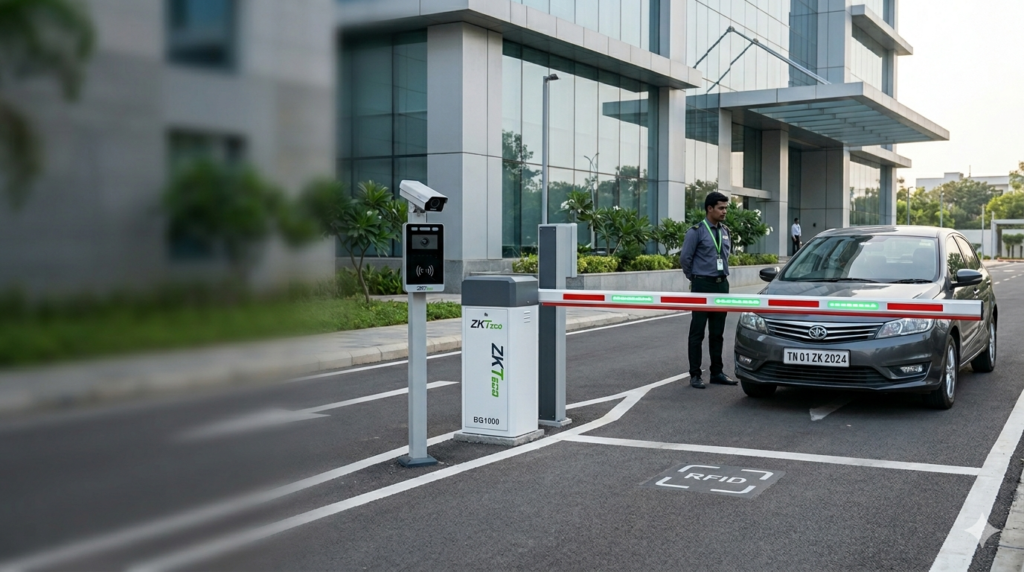
Key characteristics of a boom barrier:
- Arm length typically ranges from 3 to 6 metres
- Designed exclusively for vehicle access control
- Can handle very high traffic volumes
- Motorised opening speed ranges from 1.5 to 6 seconds
- Works outdoors, in all weather conditions
- Can be integrated with RFID, number plate recognition, and parking management software
What Is a Flap Barrier?
A flap barrier — sometimes called a wing barrier or paddle barrier — is a pedestrian access control gate that uses retractable flap panels (paddles) mounted on a sleek stainless-steel housing. When access is granted, the flaps retract inward to allow one person to pass. When denied, they remain extended, blocking the passage.
You’ll find flap barriers at IT company entrances in Mangalagiri, at metro-style office lobbies in Vijayawada’s growing commercial zones, at university campuses, and at premium apartment complexes that want a clean, modern entrance experience.
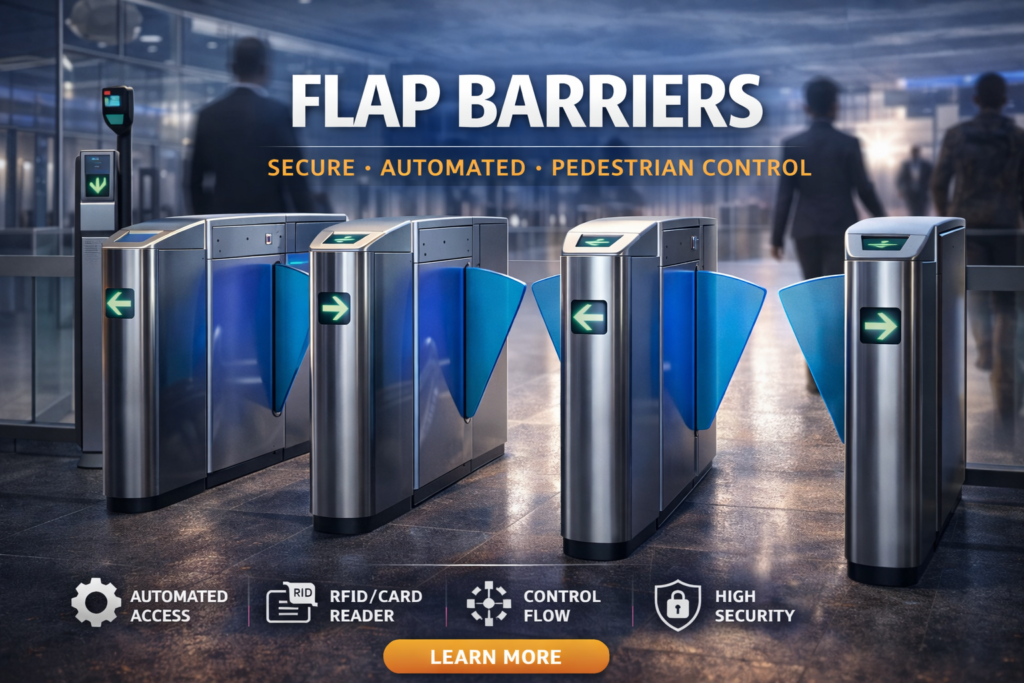
Key characteristics of a flap barrier:
- Designed for pedestrian access control — not vehicles
- Bi-directional: controls both entry and exit lanes
- Integrates with biometric terminals, RFID cards, QR codes, and face recognition
- An anti-tailgating mechanism prevents two people from entering on one authentication
- Available in full-height and waist-height configurations
- Stainless steel body — clean, modern aesthetic
The Core Difference: Vehicles vs People
Before going any further, let’s settle the most important point that confuses most buyers:
Boom barriers control vehicle access. Flap barriers control pedestrian access.
These are not competing products — they solve different problems. If you need to stop unauthorised cars from entering your parking area, you need a boom barrier. If you need to control which employees or residents can walk into your building or office floor, you need a flap barrier.
Many facilities in Vijayawada actually need both: a boom barrier at the vehicle entry gate and flap barriers at the building’s pedestrian entrance lobby.
That said, there are scenarios where the choice genuinely overlaps — particularly in mixed-use facilities, apartment complexes with both vehicle and pedestrian gates, or compact office premises where the parking area is accessed on foot as well. We’ll address those scenarios specifically.
Boom Barrier: Where It Excels
1. High-Traffic Vehicle Parking Facilities
If your parking facility handles more than 50 vehicle movements per day — which describes virtually every apartment complex, hospital, mall, and office building in Vijayawada — a boom barrier is non-negotiable.
Manual rope barriers or security guards cannot maintain accuracy and accountability at this volume. A boom barrier, especially one integrated with RFID readers or vehicle loop detectors, can process vehicles in under 3 seconds per movement with zero manual intervention.
2. Apartments and Gated Communities
Vijayawada has seen explosive growth in apartment complexes — particularly in Kanuru, Poranki, Moghalrajpuram, and Kesarapalle. Most of these communities face the same problem: residents, delivery personnel, domestic workers, and visitors all need different levels of vehicle access.
A boom barrier integrated with an RFID-based parking management system allows residents to enter with a preprogrammed tag attached to their vehicle, while visitors require manual authorisation from the security cabin. Delivery vehicles can be given timed access. Unauthorised vehicles are physically blocked.
3. Commercial and Industrial Facilities
Factories in Auto Nagar, warehouses in the industrial estates near Gannavaram Airport, and logistics hubs need a robust physical barrier that can handle heavy goods vehicles, not just cars. Heavy-duty boom barriers with steel arms and high-cycle motors (rated for 10 million+ operations) are built exactly for this.
4. Hospitals and Institutions
Hospitals in Vijayawada — including government medical facilities near One Town and private hospitals in Governorpet — manage constant vehicle flow: ambulances, patient drop-offs, staff parking, and vendor deliveries. A boom barrier with a remote override for emergency vehicles and an RFID fast-lane for staff is standard for this use case.
Flap Barrier: Where It Excels
1. Corporate Office Lobbies
If your office building has a reception area or entrance lobby where you want to control which employees — and which visitors — can enter, a flap barrier is the right tool.
It presents a professional, modern image at the entrance. More importantly, it enforces accountability: every entry and exit is logged against a specific employee ID, face, or access card. No tailgating. No piggyback entry. No signing a paper register that nobody checks.
This is particularly relevant for IT companies, BPOs, and financial services offices that are establishing a presence in Vijayawada as the Amaravati capital region develops.
2. Manufacturing Plants Requiring Shift-Based Access
Factories and production units that operate in shifts need to know exactly who is on the production floor at any given time — both for productivity tracking and for safety compliance. A flap barrier at the plant entrance, integrated with biometric terminals, provides a live headcount and blocks off-shift workers from entering restricted production areas.
3. Educational Institutions
Schools and engineering colleges in Vijayawada increasingly need to restrict access to campus buildings — not just the outer gate. A flap barrier at the main building entrance, linked to student ID cards or biometric data, ensures only enrolled students and authorised staff can enter.
4. Premium Apartment Lobbies
Beyond the vehicle entry boom barrier, many upscale apartments in Vijayawada are installing flap barriers in their ground-floor lobbies. Residents use their key card or mobile app to pass through. Visitors are buzzed in by residents. Domestic workers have time-restricted access. It is the difference between a secure building and a building that merely looks secure.
Head-to-Head Comparison
| Feature | Boom Barrier | Flap Barrier |
|---|---|---|
| Primary use | Vehicle access | Pedestrian access |
| Installation location | Outdoor vehicle lane | Indoor/outdoor walkway |
| Throughput speed | 1 vehicle / 3–6 sec | 1 person / 0.5–1 sec |
| Weather resistance | IP54–IP65 rated | Stainless steel, IP42–IP54 |
| Anti-tailgating | No (vehicle spacing) | Yes (sensor-based) |
| Integration | RFID, loop detector, LPR | Biometric, RFID, QR, face |
| Starting cost (installed) | ₹25,000 – ₹60,000 | ₹35,000 – ₹90,000 per lane |
| Maintenance frequency | 6-monthly | Annual |
| Ideal for | Parking lots, toll gates | Office lobbies, factories |
| Arm/panel material | Fibreglass, aluminium, steel | Stainless steel panels |
| Typical lifespan | 7–12 years | 8–15 years |
| Power backup | UPS optional | UPS optional |
Cost Breakdown: What to Budget in Vijayawada
One of the most common questions we receive is: “How much will this actually cost?”
Here is an honest answer, based on real installations across Vijayawada.
Boom Barrier Costs
Basic boom barrier (3m arm, standard motor): ₹25,000 – ₹35,000 installed Suitable for: small apartment complexes, compact office parking
Mid-range boom barrier (4–5m arm, RFID-ready, LED arm): ₹40,000 – ₹55,000 installed Suitable for: mid-size apartments, commercial buildings, hospitals
Heavy-duty boom barrier (6m arm, high-cycle motor, integrated with parking software): ₹60,000 – ₹1,20,000 installed Suitable for: malls, factories, large institutional parking facilities
Flap Barrier Costs
Single-lane flap barrier (basic RFID integration): ₹35,000 – ₹50,000 installed Suitable for: small offices, ground-floor apartment lobbies
Mid-range flap barrier (biometric + RFID, anti-tailgating): ₹55,000 – ₹75,000 per lane installed Suitable for: corporate offices, manufacturing plants, schools
Premium flap barrier (face recognition, full access control software): ₹80,000 – ₹1,50,000 per lane installed Suitable for: IT parks, premium apartments, banks, high-security facilities
Important note: Always get a fixed written quote before installation. At Raise Solutions, the price we quote is the price you pay — no revisions at the door.
Durability in Vijayawada’s Climate
This is a factor that vendors rarely discuss honestly, but it matters enormously in our context.
Vijayawada has one of the harshest summer climates in India — temperatures regularly cross 45°C between April and June. The monsoon brings heavy humidity and occasional flooding in low-lying areas. Dust from construction activity is constant year-round in the expanding outer city zones.
How boom barriers handle Vijayawada’s climate:
The motor housing of a boom barrier is exposed to the outdoor environment. Cheaper motors with inadequate IP (Ingress Protection) ratings will overheat in summer and corrode during monsoon. Always insist on a minimum IP54-rated motor housing for outdoor installations in this climate. Brands like ZKTeco and ROGER (which we install) are rated and tested for high-temperature continuous operation.
The boom arm itself is the most vulnerable component. Fibreglass arms are lighter and flex on impact rather than snapping — making them ideal for busy parking lots where occasional accidental contact with vehicles is inevitable. Aluminium arms are stronger but will bend rather than flex. Steel arms are the most durable but add motor load.
How flap barriers handle Vijayawada’s climate:
Flap barriers installed indoors — which is the most common configuration — are largely insulated from climate stress. The stainless-steel 304 body used in quality products resists the corrosion that cheaper painted steel housings suffer in humid monsoon conditions.
For outdoor flap barrier installations (at covered building entrances or car park stairwells), ensure the unit is rated for outdoor use and is installed under a weather canopy.
Integration: The Part Most Vendors Skip
A barrier without smart integration is just an expensive gate.
The real value of both boom barriers and flap barriers in 2025 comes from their ability to connect with the broader security and operational ecosystem of your facility.
What a boom barrier can integrate with:
RFID vehicle tags — Residents or employees attach a small RFID transponder to their windscreen. The reader at the barrier recognises the tag from up to 5 metres away and lifts the barrier automatically. No stopping, no card swiping, no interaction with the guard cabin.
Vehicle loop detectors — Buried sensors in the road surface detect the presence of a vehicle and can trigger the barrier automatically for exit, or signal the system that a vehicle is waiting for entry authorisation.
Licence plate recognition (LPR) cameras — AI-powered cameras read the number plate of incoming vehicles and cross-reference against a registered database. Registered vehicles enter automatically; unregistered vehicles trigger an alert.
Parking management software — The barrier becomes part of a complete parking operations system: entry timestamps, exit timestamps, duration tracking, fee calculation, and revenue reporting — all automated.
What a flap barrier can integrate with:
Fingerprint terminals — The most common integration in Vijayawada offices. The employee places their finger on a ZKTeco terminal beside the flap barrier, the system verifies identity in 0.3 seconds, and the flaps retract.
Face recognition terminals — Fully contactless. The camera identifies the employee’s face as they approach, the flaps retract automatically. No card, no fingerprint, no physical contact.
RFID access cards — Tap-and-go entry using smart cards or key fobs. Easy to issue and revoke. Best used in combination with biometric for higher-security zones.
Visitor management systems — Visitors receive a QR code on their phone after pre-registration. They scan it at the flap barrier on arrival, granting timed, single-use access.
Time and attendance software / payroll — Every flap barrier event (entry, exit) is recorded against an employee ID and synced to attendance management software. Integrated with payroll software like EasyPayPro, this eliminates manual attendance completely.
Common Mistakes Vijayawada Buyers Make
After installing barrier systems across hundreds of sites in Vijayawada and the Krishna district, we have seen the same mistakes repeated. Here are the most costly ones:
Mistake 1: Buying on price alone
The cheapest boom barrier you can find in the grey market will cost you ₹18,000 to ₹22,000 installed. It will likely fail within 18 months in Vijayawada’s climate — either the motor overheats, the arm mechanism wears, or the PCB corrodes during monsoon. The replacement cost, plus the downtime, plus the lost productivity will far exceed the money you thought you saved. Buy certified brands with manufacturer warranties.
Mistake 2: Installing the wrong barrier for the use case
We have seen flap barriers installed at vehicle entry points and boom barriers wedged into narrow pedestrian corridors. Neither works. Understand your traffic type — vehicle or pedestrian — before choosing your barrier type.
Mistake 3: Not planning for power outages
Vijayawada still experiences load shedding in certain zones and areas, particularly during peak summer. A barrier system without an uninterruptible power supply (UPS) or battery backup will fail during every power cut — leaving your vehicle gate stuck open (a security disaster) or stuck closed (an operational disaster). Always include a UPS in your installation plan.
Mistake 4: Skipping the AMC
Many buyers sign off on installation and never think about maintenance again — until the system fails at 11 PM on a Saturday and there is no one to call. An Annual Maintenance Contract (AMC) with your installer ensures quarterly servicing, preventive checks, firmware updates, and a guaranteed emergency response window.
Mistake 5: Ignoring integration until after installation
“We’ll connect it to our system later” is a phrase that leads to expensive retrofitting. Plan your integration requirements — RFID, biometric, software — before installation, not after. Cabling, hardware positioning, and power planning all depend on what the barrier will connect to.
Which One Should You Choose? (Scenario Guide)
Let us make this as simple as possible for common Vijayawada property types:
Apartment complex (50–200 units): Install a boom barrier at the vehicle entry/exit gate with RFID tags for residents. Add a flap barrier at the building lobby entrance if you want to control who enters the building itself. You likely need both.
Small office (under 50 employees): A single flap barrier lane at the entrance with fingerprint integration is sufficient. You probably do not need a boom barrier unless you have a dedicated parking area.
Mid-size corporate office (50–300 employees): Two-lane flap barrier setup (one entry, one exit) at the main entrance with biometric integration. If you have an underground or surface parking area, add a boom barrier at the parking entry.
Hospital or clinic: Boom barrier at the main vehicle gate with a fast-lane RFID for staff and an intercom for visitors and ambulances. Flap barriers at the entrance to restricted areas like ICU, pharmacy, and medical records.
Mall or commercial complex: Heavy-duty boom barrier at the parking entry/exit with a parking management system for ticketing and fee collection. Flap barriers are optional for staff-only zones.
Factory or industrial unit (Auto Nagar area): Heavy-duty boom barrier at the main gate for trucks and vehicles. Flap barrier at the worker entrance for shift-based attendance tracking. Both are essential.
School or college: Flap barrier at the main building entrance with student ID card or biometric integration. A boom barrier at the vehicle gate if the campus has significant vehicle traffic.
Gated villa community: Boom barrier at the community entry with RFID for residents and a visitor intercom system. Flap barriers are optional at clubhouse or gym facilities.
Why Local Expertise Matters
Here is something most online guides will not tell you: barrier installation in Vijayawada has specific local considerations that a vendor based in Hyderabad or Chennai will not account for.
Road surface conditions: Many apartment complexes and commercial buildings in Vijayawada — particularly in areas like Krishna Lanka, Suryaraopet, and parts of One Town — have uneven road surfaces or narrow entry lanes that affect the type and size of barrier arm that can be installed. A local installer will assess this during the site survey.
Power infrastructure: Certain zones in Vijayawada have older electrical infrastructure with voltage fluctuations. A competent local installer will specify the right surge protection and UPS capacity for your specific area, not a generic one-size-fits-all spec.
Municipal permissions: Large barrier installations on roads adjacent to municipal property may require NOC (No Objection Certificate) from the Vijayawada Municipal Corporation (VMC) or VUDA. A local installer familiar with the process can guide you through this rather than leaving it to you to figure out alone.
After-sales response time: If your boom barrier motor fails at 7 AM on a working day when 200 residents are trying to leave for work, you need a technician on-site within hours — not a call centre ticket. Local presence means local response.
Final Verdict
Choose a boom barrier if: You need to control vehicle access to a parking lot, campus, or gated community. It is the right tool for any application involving cars, bikes, trucks, or other vehicles.
Choose a flap barrier if: You need to control pedestrian access to a building entrance, office floor, factory production area, or any zone where you need to enforce accountability at the individual level.
Choose both if: You run an apartment complex, corporate campus, hospital, factory, or any facility where both vehicles and pedestrians need to be managed at different entry points — which describes the majority of commercial and institutional properties in Vijayawada.
The right barrier system is not the cheapest one or the most expensive one. It is the one that matches your traffic type, your integration requirements, your usage volume, and your local environment — specified and installed by someone who understands all four.
Get a Free Site Assessment in Vijayawada
At Raise Solutions, we have installed boom barriers and flap barrier systems across apartments, factories, hospitals, offices, and institutions throughout Vijayawada — from Poranki and Kanuru to Auto Nagar and Governorpet.
We do not sell barrier systems over the phone. We visit your site, assess your actual requirements, and give you a fixed written quote that will not change on installation day.
📞 Call us: +91 85229 59096 ✉ Email: info@raisesolutions.in 📍 Office: Poranki, Nidamanuru Road, Vijayawada – 521137
Frequently Asked Questions
A quality boom barrier from a certified brand like ZKTeco, installed with proper IP-rated motor housing and regular AMC servicing, will last 7 to 12 years in Vijayawada’s climate. Cheaper, unbranded units typically fail within 18 to 36 months.
Published by the Raise Solutions Team — Vijayawada’s trusted partner for entrance and exit management, biometric access control, CCTV surveillance, and parking automation. MSME registered. ISO 9001:2008 certified. ZKTeco authorised partner.
Pingback: Types of Flap Barriers — Optical, Swing, Speed Gate & Turnstile Guide 2026
Pingback: Flap Barrier Price in India 2026 — ₹60,000 to ₹2,20,000 Brand & Lane Cost
Pingback: What is a Flap Barrier? Meaning, Working, Types & Price in India 2026