
If you are planning to install a flap barrier at your office, hospital, apartment complex, IT park, or institution — the first question you need to answer is not which brand to buy. It is which type of flap barrier suits your specific entry point.
Get the type wrong and you end up with a beautiful piece of equipment that creates queues, causes safety issues, or simply does not fit the physical space. Get it right and you have a system that runs silently, quickly, and without complaint for 10 years.
This guide covers every type of flap barrier available in India — optical turnstile flap barriers, swing barriers, drop arm barriers, full-height turnstiles, and more — with clear guidance on which type suits which environment.
💡 Raise Solutions supplies, installs, and provides AMC for all types of flap barriers across Vijayawada and Andhra Pradesh — and now across Hyderabad, Bangalore, Pune, and Mumbai. Call +91 8522959096 for a free site survey.
What is a Flap Barrier?
Before diving into types, a quick definition. A flap barrier is an electromechanical pedestrian access control device that uses retractable wing-shaped panels — the “flaps” — to allow or deny entry to one person at a time.
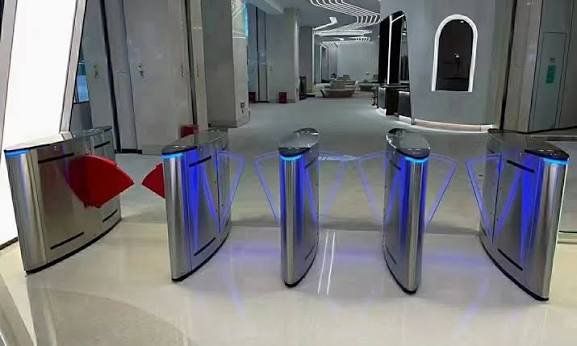
When a valid credential is presented — RFID card, face recognition, QR code, fingerprint — the flaps retract into the housing, the lane opens, the person walks through, and the flaps close behind them. The entire cycle takes under one second in most models.
Flap barriers are the pedestrian equivalent of boom barriers — designed for people instead of vehicles. If you are wondering which one you need for your premises, read our detailed guide on boom barrier vs flap barrier before deciding.
For a complete introduction before reading this types guide, visit our main article: What is a Flap Barrier?
The 6 Main Types of Flap Barriers
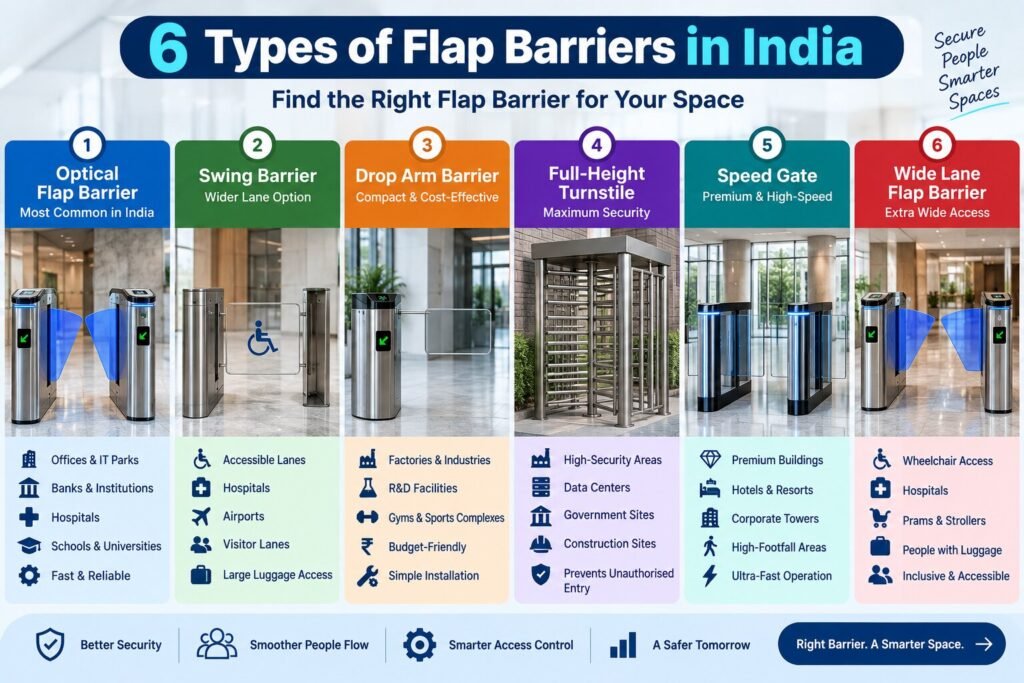
Type 1 — Optical Flap Barrier (Most Common in India)
The optical flap barrier is the most widely installed type across corporate offices, IT parks, hospitals, and institutions in India. It uses slim, retractable acrylic or tempered glass wings that open and close smoothly as each person passes through.
How it looks: A pair of sleek stainless steel pedestals — typically 90 to 120 centimetres tall — facing each other across a 550 to 750mm lane width. The flaps sit inside slots on each pedestal and extend horizontally across the lane when closed.
How it works: IR sensors create an invisible detection grid across the lane. When a valid credential opens the flaps and the person walks through, multiple IR beams track their passage. If a second person attempts to follow (tailgate) without presenting a credential, the system detects the second body in the lane and immediately alerts the guard.
Best for:
- Corporate offices and IT parks
- Banks and financial institutions
- Hospitals and healthcare facilities
- Government buildings and secretariats
- Metro station entry gates
- Hotel staff entrances
- Schools and universities
Flap material options:
- Acrylic flaps — lighter, quieter, standard for most deployments
- Tempered glass flaps — heavier, premium appearance, preferred in high-end lobbies
Lane width: 550mm to 900mm standard. Wider ADA-compliant lanes (900mm+) available for wheelchair access.
Speed: 0.2 to 0.5 seconds per cycle — fast enough for uninterrupted high-footfall flow.
Price range: ₹80,000 – ₹2,50,000 per lane depending on material, brand, and features.
For a full breakdown of flap barrier costs including installation, see our complete flap barrier price guide for India 2026.
Type 2 — Swing Barrier (Wider Lane Option)
The swing barrier — also called a swing gate — uses a single wide panel that swings open rather than retracting. Unlike the optical flap barrier where flaps slide into the housing, the swing barrier’s panel pivots on a hinge.
How it looks: A single pedestal with a wide gate panel — typically 900mm to 1200mm wide — that swings open when a valid credential is presented.
Why it exists: Standard flap barrier lanes are 550 to 750mm wide. For environments that require wider access — wheelchair users, people with prams, large luggage, or workers with equipment — a swing barrier provides the accessible wide lane that is mandatory under accessibility standards.
Best for:
- ADA-compliant accessible lanes in any installation
- Hospital entrances with frequent wheelchair and trolley movement
- Airport check-in areas
- Any location requiring wide-lane access
- Visitor lanes at corporate offices
Important: In most installations, swing barriers are installed alongside optical flap barriers rather than replacing them. A standard corporate deployment might have 3 optical flap lanes and 1 swing barrier lane for accessible access.
See how flap barriers are used across different environments in India for real-world examples of mixed-type deployments.
Price range: ₹60,000 – ₹1,80,000 per unit.
Type 3 — Drop Arm Barrier / Speed Gate
The drop arm barrier — commonly called a speed gate — uses a vertical arm that drops down to block the lane rather than horizontal flaps. The arm is typically a thin rod or panel that hangs vertically and drops into a floor socket or rises into a ceiling mount.
How it looks: Very slim, very sleek pedestals — much thinner than standard flap barriers — with a thin vertical arm that drops or rises to control access. Sometimes called “speed gates” because of their extremely fast operation.
How it is different: Standard flap barriers open horizontally. Speed gates operate vertically — meaning they can be made much slimmer in profile, creating a more open-looking entry point that feels less like a security checkpoint and more like a modern lobby feature.
Best for:
- Premium corporate headquarters and MNC offices
- Five-star hotel lobbies
- High-end co-working spaces
- Exhibition and conference centres
- Airport premium lounges
Trade-off: Speed gates are faster and more aesthetically refined but generally provide less physical deterrence than standard flap barriers. They are chosen when visual sophistication matters as much as security.
Price range: ₹1,50,000 – ₹4,00,000 per lane. Premium pricing reflects premium aesthetics.
Type 4 — Tripod Turnstile (Budget Option)
The tripod turnstile is the simplest and most affordable form of pedestrian access control. Instead of flaps, it uses a rotating three-arm stainless steel rotor. One arm blocks the passage at all times. When a credential is presented, the rotor unlocks and allows one rotation — one person passes through — before locking again.
How it looks: A single waist-height pedestal with three metal arms extending outward in a Y shape. Very industrial in appearance.
How it is different from a flap barrier: Tripod turnstiles are physically more restrictive — the rotating arm physically stops anyone from passing without a credential. Flap barriers are faster and more elegant but rely on the IR detection system. Tripod turnstiles offer higher physical deterrence at a much lower cost.
Best for:
- Construction sites and industrial facilities
- Warehouse entry points
- Factory worker entry gates
- Sports stadiums and outdoor venues
- Budget deployments where aesthetics are secondary to cost
Not suitable for: Corporate lobbies, hospitals, hotels, or any environment where visual impression matters to clients and visitors.
Price range: ₹15,000 – ₹45,000 per unit. The most affordable pedestrian access control option available in India.
Type 5 — Full-Height Turnstile (Maximum Security)
The full-height turnstile extends from floor to ceiling — typically 2 to 2.2 metres tall — with a full-height rotating gate that completely blocks the passage. Nobody can climb over or duck under it.
How it looks: A full-height metal rotating cage or bar structure — floor to ceiling — that requires one person to enter the enclosed space and present their credential before the bars rotate to let them through.
How it is different: While flap barriers can theoretically be jumped over or crawled under (though IR sensors detect this), a full-height turnstile provides absolute physical containment. One person enters at a time with no exceptions.
Best for:
- Data centres and server rooms
- High-security government facilities
- Defence installations and military bases
- Nuclear facilities and research installations
- High-security factory zones
Not suitable for: Anywhere requiring speed, accessibility, or a welcoming appearance. Full-height turnstiles are slow, intimidating in appearance, and not wheelchair accessible.
Price range: ₹1,20,000 – ₹3,50,000 per unit.
Type 6 — Waist-Height Swing Turnstile
A middle ground between the tripod turnstile and the full flap barrier. A waist-height rotating gate — typically with one to three bars — that swings open when a credential is presented and swings back to block after one person passes.
Best for:
- Club and gym entrances
- Sports facility access
- Budget office installations
- Residential society entry points with lower traffic volumes
Price range: ₹25,000 – ₹70,000 per unit.
Flap Barrier Types — Side-by-Side Comparison
| Type | Security Level | Speed | Aesthetics | Cost | Best Environment |
|---|---|---|---|---|---|
| Optical Flap Barrier | High | Very Fast | Excellent | Medium | Offices, hospitals, IT parks |
| Swing Barrier | Medium | Medium | Good | Low–Medium | Accessible lanes, wide access |
| Drop Arm / Speed Gate | High | Fastest | Premium | High | Luxury offices, hotels |
| Tripod Turnstile | Medium | Medium | Basic | Very Low | Factories, warehouses |
| Full-Height Turnstile | Very High | Slow | Industrial | Medium–High | Defence, data centres |
| Waist-Height Swing | Medium | Medium | Basic | Low | Gyms, clubs, small offices |
How to Choose the Right Type for Your Premises
Corporate Office or IT Park
Choose optical flap barrier. The speed, aesthetics, and credential integration options make it the clear choice for any professional environment. Install 3 to 6 lanes depending on peak headcount, with one swing barrier lane for accessibility compliance.
Many Vijayawada offices are making this switch — read why offices in Andhra Pradesh are installing flap barriers in 2026.
Hospital or Healthcare Facility
Choose optical flap barrier with wider lanes. Hospital traffic includes wheelchairs, trolleys, and medical equipment. Wider 750 to 900mm lanes on all units. Include one swing barrier as the wide accessible lane for beds and large medical equipment.
See how flap barriers are deployed in hospitals and healthcare facilities across India.
Apartment Complex or Gated Community
Choose optical flap barrier or waist-height swing turnstile. For a premium residential complex — optical flap barrier with RFID and face recognition for residents, with a visitor management system at the guard desk. For a mid-range society with lower traffic — waist-height swing at a lower budget.
Five-Star Hotel
Choose speed gate or premium glass flap barrier. The aesthetic premium of a speed gate or tempered glass flap barrier matches the hotel’s visual standards. Visitors and guests expect a sophisticated entry — not an industrial tripod turnstile.
Factory or Warehouse
Choose tripod turnstile for worker entry gates. Budget-effective, physically robust, and provides adequate access control for industrial environments. If the factory also has a corporate reception or visitor entrance — add an optical flap barrier there.
School or College
Choose optical flap barrier for staff entrance, waist-height swing for student entry. Staff use RFID or face recognition through standard lanes. Students use simpler, more robust lanes that handle the physical wear of high-volume student traffic.
Construction Site
Choose tripod turnstile. Durable, affordable, and available in weatherproof options. Handles the rough treatment of a construction environment without worry.
High-Security Zone — Data Centre, Server Room, Vault
Choose full-height turnstile. No compromise on physical containment at critical infrastructure entry points.
Multi-Lane Deployments — Mixing Types in One Installation
Most professional installations mix types rather than using a single type throughout. This is actually best practice — different lanes serve different users at the same entry point.
Standard corporate office setup (200–500 employees):
- 4 × optical flap barrier lanes (main staff entry)
- 1 × swing barrier lane (accessible / visitor entry)
- Total: 5 lanes across a 3.5 to 4-metre entry width
Hospital main entrance (high footfall):
- 6 × optical flap barrier lanes (staff and visitor standard entry)
- 2 × swing barrier lanes (wide — for trolleys, wheelchairs, beds)
- Total: 8 lanes across 6 metres
IT park campus with multiple buildings:
- Per building entry: 4 optical flap + 1 swing
- Main campus gate: 6 optical flap + 2 swing + boom barrier for vehicles
For guidance on the right number of lanes for your footfall, contact our team for a free flap barrier installation assessment in Vijayawada.
Credential Integration — What Works With Each Type
What separates a basic flap barrier from a smart access control system is what it integrates with. Here is what each type can connect to:
RFID Card Reader
Works with all types. Employees tap a card to open the flap. Cards are programmed, cancelled, or time-restricted centrally from the management software.
Face Recognition Terminal
Works with optical flap barriers and speed gates. Completely contactless — the camera recognises the face and opens the flap in under 0.5 seconds. No card needed. Works with mask recognition on advanced models.
Fingerprint Scanner
Works with optical flap barriers. Finger placed on the reader opens the flap. Simultaneous attendance recording without a separate biometric device.
QR Code Scanner
Works with all types. Visitor receives a QR code on their phone and scans it at the reader for one-time entry. Ideal for visitor management.
Attendance and Payroll Software
Every flap barrier entry and exit is recorded as an attendance event — automatically feeding into payroll software without manual input.
CCTV Integration
Each lane has a camera mounted overhead. Every credential event links to a timestamped camera snapshot — a complete visual audit trail for security and HR.
Flap Barrier Maintenance — What to Expect
Regardless of type, all flap barriers require periodic maintenance to perform reliably over their 8 to 12-year lifespan.
Monthly — lubricate the flap mechanism and clean sensor lenses.
Quarterly — inspect motor housing, check cable insulation, test safety functions.
Annually — complete mechanical inspection, replace wear parts, recalibrate sensors.
Raise Solutions offers comprehensive flap barrier maintenance and AMC packages for all brands and types we install. Our average response time for AMC clients in Vijayawada is under 4 hours.
Flap Barrier Price by Type — India 2026
| Type | Price Per Lane | Total Installed Cost (3 lanes typical) |
|---|---|---|
| Optical Flap Barrier (Acrylic) | ₹80,000 – ₹1,40,000 | ₹3,00,000 – ₹5,00,000 |
| Optical Flap Barrier (Glass) | ₹1,40,000 – ₹2,50,000 | ₹5,00,000 – ₹9,00,000 |
| Swing Barrier | ₹60,000 – ₹1,80,000 | Usually 1 unit per installation |
| Speed Gate / Drop Arm | ₹1,50,000 – ₹4,00,000 | ₹5,50,000 – ₹14,00,000 |
| Tripod Turnstile | ₹15,000 – ₹45,000 | ₹50,000 – ₹1,50,000 |
| Full-Height Turnstile | ₹1,20,000 – ₹3,50,000 | ₹1,20,000 – ₹3,50,000 |
For a complete, detailed price breakdown by brand and lane configuration, read our flap barrier price guide India 2026.
⚠️ All prices are per lane unit only. RFID readers, face recognition terminals, software, installation, cabling, and AMC are additional costs. Always request an all-inclusive quote.
One important consideration: Many businesses compare the cost of a flap barrier against the cost of a security guard. Our dedicated guide on flap barrier vs security guard cost shows the full ROI calculation — most installations pay back within 18 to 24 months purely on saved manpower costs.
Top Flap Barrier Brands Available in India
Choosing the right type is only half the decision. The brand determines build quality, after-sales support, and long-term reliability. Our detailed guide on top 10 flap barrier manufacturers and suppliers in India covers every major brand with honest pros and cons.
Raise Solutions is an authorised dealer for ZKTeco and ESSL — two of the most widely deployed flap barrier brands in India — giving you genuine products with full manufacturer warranty, proper GST invoice, and a local support team.
For buyers in Andhra Pradesh, our flap barrier suppliers page for Vijayawada lists all available models with local pricing.
Flap Barrier Installation — What to Expect
Step 1 — Free Site Survey
Our engineer visits your entry point, measures the lane width, checks the floor surface, assesses power availability, and counts peak-hour footfall. We recommend the right type, quantity, and configuration before you commit to anything. This is completely free.
For local buyers: Book a free flap barrier installation survey in Vijayawada.
Step 2 — Lane Configuration Design
We prepare a layout showing exactly where each unit sits, the lane widths, credential reader positions, and cabling routes. You approve the layout before any work begins.
Step 3 — Civil Work
Channel cutting for cable routing, floor anchor bolt setting for each pedestal, and any necessary floor preparation. Done cleanly and professionally.
Step 4 — Installation and Wiring
Each unit is anchored, powered, and connected to the control system. Credential readers, face recognition cameras, or RFID readers are mounted and configured.
Step 5 — Software Configuration
Access rules are set — which credential opens which lane at what time. Shift schedules, visitor rules, and exception handling are configured. Full live testing before handover.
Step 6 — Training and Handover
Your security team and HR team are trained on daily operation, credential management, attendance reporting, and basic troubleshooting.
🔧 Raise Solutions completes a standard 4-lane optical flap barrier installation in 1 to 2 working days from order confirmation. Multi-building campus installations may take 3 to 5 days.
Frequently Asked Questions
Q: What is the most popular type of flap barrier used in Indian offices?
The optical flap barrier with acrylic or tempered glass wings is overwhelmingly the most common type in Indian corporate offices, IT parks, hospitals, and institutions. It offers the right balance of speed, security, aesthetics, and cost for most professional environments in India.
Q: What is an optical turnstile — is it the same as a flap barrier?
Yes. Optical turnstile and optical flap barrier are two names for the same device. The “optical” refers to the infrared sensor system used to detect passage and prevent tailgating. In India, both terms are used interchangeably in the market.
Q: Can flap barriers detect tailgating?
Yes. All quality optical flap barriers have anti-tailgating IR sensor arrays. If a second person attempts to follow through the same opening after the credential holder, the system detects the second body and triggers an alert immediately. Premium models use camera-based AI detection for even more accurate tailgate identification.
Q: How many people can a flap barrier lane handle per hour?
A standard optical flap barrier handles 600 to 1,200 persons per hour per lane depending on the credential type. RFID card tap is the fastest — no stopping required. Face recognition with a 0.3-second recognition time allows very high throughput at busy entry points.
Q: Which type of flap barrier is best for apartments and gated communities?
For premium residential complexes — optical flap barrier with RFID for residents and a visitor management system. For mid-range housing societies with lower traffic — a waist-height swing turnstile provides adequate control at a lower cost. Contact us for a site-specific recommendation.
Q: Do flap barriers work during power cuts?
All quality flap barriers have a failsafe mode — flaps open automatically during power failure, allowing free evacuation. This is a mandatory safety feature. A UPS connection ensures controlled, credential-based operation continues during brief power outages.
Q: What is the difference between a flap barrier and a boom barrier?
A boom barrier controls vehicle entry — a horizontal arm rises and falls to allow or stop cars and trucks. A flap barrier controls pedestrian entry — retractable wings open and close to allow or stop people. For a complete comparison, read boom barrier vs flap barrier.
Why Choose Raise Solutions for Your Flap Barrier?
Flap barriers are not a commodity purchase. The difference between a well-installed, properly calibrated flap barrier system and a poorly configured one is the difference between a smooth, reliable access control layer and a daily headache for your security team and staff.
Raise Solutions has installed flap barrier systems at corporate offices, IT parks, hospitals, schools, and institutional campuses across Andhra Pradesh. We bring 12+ years of real-world deployment experience to every project.
- ✅ Authorised dealer for ZKTeco and ESSL — genuine products, full manufacturer warranty
- ✅ Free site survey and lane configuration design
- ✅ End-to-end service — supply, civil work, installation, integration, staff training, and AMC
- ✅ All credential types — face recognition, RFID, QR code, fingerprint
- ✅ Comprehensive AMC and maintenance packages for long-term reliability
- ✅ Multi-site networked systems for campuses and multi-branch organisations
- ✅ ISO Certified | MSME Registered | NSIC Recognised
- ✅ Head office in Vijayawada with branches in Hyderabad, Bangalore, Pune and Mumbai
📞 Book Your Free Site Survey Today
Call: +91 8522959096
Email: info@raisesolutions.in
Website: raisesolutions.in
Visit: Nidamanuru Road, Poranki, Vijayawada, Andhra Pradesh – 521137
Tell us your premises type, entry point dimensions, and peak daily footfall — we will recommend the right flap barrier type and configuration with full all-inclusive pricing within 24 hours.
© 2026 Raise Solutions | All Rights Reserved | ISO Certified | MSME Registered | NSIC Recognised