
By Raise Solutions | Vijayawada, Andhra Pradesh | April 2026 | 11 min read
Introduction
If you have ever entered a mall parking lot, a gated community, a hospital, or a corporate campus, there is a good chance a boom barrier stopped you — and then let you through. That horizontal arm lifting and lowering at the gate is one of the most widely used access control tools in the world.
Yet most people searching for “boom barrier meaning” simply want a quick, clear answer. So let’s start there.
For a complete breakdown of what a boom barrier is, visit our dedicated page: What Is a Boom Barrier?
Boom Barrier Meaning: A Simple Definition
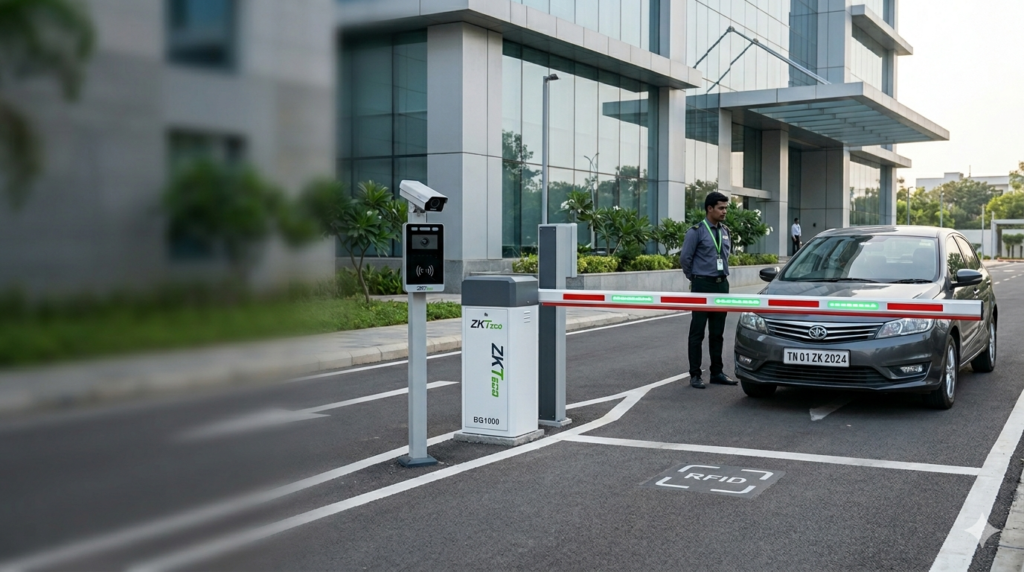
A boom barrier is an automated or manually operated horizontal bar — called the “boom” — that pivots at one end to block or allow vehicle passage through a controlled entry or exit point.
In plain terms: it rises to let a vehicle in, and lowers to stop unauthorised vehicles from entering. That single action — lift and lower — is what gives the boom barrier its name.
The boom arm itself is typically made of aluminium or fibreglass and ranges from 1 metre to 9 metres in length, depending on the width of the lane it covers. The arm sits in a sturdy housing box that contains the motor, controller board, and counterbalance mechanism — the parts that do the actual work behind that simple up-and-down motion.
Also known as: Boom gate | Parking barrier | Vehicle barrier | Road barrier | Arm barrier | Drop arm barrier
Although the term sounds technical, the concept behind it is something almost everyone has experienced — whether at a toll booth, an office gate, or an apartment entrance.
How Does a Boom Barrier Work?
Now that the meaning is clear, here is what actually happens behind that simple lift-and-lower motion. A modern boom barrier system relies on several components working together to detect, authenticate, and physically control vehicle access.
Step 1: Vehicle Detection
First, a sensor detects the approaching vehicle. This is usually an inductive loop embedded in the road, an infrared sensor, or a camera-based detection system. Once triggered, it signals the controller that a vehicle is waiting.
Step 2: Authentication
Next, depending on the setup, the driver authenticates using one of several methods — a ticket dispenser, an RFID card tap, a number plate recognition camera, or a QR code scan. In pay-and-exit parking systems, a payment kiosk handles this step instead.
Step 3: Controller Signal
Once access is approved, the controller sends an electrical signal to the motor inside the barrier housing. The motor then drives a gear mechanism that lifts the boom arm from horizontal (closed) to vertical (open).
Step 4: Vehicle Passes Through
As the arm rises to 90 degrees, it holds position while the vehicle passes. Meanwhile, a safety sensor continuously monitors the passage zone, preventing the arm from lowering if a vehicle or person is still underneath it.
Step 5: Arm Lowers Automatically
Finally, once the vehicle has cleared, the arm lowers back to horizontal, closing the access point. The system then resets itself, ready for the next vehicle.
Impressively, modern high-speed barriers complete this entire cycle in under 1.5 seconds — which is exactly why they suit high-traffic locations like toll plazas and large corporate campuses.
Types of Boom Barriers
Boom barriers are not one-size-fits-all. They vary in design, speed, and configuration depending on where they are used. Below are the main types found across India.
Standard Boom Barrier
This is the most common type, used in parking lots, offices, and residential complexes. The arm typically ranges from 3 to 6 metres, with an opening speed of around 3 to 6 seconds. It suits locations with moderate vehicle traffic where cost and reliability matter most.
High-Speed Boom Barrier
In contrast, this type is built for very high vehicle throughput — toll plazas, large factory gates, and busy commercial complexes. It opens in under 1.5 seconds and handles thousands of cycles per day without mechanical fatigue.
Folding or Flap Boom Barrier
Here, the arm folds in the middle as it rises, requiring less vertical clearance. As a result, it works well in multi-storey car parks, basement parking areas, or locations with low overhead obstructions like beams or pipes.
Heavy-Duty or Crash-Rated Barrier
For high-security perimeters — military installations, data centres, government buildings, and embassies — this is the barrier of choice. Crash-rated models are engineered to stop a vehicle even during a forced, high-speed breach attempt.
Solar or Wireless Boom Barrier
Finally, this type runs on solar panels and operates wirelessly, making it ideal for remote locations without reliable power — construction sites, temporary event access points, or rural industrial facilities.
| Type | Best For | Typical Speed |
|---|---|---|
| Standard | Offices, apartments, parking | 3–6 seconds |
| High-Speed | Toll plazas, factories, malls | Under 1.5 seconds |
| Folding / Flap | Basements, low-clearance areas | 2–4 seconds |
| Heavy-Duty | Security perimeters, govt. sites | 3–5 seconds |
| Solar / Wireless | Remote sites, temporary access | 3–5 seconds |
Key Components of a Boom Barrier System
Understanding the parts of a boom barrier helps you evaluate quality and plan maintenance properly. A complete system consists of the following components.
Boom arm — the horizontal bar that physically blocks the road. It is made from either aluminium, which is lightweight and corrosion-resistant, or fibreglass, which offers more flexibility for long spans.
Motor unit — the heart of the system. A DC or AC motor drives the arm up and down, and the quality of this motor ultimately determines speed, duty cycle, and longevity.
Control panel (PCB) — essentially the brain of the barrier. It receives signals from sensors and authentication devices, then sends commands to the motor. Notably, modern PCBs support integration with RFID, licence plate recognition cameras, and parking software.
Safety sensors — infrared or pressure sensors that detect a person or vehicle in the path of the lowering arm, thereby preventing accidents.
Counterbalance mechanism — a spring or weight system that offsets the weight of the boom arm. This significantly reduces motor load and extends motor life.
Limit switches — mechanical or electronic switches that tell the controller exactly when the arm has reached its fully open or fully closed position.
Manual release — a key-operated override that allows staff to operate the barrier manually during a power failure.
LED arm lighting — many modern barriers include LED strips along the boom arm for improved visibility, particularly useful at night or in low-light conditions.
Where Are Boom Barriers Used?
Boom barriers are remarkably versatile. Here is a breakdown of their most common applications across India.
In parking lots and commercial complexes, malls, hospitals, hotels, and office parks use boom barriers at entry and exit points, paired with ticket dispensers or RFID systems to manage paid or restricted parking.
In gated residential communities, apartment complexes use boom barriers with RFID tags for residents, alongside manual or intercom-based access for visitors. This setup eliminates the need for a security guard to physically check every vehicle.
On toll plazas, high-speed boom barriers integrate with FASTag RFID readers for fully automated toll collection. Consequently, the barrier opens within milliseconds of a valid FASTag read.
At corporate and IT campuses, large sites with multiple vehicle entrances use boom barriers integrated with employee ID systems, visitor management software, and CCTV — maintaining a complete log of all vehicle movements.
In hospitals and educational institutions, schools, colleges, and hospitals use boom barriers to prevent unauthorised entry, manage emergency vehicle access, and control parking for staff and visitors.
At industrial and manufacturing plants, factories use boom barriers at goods entry points to log and control truck movement, often integrating the system with weighbridges.
Finally, at petrol pumps and drive-throughs, some outlets use barriers to manage queue flow and customer movement efficiently.
Boom Barrier vs Other Access Control Systems
Boom barriers are not the only way to control vehicle access. Here is how they compare to common alternatives.
| System | Key Difference |
|---|---|
| Sliding Gate | Fully blocks the opening; better security but slower and more expensive |
| Bollards | Fixed or retractable posts; higher security rating, no arm |
| Tripod Turnstile | Controls pedestrian access only, not vehicles |
| Speed Gate / Flap Barrier | Pedestrian-only, high-throughput; used in offices and metro stations |
| Tyre Killers | Ultra-high-security vehicle spikes; used for one-way exit enforcement |
Ultimately, the boom barrier wins on the combination of cost, speed, ease of integration, and reliability for standard vehicle access control. That is precisely why it remains the most widely deployed solution worldwide.
Benefits of Installing a Boom Barrier
Why do thousands of businesses across India install boom barriers every year? Here are the core benefits.
First, enhanced security — a boom barrier prevents unauthorised vehicles from entering your premises, significantly reducing theft, vandalism, and trespassing.
Second, automated access control — it eliminates the need for a security guard at every vehicle entry point, considerably reducing manpower costs.
Third, a complete audit trail — every vehicle entry and exit gets logged with a timestamp, which is ideal for liability, attendance, and security reporting.
Fourth, reduced congestion — high-speed barriers process vehicles faster than manual checking, cutting down queues during peak hours.
Fifth, the system is integration-ready — modern barriers connect with RFID, ANPR cameras, parking software, and building management systems for a fully automated facility.
In addition, boom barriers require low maintenance — quality units typically need just a quarterly check of the motor, springs, and sensors.
They are also highly scalable — a single site can run 1 barrier or 20, all managed from a central software dashboard.
Lastly, they are durable and weather-resistant, built for outdoor use in rain, heat, and dust — conditions well-suited to the Indian climate.
What to Look for When Buying a Boom Barrier in India
Choosing the wrong barrier can cost you in repairs, replacements, and security gaps. Therefore, here is what to evaluate before you buy.
Duty cycle tells you how many open-close cycles the barrier can handle per day. A 40% duty cycle means it can run continuously for 40% of the time. For high-traffic locations, look for barriers rated at 90–100% duty cycle.
Arm length should be measured accurately against your lane width. While most standard barriers cover 3 to 6 metres, wider lanes need a folding arm or two opposing barriers.
IP rating indicates how well the housing resists dust and water. For outdoor Indian conditions, an IP54 rating or higher is recommended.
Brand and authorised dealer matter more than most buyers realise. Stick with established brands like ZKTeco, Matrix, or eSSL, and always buy from an authorised dealer to ensure genuine components, valid warranty, and local service support — particularly critical in cities like Vijayawada, where response time matters.
Integration capability becomes important if you plan to connect the barrier with RFID readers, cameras, or parking software. In that case, confirm the barrier has relay output, RS-485, or TCP/IP communication ports.
Warranty and AMC terms should always be clarified upfront. A good barrier should include at least a 1-year warranty, and you should ask your vendor about Annual Maintenance Contracts covering periodic servicing and emergency call-outs.
Quick Buying Checklist
- Confirm lane width before ordering arm length
- Check the duty cycle rating against your expected daily traffic volume
- Verify the IP rating — minimum IP54 for outdoor locations
- Ask for the brand authorisation certificate from your vendor
- Confirm integration ports (relay, RS-485, TCP/IP)
- Request a demo or free site survey before finalising
- Clarify the warranty period and AMC terms
- Check for UPS or battery backup for power-cut situations
Boom Barrier Price in India — What to Expect in 2026
Pricing depends on brand, arm length, speed, and feature set. Below is a general market range to guide your budgeting.
| Barrier Type | Approximate Price (INR) |
|---|---|
| Standard boom barrier (3–4m arm) | ₹18,000 – ₹40,000 |
| High-speed barrier (full duty cycle) | ₹45,000 – ₹90,000 |
| Folding / flap barrier | ₹35,000 – ₹70,000 |
| Heavy-duty / crash-rated barrier | ₹1,20,000 – ₹3,00,000+ |
| Solar / wireless barrier | ₹50,000 – ₹1,00,000 |
| Annual Maintenance Contract (AMC) | ₹5,000 – ₹15,000 per unit/year |
Note: These prices are indicative and exclude installation charges, wiring, conduit, civil work, and integration hardware. Always request a detailed, site-specific quotation from your vendor.
Common Boom Barrier Problems & How to Fix Them
Even the best barriers occasionally need attention. Here are the most frequent issues and how to resolve them.
Arm not opening fully usually points to a limit switch misalignment. Check and recalibrate the open-position limit switch — though in older units, this can also indicate motor fatigue.
Barrier opening without authentication generally means the sensor sensitivity is set too high, or a faulty sensor is detecting phantom vehicles. In this case, recalibrate the ground loop or infrared sensors.
Arm lowering on vehicles is a safety-critical issue caused by a dirty, misaligned, or malfunctioning safety sensor. Clean the IR sensors, check alignment, and fix this immediately.
Motor noise or grinding sounds typically signal that gear lubrication has dried out. Apply appropriate grease to the mechanism; if the noise persists, the gearbox may need replacement.
Arm swaying in strong wind suggests the counterbalance spring needs adjustment, or the arm is too long for local wind conditions. Consider a wind deflector or a heavier arm profile.
Barrier stuck during a power failure can be resolved using the manual release key. To prevent this recurring, add a UPS or battery backup to the barrier controller.
Boom Barriers as Part of a Complete Access Control System
On its own, a boom barrier is simply a physical gate. However, its real power emerges when integrated into a complete access control ecosystem.
RFID readers allow residents and employees to tap a card or sticker, opening the barrier automatically without manual intervention.
LPR/ANPR cameras read the number plate and cross-check it against a database — meaning no card or action is needed from the driver at all.
Parking management software tracks occupancy in real time, calculates fees, generates reports, and sends alerts for unauthorised vehicles.
Visitor management systems allow visitors to be pre-registered or issued a one-time pass that triggers the barrier automatically on arrival.
CCTV integration ensures every barrier event is timestamped and tied to camera footage, creating a complete, tamper-proof audit trail.
Fire alarm integration allows the barrier to open automatically when a fire alarm triggers — keeping evacuation routes clear during emergencies.
At Raise Solutions, we do not just supply the barrier. Instead, we design and install complete integrated systems — from RFID readers and cameras to parking software and 24/7 AMC support — so your access control works as one seamless, reliable unit
A boom barrier is an automated or manual horizontal arm that rises to allow vehicle entry and lowers to block it. The term “boom” simply refers to the long pivoting bar itself.
A boom barrier is far more than a simple arm that goes up and down. In reality, it is the cornerstone of modern vehicle access control — combining physical security, automated authentication, and data logging into a system that runs 24 hours a day, 7 days a week, with minimal human intervention.
For businesses in Vijayawada and across Andhra Pradesh, choosing the right boom barrier system means selecting the right type for your traffic volume, the right brand for reliability, and the right vendor for installation and long-term support.
At Raise Solutions, we are an authorised dealer and certified installer of ZKTeco, Matrix, and eSSL boom barrier systems across Vijayawada, Guntur, Amaravati, and the Krishna district. We provide free site surveys, end-to-end installation, integration with RFID and parking software, and Annual Maintenance Contracts for worry-free operation.
अधिक जानकारी के लिए पढ़ें: Boom Barrier क्या होता है — पूरी जानकारी“
Get a Free Boom Barrier Consultation
📞 +91 8522959096
📧 info@raisesolutions.in
🌐 www.raisesolutions.in
📍 Poranki, Vijayawada, Andhra Pradesh
Serving Vijayawada | Guntur | Amaravati | Krishna District | All of Andhra Pradesh
Pingback: Boom Barrier Installation in Vijayawada — Cost, Brands & Best Options
Pingback: Boom Barrier Gate Price in India 2026 | Complete Buyer's Guide
Pingback: Types of Flap Barriers — Optical, Swing, Speed Gate & Turnstile Guide 2026
Pingback: Boom Barrier AMC Cost in India 2026 | Price Guide
Pingback: Parking Barrier Gate Price in India 2026 — ₹18,000 to ₹25 Lakh
Pingback: What is a Flap Barrier? Meaning, Working, Types & Price in India 2026