
A flap barrier has more moving parts working faster than a boom barrier — swing-out or slide-open wings, a sensor array, a motor per lane, and (in most modern installs) an RFID, biometric, or QR reader bolted on top. That’s more that can wear out, and more reasons an Annual Maintenance Contract matters here even more than it does for a simple boom gate.
If you’ve installed flap barriers at an office lobby, metro station, or gated community and are now getting AMC quotes that vary wildly between vendors, this guide breaks down what a flap barrier AMC should actually cost, what spare parts run separately, and how to tell a fair quote from an inflated one.
What Does a Flap Barrier AMC Cover?
Unlike a boom barrier’s single arm and motor, a flap barrier lane typically has:
- Two motorised flap panels (or one sliding panel, depending on model)
- Infrared sensor arrays for tailgating detection
- A control board managing lane logic and access credentials
- The reader/credential layer (RFID card, biometric, QR, or face recognition)
An AMC should service all four layers, not just the mechanical flaps. This is the single biggest gap we see in cheap AMC quotes — vendors price only the mechanical service and leave the reader/credential system uncovered, which is often the part that fails first in high-traffic sites like the ones covered in our flap barrier guide for metro stations and offices.
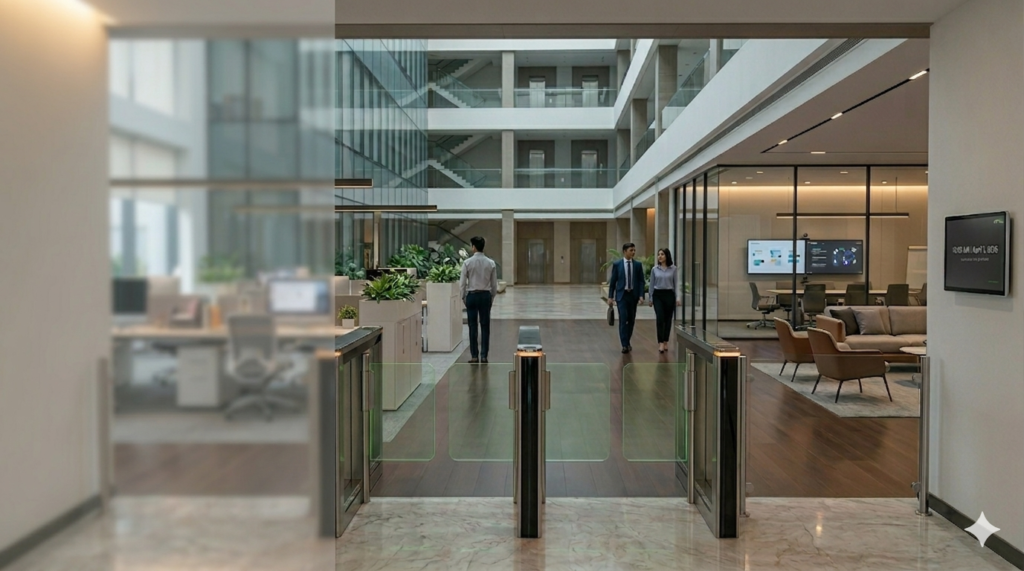
Flap Barrier AMC Cost in India — Typical Price Ranges
Pricing is quoted per lane, not per unit, since that’s how flap barriers are installed and sold. Refer back to our flap barrier price guide with lane costs if you’re still deciding how many lanes you need before budgeting the AMC.
| Site Type | Non-Comprehensive AMC (per lane/year) | Comprehensive AMC (per lane/year) |
|---|---|---|
| Apartment / gated community entrance | ₹5,000 – ₹8,000 | ₹10,000 – ₹16,000 |
| Corporate office lobby | ₹7,000 – ₹11,000 | ₹14,000 – ₹22,000 |
| Metro station / high-footfall public site | ₹12,000 – ₹18,000 | ₹24,000 – ₹38,000 |
| Factory / industrial gate with biometric integration | ₹10,000 – ₹15,000 | ₹20,000 – ₹32,000 |
Multi-lane sites (3+ lanes side by side, common at metro and large office deployments) typically get a 15–20% per-lane discount when bundled into one AMC.
Flap Barrier Spare Parts Cost Guide
This is where flap barrier ownership differs most from boom barriers — parts wear faster because they move heavier panels through more cycles per hour. Approximate replacement costs (parts only, excluding labour):
| Spare Part | Approx. Cost (₹) | Typical Lifespan |
|---|---|---|
| Flap panel / wing (single, acrylic or tempered glass) | 2,500 – 6,000 | 3–5 years |
| Lane motor / actuator | 4,000 – 9,000 | 2–4 years (high-traffic sites wear faster) |
| Infrared sensor pair | 1,200 – 3,000 | 1–2 years |
| Main control board (PCB) | 5,000 – 12,000 | 4–6 years |
| RFID/card reader module | 2,000 – 5,000 | 3–5 years |
| Biometric reader module | 4,000 – 9,000 | 3–5 years |
| Power supply unit | 1,500 – 3,500 | 3–5 years |
These figures assume standard mid-range flap barrier brands. If your installation uses premium or imported models, expect parts pricing 30–50% higher, and longer lead times if the vendor doesn’t stock locally.
Comprehensive vs. Non-Comprehensive AMC — Which Do You Need?
Non-comprehensive AMC covers scheduled service visits and labour but bills spare parts separately at the time of failure. This works for flap barriers under 2 years old, where panel and motor wear is minimal.
Comprehensive AMC rolls parts into the annual fee — motors, sensors, control boards, and reader modules are replaced at no extra charge within the contract term. Given how frequently flap barrier motors and sensors fail compared to a boom barrier’s single arm mechanism, comprehensive coverage tends to pay for itself faster here than it does for boom barriers. If your site runs 500+ cycles a day (typical for metro or large office lobbies), comprehensive is close to mandatory rather than optional.
Factors That Push Flap Barrier AMC Cost Up
- Number of lanes and panel material — glass panels cost more to replace than acrylic, raising comprehensive AMC premiums
- Credential system complexity — a lane running RFID + biometric + visitor QR together needs all three covered, not just the mechanical service
- Cycle volume — a metro gate cycling thousands of times a day wears the motor and sensors far faster than an apartment gate
- Integration with security guard workflows — sites that also budget for manned security alongside flap barriers should factor AMC response time into guard shift planning, since a stuck lane during peak hours needs fast resolution
- Brand and spare parts availability — locally stocked brands keep both AMC and one-off spare part costs lower
Comparing This to a Boom Barrier AMC
If your site runs both systems — a boom barrier for vehicles and flap barriers for pedestrian access, common at gated communities and corporate campuses — it’s worth reading our boom barrier vs. flap barrier comparison alongside this guide. The two systems have different wear profiles and shouldn’t be bundled into a single generic AMC quote; ask your vendor for separate line items so you can see what each system is actually costing you.
For general upkeep advice outside of formal AMC contracts, our flap barrier maintenance guide covers the day-to-day checks any facility team can do between scheduled service visits.
How to Choose a Flap Barrier AMC Provider
- Confirm the reader/credential layer is covered, not just the mechanical flap and motor — this is the most commonly excluded item in cheap quotes
- Ask for a per-lane cost breakdown, especially at multi-lane sites, to avoid a vague bundled number
- Check response-time SLA — high-footfall sites like metro stations or office lobbies can’t tolerate a lane down for more than a few hours
- Verify local spare parts stock — a comprehensive AMC is only as good as how fast the vendor can actually get a replacement motor or panel to site
- Get the panel material specified — glass vs. acrylic replacement costs differ significantly, and vague contracts often don’t specify which is covered
Frequently Asked Questions
Generally yes, per unit — a flap barrier lane has more components (dual motors, sensors, reader hardware) than a single boom barrier arm, and typically sees higher cycle counts in commercial settings.
Every 2–3 months for high-traffic sites, every 6 months for lower-footfall installations like small offices or apartment lobbies. Sensor drift is the most common cause of false tailgating alerts or panels not opening.
Only under comprehensive AMC, and only for wear-related failure — accidental damage or vandalism is usually excluded and billed separately. Check your contract’s exclusion clause specifically for this
Yes, many vendors bundle both, but ask for separate cost breakdowns per system so you know what each is actually costing and can benchmark them independently.
What’s the average lifespan of a flap barrier before major overhaul? With a comprehensive AMC and regular servicing, 7–10 years is typical before a full unit replacement becomes more economical than continued part-by-part repair.
Need an AMC quote for your flap barrier installation? Raise Solutions supplies, installs, and maintains flap barriers for offices, apartments, and high-footfall sites across Vijayawada and Andhra Pradesh, with comprehensive AMC plans that cover the full reader-to-motor stack — not just the mechanical flap. Get in touch for a per-lane AMC quote