
If you manage or own a gated community, you’ve almost certainly had this debate: should we install a boom barrier or a sliding gate at the entrance?
Both systems control vehicle access. Both can be automated. Both look professional. But they serve very different purposes — and choosing the wrong one can cost you time, money, and a lot of headaches down the road.
In this guide, we break down everything you need to know: how each system works, where it excels, where it falls short, and which one is the right fit for your specific community. By the end, you’ll have a clear answer.
What is a Boom Barrier?
A boom barrier (also called a boom gate or lift gate) is a horizontal pole that pivots upward to allow vehicles to pass and comes back down to block entry. You see them everywhere — parking lots, toll booths, corporate campuses, apartment complexes, and fuel stations.
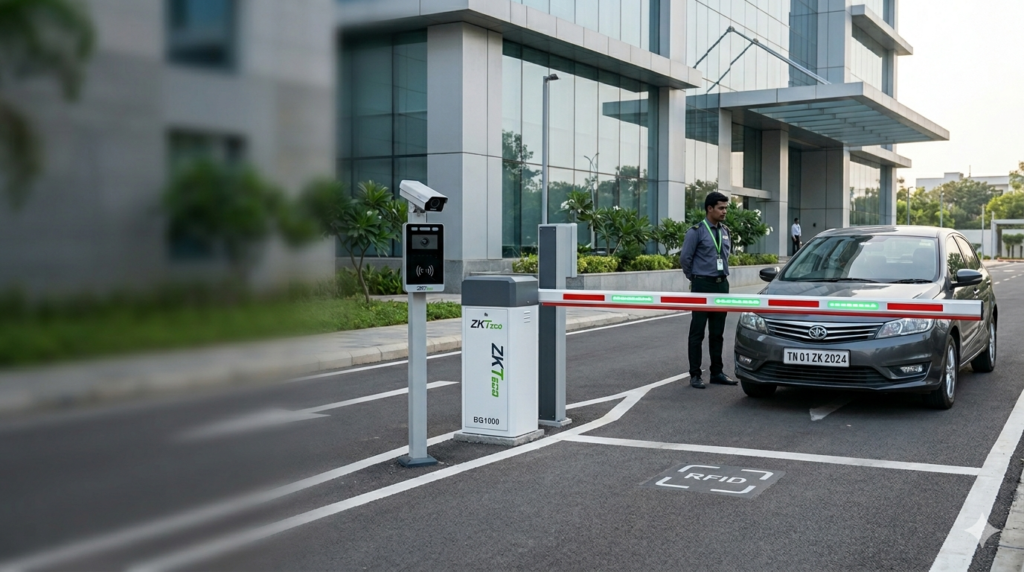
Modern boom barriers are motorised, fast, and can integrate with RFID cards, vehicle sensors, number plate recognition cameras, and remote controls. High-end models from brands like ZKTeco and ESSL open in under 1.5 seconds and can handle thousands of operations per day without breaking down.
How it works: A vehicle approaches the barrier. The driver presents an RFID card, enters a PIN, or a camera reads the number plate. The boom arm lifts, the vehicle passes through, and the arm comes back down automatically after the vehicle clears.
Simple, fast, and reliable.
What is a Sliding Gate?
A sliding gate is a full-panel gate — usually made of iron, MS steel, aluminium, or stainless steel — that slides horizontally along a track to open and close. Unlike a boom barrier, a sliding gate physically fills the entire entrance gap, providing a solid barrier that a vehicle simply cannot drive through.
Sliding gate motors from brands like FAAC, Roger Technology, and BFT automate the movement, allowing the gate to be controlled via remote, keypad, intercom, or RFID system.
How it works: A resident presses a remote or the guard activates the gate. The gate slides along the track to one side, the vehicle enters or exits, and the gate slides back and locks into position.
More substantial, more secure — but also slower and more expensive to install.
Boom Barrier vs Sliding Gate: Head-to-Head Comparison
1. Speed of Operation
Boom barriers open and close in 1–3 seconds. For gated communities with 200+ flats and heavy morning and evening traffic, this speed is non-negotiable. A slow gate during peak hours creates traffic jams that spill onto the main road.
A sliding gate takes 8–15 seconds to fully open depending on width and motor speed. For a wide entrance of 5–7 metres, that’s a long wait. During peak hours, this becomes a genuine bottleneck.
Winner: Boom Barrier — especially for high-traffic residential complexes.
2. Security Level
Here’s the honest truth: a boom barrier is a traffic management tool, not a full security barrier. A determined driver can crash through it. While modern barriers have anti-crash features, they are not designed to physically stop an unauthorised vehicle.
A solid MS steel sliding gate, on the other hand, is a genuine physical deterrent. It cannot be brushed aside. For communities in areas with higher security concerns, this difference matters a great deal.
Winner: Sliding Gate — when physical security is the top priority.
3. Cost of Installation
Boom barriers are significantly more affordable. A good quality automated boom barrier system — including motor, arm, RFID reader, and installation — typically costs between ₹35,000 and ₹80,000 depending on arm length and features.
A sliding gate involves the gate panel itself (which is priced by weight and material), the motor, the track, civil work, and installation. For a standard 4-metre entrance, you’re looking at ₹80,000 to ₹2,50,000 or more.
Winner: Boom Barrier — for budget-conscious communities.
4. Maintenance Requirements
Boom barriers have fewer moving parts. The motor, arm, and sensors are the main components. Maintenance is straightforward — periodic lubrication, sensor cleaning, and occasional arm replacement if damaged. Downtime is minimal.
Sliding gates involve a track system that collects dust, dirt, and debris over time. The track must be kept clean or the motor strains and wears out faster. In cities like Vijayawada where dust and monsoon mud are real concerns, track maintenance is a recurring task.
Winner: Boom Barrier — lower ongoing maintenance effort and cost.
5. Space Requirements
A boom barrier needs very little space. The arm swings upward, so there’s no lateral clearance needed. This makes it ideal for tight entrances, basement parking ramps, and narrow lanes.
A sliding gate needs a clear run of space equal to the gate width on one side of the entrance. For a 5-metre gate, you need 5+ metres of clear wall space beside the opening. If your entrance is flanked by walls, pillars, or utility boxes, a sliding gate may simply not be possible.
Winner: Boom Barrier — for space-constrained entrances.
6. Aesthetics and Impression
Boom barriers are functional and recognisable, but they don’t make a grand statement. They signal “managed access” more than “premium living.”
A well-designed sliding gate in powder-coated MS steel or stainless steel with laser-cut patterns gives a gated community a premium, polished entrance. For luxury villa projects, high-end apartments, and communities where first impressions matter to residents and visitors alike, the sliding gate wins on visual impact.
Winner: Sliding Gate — for premium aesthetic appeal.
7. Integration with Smart Systems
Both systems can integrate with modern access control technology — RFID, facial recognition, number plate reading cameras, mobile apps, and intercom systems. However, boom barriers are generally easier and cheaper to integrate because the ecosystem of compatible devices (RFID readers, vehicle loop detectors, IP cameras) is wider and more standardised.
Sliding gates can also be fully automated and integrated, but the electronics add cost on top of an already higher base price.
Winner: Tie — both integrate well, but boom barriers do it at lower cost.
Quick Comparison Summary
| Feature | Boom Barrier | Sliding Gate |
|---|---|---|
| Opening speed | 1–3 seconds | 8–15 seconds |
| Security strength | Moderate | High |
| Installation cost | ₹35K–₹80K | ₹80K–₹2.5L+ |
| Maintenance | Low | Medium–High |
| Space needed | Minimal | Requires side clearance |
| Aesthetics | Functional | Premium |
| Smart integration | Easy & affordable | Possible, higher cost |
So Which One Should Your Gated Community Choose?
The answer depends on your community’s specific priorities. Here’s a simple way to decide:
Choose a Boom Barrier if your community has high daily vehicle traffic and speed is critical, your entrance space is limited, you’re working with a tight budget, you want low-maintenance, high-reliability operation, or you’re managing a large apartment complex with 100+ units.
Choose a Sliding Gate if physical security and deterrence are your top priorities, your community is a villa project or premium residential layout, you have adequate space beside the entrance for the gate to slide, you want a strong aesthetic statement at the entrance, or your community has moderate traffic and speed is less of a concern.
Can You Use Both?
Yes — and many smart communities do exactly this.
A common setup is to use a sliding gate as the main entrance for pedestrians and after-hours security, combined with a boom barrier lane for quick vehicle access during the day. This gives you the best of both worlds: a strong security barrier when needed, and fast vehicle throughput during peak hours.
This dual-system approach is especially popular in larger gated communities and IT park residential projects across Andhra Pradesh.
Why Choose Raise Solutions for Your Gate Automation?
At Raise Solutions, we are authorised dealers and installers of ZKTeco, ESSL, and Autozone boom barrier systems, as well as automated sliding gate motors for villas and gated communities across Vijayawada and Andhra Pradesh.
We don’t just sell you equipment — we do a free site survey, recommend the right system for your specific entrance dimensions and traffic volume, handle the complete installation, and provide after-sales service and AMC support.
Whether you need a single boom barrier for a basement parking entry or a full gate automation system with RFID, intercom, and CCTV integration for a 500-villa township, we’ve got you covered.
Call us today at +91 85229 59096 or visit raisesolutions.in to book your free site survey.
Boom barriers are cheaper to maintain. They have fewer moving parts, no track system to clean, and replacement components are widely available and affordable.
Pingback: Sliding Gate Motor Price in India 2026 — Brand-wise Cost Guide