
Whether you’re managing a corporate office, gated community, hospital, or a busy parking lot — controlling vehicle access is no longer optional. Boom barriers are the frontline of automated access management, offering a smart, reliable, and cost-effective way to regulate who enters and exits your premises.
But with so many types available in the market today, choosing the right boom barrier can be confusing. Do you need a high-speed barrier or a standard automatic one? Should you go for a long-arm barrier or a flap-type?
In this comprehensive guide, Raise Solutions — Vijayawada’s trusted security and automation partner — breaks down every type of boom barrier, its features, ideal use cases, and how to pick the right one for your facility.
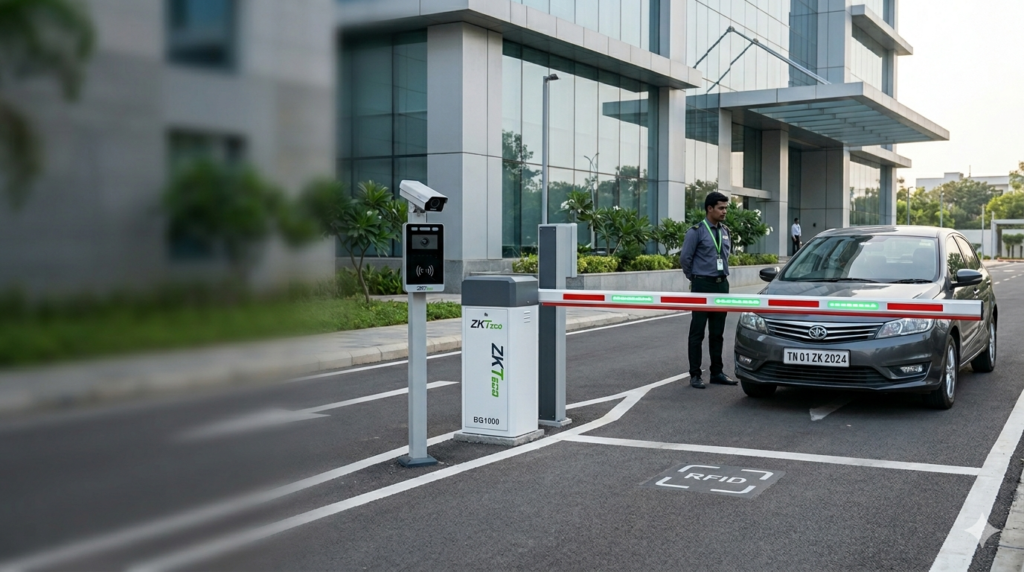
What Is a Boom Barrier?
A boom barrier (also called a boom gate or vehicle barrier) is an automated gate system that controls vehicular entry and exit at a checkpoint. A horizontal bar — or “arm” — is raised or lowered to allow or restrict vehicle movement.
Modern boom barriers are integrated with ticketing systems, RFID card readers, biometric access control, ANPR cameras, and parking management software to deliver seamless, secure, and contactless access control.
At Raise Solutions, we supply, install, and service boom barriers across Andhra Pradesh for corporate parks, malls, hospitals, colleges, toll plazas, and residential communities — from trusted brands like ZKTeco, ESSL, and Autozone.
Types of Boom Barriers
1. Automatic Boom Barrier
The most widely used type, automatic boom barriers are motorised systems that operate via remote control, push button, loop detector, or integrated access control systems. They require minimal human intervention and are ideal for any location with regular vehicle movement.
Key features:
- Motorised arm operation (typically 3–6 seconds open/close)
- Compatible with RFID, biometric, and parking software
- Available in arm lengths from 3m to 6m
- Suitable for 24/7 operation with an appropriate duty cycle
Best for: Corporate offices, apartment complexes, shopping malls, hospitals, and schools.
2. Manual Boom Barrier
Manual boom barriers are operated by a security guard stationed at the checkpoint. While they lack automation, they are cost-effective and serve as reliable backup systems or primary barriers at low-traffic entry points.
Key features:
- No power dependency for operation
- Simple mechanical design with low maintenance
- Can be locked in the open or closed position
- Often used alongside automated systems
Best for: Low-traffic entry points, budget-sensitive projects, and security checkpoints requiring human verification.
3. High-Speed Boom Barrier
As the name suggests, high-speed boom barriers open and close rapidly — in as little as 0.8 to 2 seconds. They are engineered for locations where vehicle throughput is critical, and delays cannot be tolerated.
Key features:
- Ultra-fast operation (0.8–2 seconds)
- Heavy-duty motor capable of 300–600 cycles per hour
- Built-in safety sensors to prevent arm collision
- Robust build for continuous, high-intensity use
Best for: Toll plazas, airports, railway stations, large commercial parking facilities, and industrial zones.
4. Safety Boom Barrier
Safety boom barriers are designed with occupant protection as the top priority. They feature rubber-coated arms, safety light curtains, and anti-crush sensors. If the arm detects an obstruction mid-motion, it automatically reverses direction.
Key features:
- Rubber or foam-padded arm to minimise injury
- Anti-crush and obstacle detection sensors
- LED lighting on the arm for improved visibility
- Compliance with safety standards for pedestrian-heavy areas
Best for: Schools, hospitals, residential communities, and any site with frequent pedestrian movement near vehicle access points.
5. Flap Barrier (Pivot Barrier)
A flap barrier features a horizontal arm that pivots or flips to one side rather than lifting vertically. This compact design is ideal for locations where overhead space is limited or where aesthetics matter.
Key features:
- Horizontal pivot action (not vertical lift)
- Compact housing, suitable for tight spaces
- Fast operation with a low mechanical footprint
- Often paired with access control readers
Best for: Residential building entrances, basement car parks, hotel driveways, and narrow entry lanes.
6. Long-Arm Boom Barrier
Standard boom barriers typically cover up to 5–6 metres. Long-arm boom barriers extend well beyond this, with arm lengths ranging from 4 metres to 9 metres or more — covering wide roads, multi-lane entries, and large toll gates.
Key features:
- Arm length from 4m to 9m+ (with counterweights for balance)
- Suitable for wide driveways and dual-lane entries
- Heavy-duty motor to handle the extended arm weight
- Often features a folding or articulated arm design for very long spans
Best for: National highways, toll booths, large industrial gates, airports, and government facilities with wide entry roads.
7. Anti-Crash / Crash-Rated Boom Barrier
Anti-crash barriers are engineered to physically stop vehicles attempting a forced breach. Unlike standard barriers that deter, crash-rated barriers can absorb and withstand the impact of a high-speed vehicle. They are certified to international crash-resistance standards.
Key features:
- Heavy-duty steel construction
- Impact-rated to stop vehicles at specified speeds (e.g., 30 km/h, 65 km/h)
- Often combined with bollards or reinforced foundations
- Available with anti-lift and anti-tamper mechanisms
Best for: Embassies, data centres, military installations, power plants, banks, and high-security government facilities.
8. Bi-Directional Boom Barrier
A bi-directional boom barrier serves both an entry lane and an exit lane from a single unit. This reduces hardware and installation costs in narrow or constrained spaces where two separate barriers would not be feasible.
Key features:
- Single barrier controls two opposing lanes
- Reduces installation and maintenance costs
- Ideal for narrow passages or single-lane two-way roads
- Compatible with standard access control integrations
Best for: Multi-level car parks, hospital basement entries, narrow residential lanes, and petrol stations.
Side-by-Side Comparison
| Type | Speed | Arm Length | Duty Cycle | Best For |
|---|---|---|---|---|
| Automatic | 3–6 sec | Up to 6m | Up to 100/hr | Offices, malls, apartments |
| Manual | Manual | Up to 4m | Unlimited | Low-traffic, backup |
| High-Speed | 0.8–2 sec | Up to 6m | 300–600/hr | Toll plazas, airports |
| Safety | 3–5 sec | Up to 5m | Up to 150/hr | Schools, hospitals |
| Flap/Pivot | 1–3 sec | Up to 3m | Up to 200/hr | Basements, lobbies |
| Long-Arm | 4–8 sec | 4m – 9m+ | Up to 60/hr | Highways, toll gates |
| Anti-Crash | 3–6 sec | Up to 6m | Up to 100/hr | Military, embassies |
| Bi-Directional | 3–6 sec | Up to 6m | Up to 120/hr | Car parks, hospitals |
How to Choose the Right Boom Barrier
Picking the wrong barrier type leads to premature wear, operational delays, and security gaps. Here’s what to evaluate before making a decision:
1. Assess your traffic volume. High-traffic sites (100+ vehicles per hour) need high-speed barriers with heavy-duty motors. Lower-traffic sites can manage with standard automatic barriers.
2. Measure your lane width Always measure your driveway width precisely. Standard barriers cover up to 5–6m. Wider roads need long-arm or articulated barriers.
3. Define your integration needs Will the barrier connect with RFID cards, ANPR cameras, biometric readers, or parking management software? Confirm compatibility before purchase.
4. Consider safety requirements Schools, hospitals, and pedestrian-heavy zones require safety barriers with anti-crush sensors and padded arms as a non-negotiable feature.
5. Plan for power backup Sites that experience frequent power outages need barriers with UPS battery backup to ensure uninterrupted operation.
6. Match security level to the site A residential gate needs a standard automatic barrier. A bank or data centre needs crash-rated protection. Don’t over-engineer or under-protect.
7. Factor in maintenance access. Choose brands with readily available spare parts and local service support. At Raise Solutions, we provide full AMC (Annual Maintenance Contracts) for all installed systems.
Industry Applications at a Glance
- Corporate offices & IT parks — Automatic barriers with RFID or biometric integration for employee access
- Residential gated communities — Safety barriers with visitor management and intercom integration
- Hospitals — Bi-directional or safety barriers with 24/7 operation and emergency override
- Shopping malls & multiplexes — High-speed barriers integrated with parking software and ticketing
- Colleges & universities — Safety barriers with student ID card access control
- Toll plazas & highways — High-speed, long-arm barriers with FASTag / RFID integration
- Industrial facilities — Heavy-duty automatic barriers with vehicle loop detectors
- Hotels — Flap barriers or automatic barriers integrated with hotel management systems
A quality boom barrier from a reputable brand lasts 7–10 years with regular maintenance. High-speed barriers at heavy-duty sites may require motor servicing every 2–3 years.
Yes. Most modern boom barriers can be configured with a UPS battery backup that keeps the system operational for several hours during a power outage. Manual release options are also standard.
Choose Raise Solutions for Boom Barrier Installation?
At Raise Solutions, we don’t just sell barriers — we deliver complete access control ecosystems tailored to your site. Here’s what sets us apart:
- Free site survey before any recommendation
- Authorised dealer for ZKTeco, ESSL, and Autozone
- End-to-end installation with full system integration
- Annual Maintenance Contracts (AMC) for worry-free operation
- Local support in Vijayawada and across Andhra Pradesh
- ISO-certified and MSME-registered company
Boom barriers are not a one-size-fits-all solution. The right barrier depends on your traffic volume, lane width, security requirements, and integration needs. Whether you need a simple automatic barrier for your apartment complex or a crash-rated system for a high-security facility, understanding the different types available is the first step to making a smart investment.
Raise Solutions is here to help you make that decision with confidence. Our team of experts will assess your site, recommend the right system, and handle installation end to end — so you get maximum security with zero hassle.
Ready to secure your premises? Call us at +91 85229 59096 or visit raisesolutions.in to book your free site survey today.
Raise Solutions — Your trusted partner for Security, Surveillance, IT, and Business Automation in Vijayawada, Andhra Pradesh.
Pingback: What Is a Boom Barrier? Meaning, Working & Types Explained (2026)