
If you have ever driven into a parking lot, entered a gated community, or passed through a toll plaza, you have already seen a boom barrier in action — even if you did not know what it was called.
The word comes up often in security system discussions, tender documents, and building management conversations. But what does boom barrier actually mean? What is it made of, how does it function, and why do thousands of businesses across India install one every single month?
This guide answers all of that — clearly, completely, and without jargon.
Boom Barrier Meaning — The Simple Definition
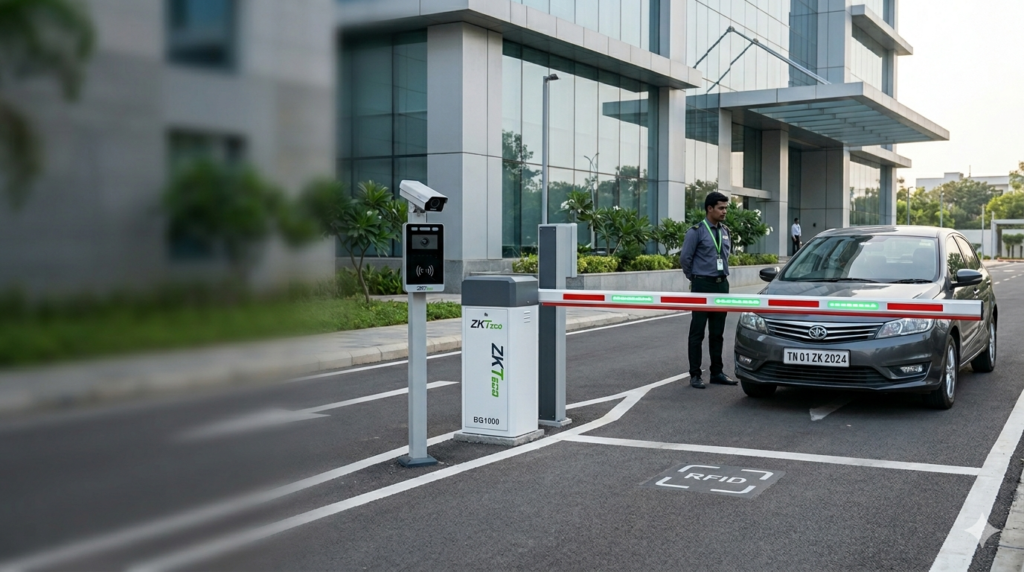
A boom barrier is an automated or manual gate system that uses a long horizontal arm — called the boom — to block or allow vehicle access at a controlled entry or exit point.
The arm pivots at one end, rising from horizontal to vertical to open, and lowering back to horizontal to close. When it is down, no vehicle can pass. When it is up, one vehicle moves through. That is the entire principle.
In one sentence: A boom barrier is a pivoting arm barrier used to control vehicle entry and exit at a secured access point.
The word boom in this context refers to the long horizontal pole or arm — the same word used in sailing for the horizontal spar on a mast, and in construction for the extending arm of a crane. All three share the same root meaning: a long, outstretched horizontal bar.
Boom Barrier Meaning in Hindi
बूम बैरियर एक स्वचालित (automated) वाहन अवरोधक प्रणाली है जिसमें एक लंबी क्षैतिज भुजा (horizontal arm) होती है जो किसी सुरक्षित स्थान के प्रवेश या निकास द्वार पर वाहनों को रोकने या जाने देने का काम करती है।
आसान शब्दों में: बूम बैरियर एक ऐसी मशीन है जो पार्किंग, गेटेड कॉलोनी, टोल प्लाज़ा, या किसी भी सुरक्षित परिसर के गेट पर लगाई जाती है — और जब तक अधिकृत नहीं होता, वाहन को अंदर नहीं जाने देती।
Other names used in India:
- Boom gate
- Boom arm barrier
- Parking barrier
- Vehicle barrier
- Road barrier
- Barrier gate
- Automatic gate barrier
All of these refer to the same fundamental device.
What Is a Boom Barrier System — All the Parts Explained
When someone refers to a boom barrier system, they mean the complete assembly — not just the arm itself. Here is what a full system consists of:
The Boom Arm
The horizontal bar that physically blocks the road. Made from aluminium (lightweight and corrosion-resistant) or fibreglass (flexible and suitable for longer spans). Standard lengths range from 1 metre to 9 metres depending on the width of the lane.
The Housing Box / Cabinet
The solid ground-mounted enclosure that contains all the mechanical and electronic components. This is the box you see beside the road with the arm attached to it. Usually made from galvanised steel or powder-coated iron for weather resistance.
The Motor
Inside the housing box, an electric motor drives the mechanism that lifts and lowers the arm. Motor quality determines the speed, duty cycle (how many times it can operate per day), and overall lifespan of the barrier.
The Control Panel / PCB
The brain of the system. It receives input signals from authentication devices (RFID readers, push buttons, remote controls, sensors) and sends commands to the motor to open or close the barrier.
Safety Sensors
Infrared sensors placed on either side of the barrier detect if a vehicle or person is in the path of the lowering arm. If anything is detected, the arm stops or reverses to prevent accidents. This is a critical safety component.
Counterbalance Mechanism
A spring or weight system that offsets the weight of the boom arm, reducing the load on the motor and extending the motor’s service life significantly.
Limit Switches
Electronic or mechanical switches that tell the controller when the arm has reached its fully open or fully closed position, so the motor stops at the right moment.
Manual Release Key
Every barrier has a mechanical key override that allows the arm to be operated manually during a power cut or system failure.
LED Arm Lighting (optional)
Many modern barriers include LED strips along the length of the boom arm for high visibility — useful in low-light conditions, basement parking areas, and night operations.
How Does a Boom Barrier Work — Step by Step
The mechanism is simple, but the engineering behind it is precise. Here is exactly what happens from the moment a vehicle approaches to the moment it passes through:
Step 1 — Detection
A ground loop sensor or infrared beam detects that a vehicle has arrived at the barrier. This signals the controller that access is being requested.
Step 2 — Authentication
Depending on the system, the driver authenticates using one of several methods — an RFID card tap, a number plate read by an ANPR camera, a QR code scan, a boom controller remote, a ticket dispenser, or a security guard pressing a button. In fully automated systems, this happens in under a second.
Step 3 — Controller Signal
The control panel receives the authentication approval and sends an electrical signal to the motor.
Step 4 — Arm Rises
The motor activates and drives the gear mechanism, lifting the boom arm from horizontal to 90 degrees vertical. Depending on the model, this takes between 1 and 6 seconds.
Step 5 — Vehicle Passes
The arm holds in the open position while the vehicle passes through. The safety sensor continuously monitors the passage zone and will not allow the arm to close until the vehicle has fully cleared.
Step 6 — Arm Lowers
Once the vehicle has passed and the detection zone is clear, the arm automatically lowers back to the horizontal closed position. The system resets and is ready for the next vehicle.
The entire cycle — from detection to arm-closed — takes between 3 and 8 seconds on a standard barrier, and under 2 seconds on high-speed models used at toll plazas and busy commercial complexes.
Boom Barrier vs Gate — What Is the Difference?
This is one of the most commonly asked questions when people first encounter the term.
A gate is a physical barrier that closes an entire opening — it can be swung, slid, or rolled, and it typically blocks pedestrians and vehicles alike. Gates are used for security perimeters, boundary walls, and full entry closures.
A boom barrier is a lane-level vehicle control device. It does not close an entire opening. It sits within a lane and controls vehicle flow one at a time, leaving the surrounding area open. It does not prevent a person on foot from walking around it.
This distinction matters for choosing the right product:
| Use Case | Right Choice |
|---|---|
| Prevent all access to a property boundary | Gate (sliding or swing) |
| Control vehicle flow in a parking lane | Boom barrier |
| Control pedestrian access at a reception | Flap barrier / turnstile |
| Mixed vehicle + pedestrian access with counting | Boom barrier + separate turnstile |
| High-security perimeter with anti-ram requirement | Crash-rated bollards or spike barriers |
Types of Boom Barriers — and What Each One Means
The term boom barrier covers several distinct product types. Understanding them is important before purchasing.
Standard Boom Barrier
The most common type across India. Arm length 3 to 6 metres. Cycle time 3 to 6 seconds. Suitable for offices, apartment complexes, hospitals, schools and standard parking facilities. Most affordable option with the widest range of brands available.
High-Speed Boom Barrier
Opens in under 1.5 seconds. Designed for toll plazas, large factories and high-throughput commercial complexes where vehicles queue up and slow barriers create congestion. Built for heavy duty cycles — some models handle over 5,000 operations per day.
Folding / Flap Boom Barrier
The arm folds in the middle when rising, requiring less vertical clearance. Used in basement parking areas, multi-storey car parks and any location with low overhead obstructions like beams, pipes or low ceilings.
Long Arm Boom Barrier
Covers lanes from 4 to 9 metres wide. Used at factory gates, highway toll booths and wide commercial entrances where the standard 3–6 metre arm is not enough.
Solar / Wireless Boom Barrier
Powered by solar panels and controlled wirelessly. Used at remote locations without reliable power — construction sites, rural facilities and temporary event access points.
Crash-Rated / Heavy-Duty Barrier
Rated to physically stop a vehicle attempting to ram through. Used at military installations, embassies, data centres and government buildings where physical security is paramount.
Boom Gate Meaning — Is It the Same as Boom Barrier?
Yes, completely. A boom gate and a boom barrier are exactly the same device. The word gate is used more commonly in Australian and British English, while barrier is the preferred term in Indian, South Asian and international security industry contexts.
Both terms appear in tender documents, product catalogues and GSC government specifications in India. If you see either term in a building project document or a security system requirement, they refer to the same product.
Where Are Boom Barriers Used in India?
Boom barriers are among the most widely installed security products in the country. Here are the most common applications:
Apartment Complexes and Gated Communities
Resident RFID tags or stickers allow registered vehicles in without stopping. Visitors use an intercom or guard-operated button. The barrier logs every entry and exit automatically.
Commercial Parking Lots
Paired with ticket dispensers on entry and payment kiosks on exit, boom barriers form the backbone of paid parking systems in malls, hospitals, hotels and commercial complexes.
Corporate Office Campuses
Integrated with employee ID systems, visitor management software and CCTV to create a fully logged and audited vehicle access record for every working day.
Factories and Industrial Plants
Control truck entry and exit at goods loading areas, often integrated with weighbridge systems and delivery management software.
Toll Plazas
High-speed barriers integrated with FASTag RFID readers for fully automated toll collection on national and state highways.
Hospitals and Educational Institutions
Manage parking for staff and visitors, restrict after-hours access and provide clear ambulance and emergency vehicle priority lanes.
Petrol Pumps and Drive-Throughs
Control vehicle flow and queue management at high-volume fuel stations and drive-through outlets.
Boom Barrier Price in India — What to Expect in 2026
Prices vary based on arm length, speed, duty cycle and brand. Here is a general market reference:
| Type | Approximate Price (INR) |
|---|---|
| Standard boom barrier (3–4m arm) | ₹18,000 – ₹40,000 |
| Mid-range barrier (5–6m arm) | ₹35,000 – ₹65,000 |
| High-speed / full duty cycle | ₹55,000 – ₹1,20,000 |
| Folding / flap arm barrier | ₹40,000 – ₹75,000 |
| Heavy-duty / crash-rated | ₹1,50,000 – ₹4,00,000+ |
| Annual Maintenance Contract (AMC) | ₹6,000 – ₹18,000 per unit/year |
Prices above exclude GST, installation charges, wiring, civil work and integration hardware. Always request a written site-specific quotation from your dealer before comparing.
Boom Barrier Meaning in a Security System Context
In the broader context of building security and access control, a boom barrier is classified as a physical access control device — specifically a vehicle access control terminal. It sits at the outermost layer of a layered security system, alongside other perimeter control devices.
In a complete security system, a boom barrier typically works alongside:
RFID Readers — Read cards or stickers on authorised vehicles and trigger the barrier automatically.
ANPR / LPR Cameras — Read number plates and match them against an authorised vehicle database. The barrier opens without any action from the driver.
Biometric Systems — In some deployments, the vehicle driver must authenticate biometrically at the barrier terminal before the arm opens.
Parking Management Software — Tracks all vehicle entries and exits, calculates fees, generates reports and sends alerts for unauthorised vehicles or suspicious patterns.
CCTV Cameras — Every barrier event is timestamped and tied to camera footage for a complete, tamper-proof audit trail.
Visitor Management Systems — Pre-registered visitor vehicles are added to the authorised list; the barrier opens automatically on arrival.
The boom barrier is the physical enforcement point of the entire system. Every other component — the software, the camera, the RFID reader — communicates with it to trigger the one action it exists to perform: opening or closing that arm.
The word boom refers to the long horizontal arm itself — the pivoting bar that extends across the lane. It comes from the same root as the boom of a ship’s sail or the boom arm of a crane — all referring to a long, outstretched horizontal extension.
Conclusion — What Boom Barrier Means and Why It Matters for Your Business
A boom barrier is one of the simplest and most effective tools in the security professional’s toolkit. It does one thing — controls whether a vehicle can enter or exit a defined point — and it does it reliably, automatically and around the clock.
Understanding what a boom barrier means goes beyond the definition. It is about knowing that behind that rising and falling arm is a complete system of authentication, detection, control and integration — working every time a vehicle approaches your gate, every hour of every day.
Whether you are managing an apartment complex in Vijayawada, a corporate campus in Guntur, a hospital in Amaravati or a factory in the Krishna district, the right boom barrier system — properly specified, properly installed and properly maintained — transforms your vehicle access from a manual, inconsistent process into an automated, audited and secure one.
Looking to Install a Boom Barrier in Vijayawada or Andhra Pradesh?
Raise Solutions is Vijayawada’s authorised dealer for ZKTeco and Matrix boom barrier systems — supplying, installing and maintaining barriers across offices, apartments, hospitals, schools and factories throughout AP.
📞 +91 85229 59096
📧 info@raisesolutions.in
🌐 www.raisesolutions.in
📍 Poranki, Vijayawada, Andhra Pradesh
Free site survey. Transparent fixed pricing. Local AMC team.