
Managing vehicle entry and exit in a busy housing society is no small task. With dozens — sometimes hundreds — of residents, daily visitors, delivery vehicles, and service staff coming and going, the main gate can quickly become a security and traffic nightmare without the right system in place.
That’s exactly why more and more residential complexes across India are switching to automatic boom barriers.
In this complete buyer’s guide, we’ll walk you through everything you need to know before installing a boom barrier in your housing society — from choosing the right type to understanding costs, features, and what to look for in a vendor.
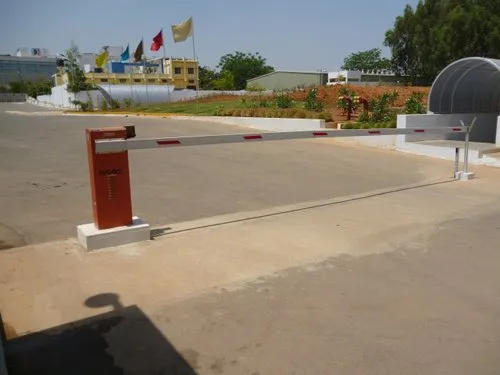
What Is a Boom Barrier and Why Do Housing Societies Need One?
A boom barrier (also called a boom gate or parking barrier) is an automated pole or arm that blocks vehicle entry until access is granted. It rises and falls automatically based on a signal — from a remote, RFID card, vehicle number plate recognition, or a security guard’s command.
For a housing society, a boom barrier does three important things:
- Controls who enters and exits — Only authorized vehicles (residents, registered visitors) can pass through
- Reduces the security guard’s workload — Instead of manually checking every vehicle, the guard can focus on exceptions
- Creates a professional, organized entry point — A well-managed gate also boosts property value and resident trust
Without a boom barrier, most societies rely entirely on a security guard to stop and verify every vehicle — which is slow, inconsistent, and prone to errors during peak hours (morning office rush, evening return, weekends).
Types of Boom Barriers Suitable for Housing Societies
Not all boom barriers are the same. Here’s a breakdown of the main types and which situation each suits best:
1. Standard Automatic Boom Barrier
The most common choice for residential societies. The arm length typically ranges from 3 to 6 metres, covering a single lane. It opens and closes within 2–4 seconds.
Best for: Small to medium housing societies with a single entry/exit lane.
2. Long-Arm Boom Barrier (Up to 9 Metres)
For wider entry points or dual-lane gates, long-arm barriers cover more ground in a single unit.
Best for: Gated communities with wide main gates or separate entry and exit lanes.
3. High-Speed Boom Barrier
Operates in under 1.5 seconds per cycle. Built for high-traffic locations where vehicles queue up quickly.
Best for: Large apartment complexes with 200+ flats, where morning and evening rush hours are intense.
4. RFID-Integrated Boom Barrier
This type connects directly to an RFID reader. Residents carry an RFID tag in their vehicle; the barrier lifts automatically when the tag is detected — no button press or guard command required.
Best for: Societies that want fully automated, touchless entry for registered vehicles.
5. ANPR (Automatic Number Plate Recognition) Boom Barrier
Uses a camera + AI software to read vehicle number plates. If the plate is in the system, the barrier opens automatically.
Best for: Premium gated communities wanting the most seamless and modern entry experience.
Key Features to Look for Before Buying
When shortlisting a boom barrier for your housing society, don’t just look at the price. These features make a significant difference in day-to-day reliability:
✅ Arm Length
Measure your entry lane width before anything else. Standard lanes are 3–4 metres wide. For wider gates, you’ll need a longer arm or consider installing two barriers.
✅ Opening Speed
For societies with heavy morning and evening traffic, a barrier that takes 4–6 seconds to open and close will create a vehicle queue. Look for barriers with a 2–3 second cycle time at minimum.
✅ Safety Sensors (Anti-Crush Feature)
A good boom barrier must have an infrared sensor or safety loop at the base. If a vehicle is still under the arm when it begins to close, the sensor detects it and reverses the arm. This is non-negotiable for a residential setting where children and pedestrians may be nearby.
✅ Manual Override
In case of a power outage, the barrier should have a manual release key so the arm can be moved manually. This prevents residents from being stuck at the gate during power cuts.
✅ UPS / Battery Backup
Many barriers can be connected to a UPS (Uninterruptible Power Supply) so they keep functioning during power failures. Essential for societies in areas with frequent power cuts.
✅ Integration with Intercom / Visitor Management
Modern housing societies use visitor management apps (like MyGate, Apartmentadda, or similar). A boom barrier that integrates with these systems allows guards to approve visitor vehicles digitally, and the barrier lifts automatically — no walkie-talkies or phone calls needed.
✅ Weatherproofing (IP Rating)
If the barrier is installed outdoors (which it almost always is), it needs to withstand rain, dust, and heat. Look for a motor unit with at least an IP54 rating for basic weather protection.
✅ Duty Cycle
The duty cycle tells you what percentage of time the barrier can operate continuously. A 40% duty cycle means the barrier can run for 40% of any given hour before it needs a rest period. For a busy society gate, look for 80–100% duty cycle barriers.
Boom Barrier Price for Housing Societies
Boom barrier pricing in India depends on arm length, speed, brand, and included features. Here’s a general price range for 2026:
| Type | Approx. Price Range |
|---|---|
| Basic 3–4m Barrier (manual trigger) | ₹18,000 – ₹30,000 |
| Standard Automatic (with remote) | ₹25,000 – ₹45,000 |
| RFID-Integrated Barrier | ₹40,000 – ₹75,000 |
| High-Speed Barrier (90% duty cycle) | ₹55,000 – ₹90,000 |
| ANPR Barrier System | ₹80,000 – ₹1,50,000+ |
Note: These prices are for the barrier unit only. Installation charges, civil work (foundation/base), wiring, and accessories (RFID readers, loop detectors) are additional. Total installed cost is typically 20–40% higher than the unit price.
For a detailed price breakdown by brand and arm length, read our guide: Boom Barrier Gate Price in India 2026 →
How Many Boom Barriers Does a Housing Society Need?
This depends on your society’s layout and vehicle volume:
- Single entry/exit gate: 1 boom barrier (or 2 if you want separate entry and exit)
- Separate entry and exit gates: Minimum 2 barriers (one per gate)
- Large complex with multiple access points: 1 barrier per lane at each gate
A common setup for a mid-size society (100–300 flats) is:
- Entry gate: 1 boom barrier + RFID reader or intercom integration
- Exit gate: 1 boom barrier (often set to open automatically for outgoing vehicles, or triggered by a loop detector in the road)
RFID vs. Number Plate Recognition — Which Is Better for Societies?
This is one of the most common questions from housing society committees:
RFID (Radio Frequency Identification)
- Residents get an RFID sticker or tag fixed inside their vehicle’s windscreen
- When the vehicle approaches, the reader detects the tag and opens the barrier
- Cost-effective to set up; tags cost ₹200–₹500 per vehicle
- Works in all lighting conditions (day, night, rain)
- Limitation: If a resident forgets or loses their tag, they can’t enter automatically
ANPR (Number Plate Recognition)
- A camera reads the number plate and matches it against a database
- No tags or cards needed — completely touchless
- Works well in good lighting; some systems struggle at night or with dirty plates
- Higher upfront cost but zero per-vehicle cost after setup
- Limitation: Requires a good camera placement and lighting; software needs regular updates
Our recommendation for housing societies: Start with RFID if budget is a concern. Upgrade to ANPR if you have a large complex (300+ flats) and want zero-friction entry for residents.
Installation Process — What to Expect
Installing a boom barrier in a housing society typically takes 1–2 days and involves:
- Site survey — Vendor visits to measure lane width, check power supply availability, and assess civil work needed
- Civil/foundation work — A concrete base is made for the barrier unit (usually half a day)
- Barrier unit installation — Mounting the motor box, fitting the arm, and securing it
- Wiring and power connection — Connecting to mains power and UPS if applicable
- Integration setup — Connecting to RFID readers, loop detectors, or visitor management software
- Testing and handover — Full testing of all functions; guards trained on the system
Always ask the vendor for a 1-year on-site warranty and an AMC (Annual Maintenance Contract) option after the warranty period.
Top Boom Barrier Brands Available in India
Here are some of the well-known brands used in residential projects across India:
- FAAC (Italy) — Premium brand, widely used in upscale gated communities
- BFT (Italy) — Known for reliability and high duty cycles
- Nice (Italy) — Good mid-range option with strong after-sales support
- Came (Italy) — Popular for RFID-integrated systems
- Magnetic AutoControl (Germany) — High-speed barriers ideal for heavy traffic
- Quiko / Beninca — Budget-friendly options suitable for smaller societies
- Elka (Poland) — Cost-effective with decent build quality for Indian conditions
For Indian brands and more budget-oriented options, there are several local manufacturers based in Gujarat and Maharashtra who offer serviceable products at ₹18,000–₹30,000.
Questions to Ask Before Finalising a Vendor
Before you sign a purchase order, get clear answers on these:
- What is the duty cycle of the barrier? (For a busy society gate, minimum 80%)
- Does the barrier have a safety sensor / anti-crush feature?
- What happens during a power cut? Does it have manual release?
- Is installation included in the quote, or charged separately?
- What is the warranty period, and is it on-site or bring-to-service-centre?
- Do you offer AMC? What does it cover and cost per year?
- Can this integrate with our existing visitor management / intercom system?
- What is the response time if the barrier stops working?
A reliable vendor should be able to answer all of these clearly and in writing.
Common Mistakes Housing Societies Make
Learning from others’ mistakes can save your society time, money, and frustration:
❌ Buying on price alone — The cheapest barrier often has a low duty cycle and no safety sensor. It’ll fail within 6–12 months of heavy use.
❌ Not accounting for lane width — A 3m arm for a 4.5m lane means vehicles can still pass around it. Measure first.
❌ No UPS backup — Societies skip this to save ₹5,000–₹8,000, then have the barrier go offline every time the power cuts.
❌ Skipping the AMC — Once the warranty is over, a broken barrier with no maintenance contract means weeks of waiting for a technician and a hefty repair bill.
❌ Installing without a loop detector — Without a loop detector embedded in the road, the exit barrier won’t know when the vehicle has fully cleared, leading to the arm coming down too early.
Final Verdict — Is a Boom Barrier Worth It for Your Society?
Absolutely — if your society has more than 50 families or experiences vehicle congestion at the gate, a boom barrier pays for itself quickly.
The right barrier cuts security lapses, reduces the guard’s physical burden, speeds up vehicle flow, and gives residents a sense of order and safety.
Start with a basic automatic barrier with RFID integration. As your society grows or if you’re upgrading an existing system, move to ANPR for a completely hands-free experience.
Need help choosing the right boom barrier for your housing society? Contact Raise Solutions — we supply and install boom barriers across Vijayawada, Hyderabad, and major cities in Andhra Pradesh and Telangana.
Also Read: