
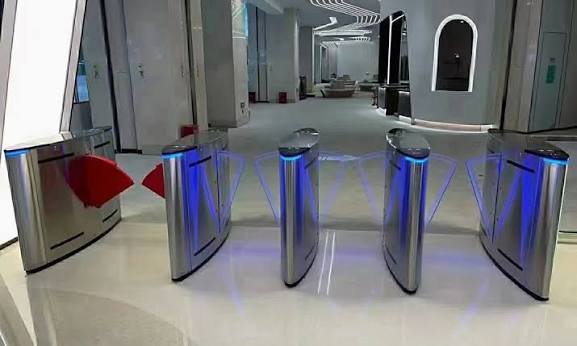
Walk into any modern corporate office, tech park, or co-working space in India today, and you’ll almost certainly see a row of sleek, automated entry gates at the reception or lobby — these are flap barriers.
They’ve replaced the old model of a receptionist manually checking ID cards or a security guard stopping every visitor at the door. Instead, employees tap their access card or scan their face, and the flap panels swing open automatically in under a second.
If your office is planning to upgrade its entry system — or you’re setting one up from scratch — this guide covers everything you need to know before buying a flap barrier.
What Is a Flap Barrier and How Does It Work?
A flap barrier (also called a swing barrier or paddle barrier) is an automated pedestrian access control gate. It consists of a waist-height cabinet with one or two retractable flap panels (paddles) that open and close to control who enters or exits.
Here’s how it works in a typical office setup:
- Employee approaches the gate
- Taps their RFID card, enters a PIN, or scans their face/fingerprint at the reader
- The system verifies the identity against the access control database
- If authorized, the flap panels retract (open) within 0.3–0.5 seconds
- The employee walks through; the panels close automatically behind them
- Unauthorized attempts trigger an alarm and keep the panels closed
The entire process takes less than 2 seconds — fast enough to handle hundreds of employees during morning rush without creating a queue.
Why Offices Are Switching to Flap Barriers
The traditional office entry model — a guard checking ID cards at the door — has several problems:
- Inconsistent — Different guards apply different levels of strictness
- Slow — Manual checks create queues during peak hours (9 AM, lunch, 6 PM)
- No audit trail — You can’t easily pull records of who entered at what time
- Tailgating — One card swipe, two people walking in
Flap barriers solve all of these at once. Here’s why they’ve become the standard for professional offices:
✅ Controlled access — Only employees (and registered visitors) can enter ✅ Anti-tailgating — Sensors detect if a second person tries to follow through on one scan ✅ Attendance integration — Entry/exit data feeds directly into HR/attendance software ✅ Visitor management — Temporary access cards or QR codes for guests ✅ Professional appearance — A clean, modern lobby impression for clients and new hires ✅ 24/7 operation — Works without a guard present during off-hours
Types of Flap Barriers Suitable for Offices
1. Single-Lane Flap Barrier
One lane, one set of flap panels. Best for small offices with up to 50 employees.
Typical use: Startup offices, clinics, small retail offices
2. Bi-Directional Flap Barrier
Handles both entry and exit from the same unit. The panels open in both directions based on the card swipe direction.
Typical use: Any office where the same gate is used for entry and exit
3. Wide-Lane Flap Barrier (ADA/Wheelchair Accessible)
Has a wider opening (700mm–900mm instead of the standard 550mm) to accommodate wheelchairs, pushchairs, or large bags.
Typical use: Offices with accessibility requirements, hospitals, government offices
4. Full-Height Flap Barrier
Panels extend from floor to ceiling height (~180–200cm). Maximum security — virtually impossible to jump over or tailgate.
Typical use: Data centres, R&D labs, high-security office floors, defence establishments
5. Glass Flap Barrier (Premium)
Same mechanism as standard, but the flap panels are made of tempered glass instead of acrylic or stainless steel. Gives a high-end, transparent look.
Typical use: Corporate headquarters, luxury co-working spaces, bank branches
Key Features to Look for in an Office Flap Barrier
✅ Opening Speed
For an office with 100+ employees clocking in between 9:00–9:30 AM, speed matters. Look for flap barriers with an opening time of 0.3–0.5 seconds per cycle. Slower gates (1+ second) create visible queues.
✅ Anti-Tailgating Sensor
This is non-negotiable for any office with sensitive data or assets. An infrared or 3D sensor detects if more than one person is passing through on a single authentication. If tailgating is detected, an alarm sounds and the entry is logged as a security event.
✅ Access Control Integration
The barrier should integrate with the access control system you’re using — or plan to use. Common integrations:
- RFID / smart card readers (most common in Indian offices)
- Fingerprint scanner
- Face recognition camera
- QR code scanner (for visitor management)
- Mobile Bluetooth / NFC (app-based entry, increasingly common)
Make sure the barrier you buy supports the reader type you want to use.
✅ Fail-Safe / Fail-Secure Mode
What happens when the power goes out?
- Fail-safe mode: Panels open automatically during power failure (good for fire safety, people can exit freely)
- Fail-secure mode: Panels stay closed during power failure (used in high-security floors where unauthorized exit is also a risk)
Most offices choose fail-safe for the main entry. Decide this based on your security policy.
✅ Fire Alarm Integration
In case of a fire alarm, the barriers should automatically open all lanes to allow fast evacuation. This is a safety requirement in many commercial buildings and should be confirmed with the vendor.
✅ Lane Width
Standard flap barrier lane width is 550mm. If your office has employees who regularly carry large bags, equipment, or there are accessibility needs, opt for a wider lane (700mm–900mm) for at least one lane.
✅ Cabinet Material and Finish
Office lobbies are visible spaces. The barrier cabinet finish matters for aesthetics:
- Brushed stainless steel — Professional, easy to clean, most popular in Indian offices
- Powder-coated — More budget-friendly, available in custom colours
- Glass + steel — Premium look for corporate headquarters
✅ Throughput Capacity
Throughput is measured in persons per minute (PPM). A standard flap barrier handles 25–40 PPM per lane. For an office with 500+ employees, plan your number of lanes accordingly.
✅ Bidirectional LED Indicators
The barrier should have clear LED indicators on top — green arrow for open/entry allowed, red X for closed/access denied. This guides employees without confusion during peak hours.
How Many Flap Barrier Lanes Does Your Office Need?
A general rule of thumb:
| Number of Employees | Minimum Lanes Recommended |
|---|---|
| Up to 50 | 1 lane |
| 50–150 | 2 lanes |
| 150–300 | 3–4 lanes |
| 300–500 | 4–6 lanes |
| 500+ | 6+ lanes (calculate based on peak PPM) |
Also consider:
- Add 1 wide-lane (wheelchair accessible) regardless of total employee count
- If you have a high visitor volume, dedicate 1 lane for visitors with temporary card access
- For large tech parks or BPOs with shift changes, calculate peak throughput (all employees arriving/leaving within 15 minutes) and size lanes accordingly
Flap Barrier Price for Offices in India (2026)
Flap barrier pricing varies based on lane width, material, speed, and integrated reader type:
| Type | Price Range (Per Lane Unit) |
|---|---|
| Basic Flap Barrier (no reader) | ₹35,000 – ₹55,000 |
| Standard with RFID Reader | ₹50,000 – ₹80,000 |
| Glass Flap Barrier | ₹75,000 – ₹1,20,000 |
| Wide-Lane (Accessible) | ₹65,000 – ₹1,00,000 |
| Full-Height Security Barrier | ₹90,000 – ₹1,80,000 |
| With Face Recognition | ₹1,00,000 – ₹2,00,000+ |
Note: These are unit prices. Installation, civil/flooring work, wiring, access control software, and server setup are additional costs. Budget approximately 25–35% on top of unit cost for a complete installed system.
For a 3-lane installation in a mid-size office, expect a total installed cost of ₹2.5 lakh – ₹5 lakh depending on technology choice.
For a detailed price breakdown by brand, read: Flap Barrier Price in India 2026 →
RFID vs Face Recognition — Which Should Your Office Use?
RFID Smart Card
- Employees carry a card or key fob
- Fast, reliable, works in all conditions
- Card cost: ₹80–₹300 per employee
- Risk: Cards can be lost, shared, or forgotten
- Best for: Most offices, practical and cost-effective
Face Recognition
- Completely contactless — no card needed
- Eliminates buddy punching (someone clocking in for an absent colleague)
- More expensive upfront (camera + server + software)
- May slow down slightly in poor lighting or with face masks
- Best for: Offices with strict attendance accountability, high employee count
Mobile / App-Based (Bluetooth/NFC)
- Entry via employee’s smartphone
- No physical card needed
- Requires app setup and smartphone policy
- Best for: Tech companies, startups, modern co-working spaces
Our recommendation: Start with RFID if you want a proven, budget-friendly system. Add face recognition for high-security areas or if buddy punching is a concern.
Attendance System Integration — A Key Benefit for HR
One of the biggest advantages of flap barriers for offices is automatic attendance capture.
Every entry and exit is timestamped and logged. This data can integrate directly with:
- HR software (Zoho People, Darwin Box, GreytHR, etc.)
- Payroll systems — late arrivals and early exits calculated automatically
- Overtime tracking — employees who stay beyond shift hours are recorded
- Compliance reports — useful for labour law documentation
Make sure the barrier + access control system you buy offers an API or software export compatible with your HR platform. Ask for this specifically during vendor evaluation
Installation Process — What to Expect
Installing a flap barrier system in an office typically takes 2–4 days depending on the number of lanes:
Day 1 — Civil Work
- Marking and cutting the floor for cable routing
- Anchor bolt installation for barrier cabinets
Day 2 — Hardware Installation
- Barrier cabinets bolted to floor
- Reader units mounted on cabinets
- Wiring routed to access control panel/server
Day 3 — Software & Integration
- Access control software installed on server/PC
- Employee cards enrolled (RFID programmed or faces registered)
- Integration with attendance/HR software tested
Day 4 — Testing & Handover
- Full system testing with all employees
- Security team and HR trained on the software
- Vendor hands over admin credentials and documentation
Always ask for a minimum 1-year on-site warranty and confirm the vendor has a local service team in your city.
Top Flap Barrier Brands for Offices in India
These are brands commonly installed in Indian corporate offices:
- Gunnebo (Sweden) — Premium brand, widely used in IT parks and corporate campuses
- Magnetic AutoControl (Germany) — High-speed, high-throughput; ideal for large employee counts
- Boon Edam (Netherlands) — Known for glass barriers and premium aesthetics
- Hikvision (China) — Popular mid-range option with integrated face recognition
- ZKTeco (China) — Budget-friendly with good access control software
- IDEMIA — Enterprise-grade with biometric integration
- Suprema (South Korea) — Strong on biometric readers and software
For Indian brands and local suppliers with better after-sales support in Tier 2 cities, there are several manufacturers in Gujarat and Maharashtra who offer reliable systems at competitive prices.
For a full supplier list, read: Top 10 Flap Barrier Manufacturers and Suppliers in India →
Questions to Ask Before Finalising a Vendor
Before signing a purchase order, get clear answers in writing on these:
- What is the throughput (persons per minute) per lane?
- Does the barrier support anti-tailgating? How does it alert security?
- What access control software is included? Is it one-time or subscription?
- Does it integrate with our HR/payroll software?
- What happens during a fire alarm — do all lanes open automatically?
- What is the fail-safe/fail-secure mode? Can we configure it?
- Is installation included in the quote?
- What is the warranty period and is it on-site?
- Do you have a local service team in our city? What is the response time?
- What is the AMC cost after warranty expires?
A vendor who cannot answer these clearly is not worth the risk on a system that controls your office’s daily security.
Common Mistakes Offices Make When Buying Flap Barriers
❌ Buying only for looks — A glass barrier that looks stunning but has slow throughput will frustrate employees every morning
❌ Skipping the software evaluation — The hardware is only as good as the software managing it; always demo the software before buying
❌ Not planning for visitor flow — Visitors need a separate lane or a dedicated process; don’t make them queue behind employees
❌ No maintenance contract — A stuck flap barrier at 9 AM is a nightmare; AMC ensures quick response
❌ Underestimating lane count — Calculate peak throughput before deciding; adding a lane later means civil work and downtime
❌ No fire alarm integration — A legal and safety requirement in most commercial buildings; always confirm this
Final Verdict — Is a Flap Barrier Worth It for Your Office?
Yes — for any office with more than 30 employees, a flap barrier system pays for itself within the first year through:
- Reduced security guard dependency
- Accurate attendance (eliminating buddy punching saves real payroll money)
- Improved security and access audit trail
- Professional first impression for clients and recruits
Start with a 2-lane RFID system for a mid-size office and scale up as your team grows.
Need help choosing the right flap barrier for your office? Contact Raise Solutions — we supply, install, and maintain flap barrier systems across Vijayawada, Hyderabad, and major cities in Andhra Pradesh and Telangana.
Also Read:
- What Is a Flap Barrier? How It Works & Types →
- Flap Barrier Price in India 2026 — Complete Buyer’s Guide →
- Top 10 Flap Barrier Manufacturers and Suppliers in India →
Published by Raise Solutions | Security Systems & Access Control Experts