
If you have a sliding gate at your home, apartment complex, factory, or office — and you’re tired of opening and closing it manually — a sliding gate motor is what you need.
A sliding gate motor automates your existing gate. You press a button, and the gate slides open. You press it again, it closes. No getting out of the car. No waiting for a guard to push the gate. No physical effort.
This guide covers everything: what a sliding gate motor is, how it works, the different types available in India, what they cost, and how installation works.
What Is a Sliding Gate Motor?
A sliding gate motor is an electric drive unit that moves a sliding gate along its track automatically. It replaces the manual effort of pushing or pulling the gate by driving it with a motor connected to a rack (a toothed strip) mounted along the bottom of the gate.
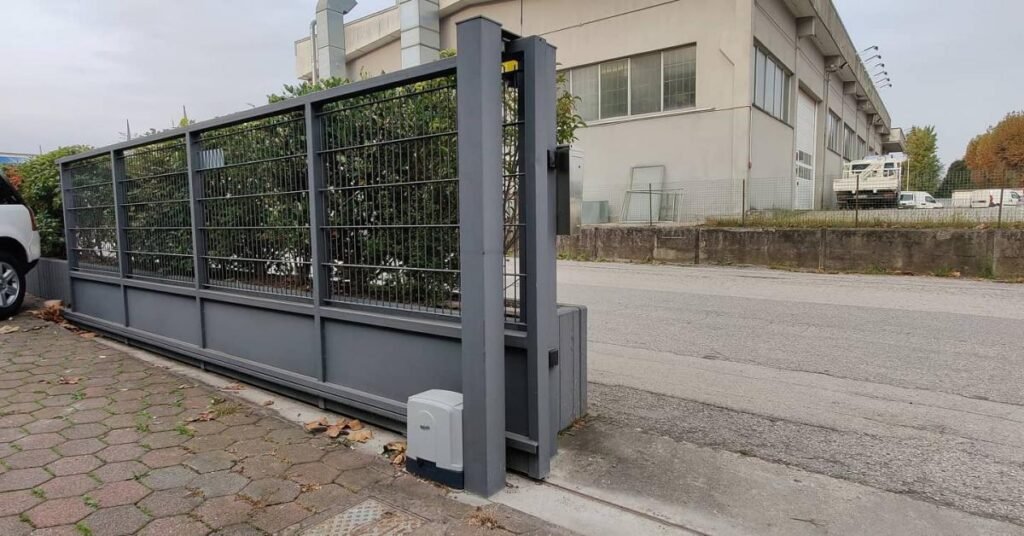
The motor sits beside the gate on a concrete pad or mounting plate. When triggered — by a remote control, RFID card, keypad, intercom, or access controller — it engages the rack and pushes or pulls the gate open or closed.
Key components of a sliding gate motor system:
- The motor unit (drive)
- Gear rack (mounted on the gate)
- Control board (manages open/close logic, timers, safety stops)
- Remote control receivers
- Safety photocell sensors (stops the gate if something is in the way)
- Limit switches (tells the motor when the gate is fully open or closed)
- Manual release key (for power cuts)
How Does a Sliding Gate Motor Work?
- You press the remote control (or tap an RFID card, or the guard presses a button)
- The control board receives the signal and activates the motor
- The motor drives a pinion gear that meshes with the rack on the gate
- The gate slides along its track — opening or closing
- When the gate reaches the fully open or fully closed position, the limit switch cuts power to the motor
- The photocell sensors monitor the path throughout — if a vehicle or person is in the way, the gate stops and reverses
The entire process takes 8–15 seconds for a standard 4-metre gate.
Types of Sliding Gate Motors
1. AC Sliding Gate Motor
Runs on standard 230V AC mains power. Most common type for residential and commercial use in India.
Best for: Permanent installations with reliable mains power supply — apartments, offices, factories, gated communities.
Pros: Powerful, reliable, long-lasting, wide spare parts availability.
Cons: Doesn’t work during power cuts unless a UPS is added.
Price range: ₹12,000 – ₹35,000 (motor unit only
2. DC Sliding Gate Motor (with Battery Backup)
Runs on DC power from a battery that is continuously charged by mains power. During a power cut, the battery keeps the motor running for several cycles.
Best for: Areas with frequent power cuts — semi-urban locations, industrial areas, places with unreliable grid supply.
Pros: Works during power cuts, softer start and stop (less mechanical stress on gate), energy efficient.
Cons: Battery needs replacement every 3–5 years. Slightly higher upfront cost.
Price range: ₹18,000 – ₹45,000 (motor unit only
3. Solar-Powered Sliding Gate Motor
Uses a solar panel to charge a battery that runs the motor. No mains connection required.
Best for: Farm gates, rural properties, warehouse perimeters, locations without easy access to mains power.
Pros: Zero electricity cost after installation, works in remote locations.
Cons: Requires sunlight — may underperform during extended cloudy periods if battery runs low. Higher upfront cost.
Price range: ₹25,000 – ₹70,000 (solar panel + motor + battery package
4. Underground Sliding Gate Motor
The motor is installed below ground level — hidden inside a chamber under the gate pillar. No visible motor unit above ground.
Best for: Premium villas, bungalows, luxury residences where aesthetics matter and the motor unit should not be visible.
Pros: Clean, invisible installation. No motor box on the surface.
Cons: More expensive, harder to service, requires waterproofing of the underground chamber.
Price range: ₹35,000 – ₹90,000 installe
5. High-Speed Industrial Sliding Gate Motor
Heavy-duty motors rated for very high cycle counts (1,000+ cycles per day) and heavy gates (up to 2,000 kg). Built for continuous industrial use.
Best for: Factories, warehouses, logistics hubs, industrial plants with heavy vehicle traffic.
Pros: Built for punishment — high duty cycle, robust mechanical components, industrial-grade control boards.
Cons: Overkill (and expensive) for residential or light commercial use.
Price range: ₹40,000 – ₹1,20,000 installe
Sliding Gate Motor — Capacity and Gate Weight
The most important spec when choosing a sliding gate motor is its maximum gate weight capacity. If your gate is heavier than the motor’s rated capacity, the motor will burn out quickly.
| Motor Class | Max Gate Weight | Suitable For |
|---|---|---|
| Light duty | Up to 300 kg | Small residential gates (3–4m) |
| Medium duty | 300–600 kg | Standard residential/commercial gates |
| Heavy duty | 600–1,000 kg | Large commercial gates (5–6m) |
| Industrial | 1,000–2,000 kg+ | Factory and warehouse gates |
How to estimate your gate weight:
A standard MS (mild steel) gate panel weighs approximately 18–22 kg per square metre. A 4-metre wide × 1.8-metre tall gate is about 7.2 square metres — roughly 130–160 kg. A medium-duty motor is sufficient for most such gates.
If your gate has decorative ironwork, MS tubes, or is fabricated from heavier gauge steel, get it weighed before specifying the motor.
Top Sliding Gate Motor Brands in India
FAAC (Italy)
Premium brand, widely used in India. Known for reliability and long service life. FAAC spare parts are available across most Indian cities. Best choice for high-use installations.
BFT (Italy)
Another European brand with strong presence in India. DC motors with battery backup are popular. BFT systems integrate well with access control and intercom systems.
CAME (Italy)
Well-regarded in the premium segment. CAME motors are common in upmarket residential projects.
Nice (Italy)
Popular for light to medium duty residential applications. Good value for the price.
DORMA / Dormakaba (Germany)
Premium brand commonly specified in commercial and institutional projects. Strong after-sales network in India.
Centsys (South Africa)
Growing presence in India. Good value for residential and light commercial use.
Local / OEM brands
A range of Indian-assembled and Chinese-imported motors are available at lower price points (₹6,000–₹15,000). These work for low-use residential gates but have shorter service lives and limited spare parts availability. Fine for a home gate that opens 10–15 times a day; not recommended for commercial use
Sliding Gate Motor Price in India 2026
Motor Unit Only (Without Installation)
| Category | Brand Examples | Price Range |
|---|---|---|
| Budget / OEM | Local brands | ₹6,000 – ₹12,000 |
| Mid-range AC | Nice, Centsys | ₹12,000 – ₹22,000 |
| Premium AC | FAAC, BFT, CAME | ₹22,000 – ₹40,000 |
| DC with battery backup | BFT, FAAC | ₹18,000 – ₹45,000 |
| Solar | Various | ₹25,000 – ₹70,000 |
| Underground | FAAC, CAME | ₹35,000 – ₹80,000 |
| Industrial heavy duty | FAAC, DORMA | ₹40,000 – ₹1,20,000 |
Fully Installed Price (Motor + Rack + Accessories + Labour)
| Gate Size | Installation Type | Total Cost |
|---|---|---|
| 3–4 m residential gate | Basic AC motor | ₹18,000 – ₹30,000 |
| 4–5 m residential/commercial | Mid-range motor | ₹28,000 – ₹50,000 |
| 5–6 m commercial gate | Premium motor | ₹45,000 – ₹80,000 |
| Industrial gate | Heavy-duty motor | ₹70,000 – ₹1,50,000 |
Prices above include the motor, gear rack, photocell sensors, remote controls (typically 2), control board, and standard installation labour. Integration with RFID, intercom, or access control systems is additional.
What Accessories Come With a Sliding Gate Motor?
A complete sliding gate motor installation typically includes:
Standard inclusions:
- Motor unit
- Gear rack (1.5m–6m depending on gate width)
- 2 remote controls
- Photocell safety sensors (pair)
- Control board
- Limit switches
- Manual release key
Optional add-ons:
- Additional remote controls
- Keypad entry (PIN code access)
- RFID card reader (integrate with access control)
- GSM module (open gate via missed call or SMS)
- Video intercom integration
- Loop detector (vehicle detection under road surface)
- UPS / battery backup for AC motors
- Flashing warning light
Installation Process — What to Expect
Step 1: Site Assessment
A technician visits to measure the gate, check the gate’s running condition (track, rollers, balance), assess the power supply point, and confirm the ground is suitable for the motor mounting pad.
Step 2: Gate Preparation
If the gate’s rollers or track are worn, they need replacement before motorizing. A gate that’s hard to push manually will burn out a motor quickly. The gate must run smoothly with minimal effort before a motor is fitted.
Step 3: Rack Installation
The gear rack is welded or bolted to the bottom rail of the gate, running the full length of the gate’s travel.
Step 4: Motor Mounting
A concrete pad is cast or a mounting plate is fixed beside the gate pillar. The motor unit is bolted to this foundation.
Step 5: Wiring
Power cable is run from the nearest MCB/distribution board to the motor’s control box. If accessories (intercom, RFID reader) are being added, their cables are laid at this stage.
Step 6: Programming and Testing
The control board is programmed — open/close limits set, auto-close timer configured if needed, remote controls paired, safety sensors tested.
Step 7: Handover
You receive remote controls, the manual release key, and a briefing on basic operation.
Total time: 1–2 days for a standard residential installation. Larger commercial installations may take 2–3 days.
Things to Check Before Installing a Sliding Gate Motor
1. Gate condition
Is the gate running smoothly on its rollers? Stiff gates burn motors. Fix the gate first.
2. Track and ground guide
The bottom track must be level and clean. The top guide (keeps the gate upright) must be in good condition.
3. Power supply
Is there a power point within reasonable cable distance of the gate? Most motors need a dedicated circuit from the distribution board.
4. Gate weight
Get an estimate of your gate’s weight before specifying the motor. Undersizing is a common mistake.
5. Usage frequency
How many times per day will the gate open and close? A home gate that opens 15 times a day has very different requirements from an apartment complex gate that opens 200 times a day.
6. After-sales service
Choose a brand whose spare parts and service are available locally. A motor from a brand with no local service network is a problem when something fails 3 years later.
Maintenance Tips for Sliding Gate Motors
- Lubricate the rack and pinion every 3–6 months with gear grease
- Clean the photocell lenses monthly — dust and spider webs cause false triggers
- Check the gate’s roller wheels every 6 months — worn rollers put extra load on the motor
- Test the manual release every few months so you know it works before a power cut
- Annual service by a technician — check all electrical connections, motor brushes (for brushed DC motors), and control board
A well-maintained sliding gate motor lasts 8–12 years.
Why Raise Solutions for Sliding Gate Motor Installation
At Raise Solutions, we supply and install sliding gate motors across Vijayawada, Guntur, Hyderabad, and surrounding areas in Andhra Pradesh and Telangana.
We work with leading brands including FAAC, BFT, CAME, and Nice — and we carry spares for the systems we install. Our technicians assess your gate’s condition, recommend the right motor capacity for your usage pattern, and handle the full installation including civil work, wiring, and access control integration.
We also install boom barriers for vehicle access control and flap barriers for pedestrian entry management — if your property needs a complete access control solution, we can design and install it as one integrated system.
Contact us for a free site assessment and quotation.
In most cases, yes — as long as the gate is in good mechanical condition and runs smoothly on its track. The technician will assess this during the site visit.
All motors have a manual release key that disengages the motor from the rack, letting you push the gate open by hand. DC motors with battery backup continue operating automatically for several cycles during a power cut.
Most systems come with 2 remote controls. Additional remotes can be paired to the system — typically ₹500–₹1,500 per extra remote depending on the brand
A sliding gate motor transforms a manual gate into a convenient, secure, automated entry point. For homes, it’s a daily comfort. For apartments and commercial properties, it’s a security and efficiency necessity.
The right motor depends on your gate’s weight, your usage frequency, your power supply situation, and your budget. Don’t undersize — a motor that’s too small for your gate will fail prematurely. And don’t skimp on the brand if your gate opens more than 30–40 times a day — the savings on a cheap motor disappear quickly when it needs replacing in 2 years.
If you’re in Andhra Pradesh or Telangana and want a professional assessment and installation, Raise Solutions is ready to help.