
Security screening has become a non-negotiable requirement across India — from airports and metro stations to schools, courts, malls, and corporate offices. Every day, thousands of people walk through security checkpoints without realising that two specific devices are doing the heavy lifting: the DFMD and the HHMD.
If you have ever seen a large gate-like frame at a building entrance, that is a DFMD. If you have seen a security guard wave a small wand around a visitor’s body, that is an HHMD. Both detect metal. Both are used for security. But they work differently, serve different purposes, and are suited to different environments.
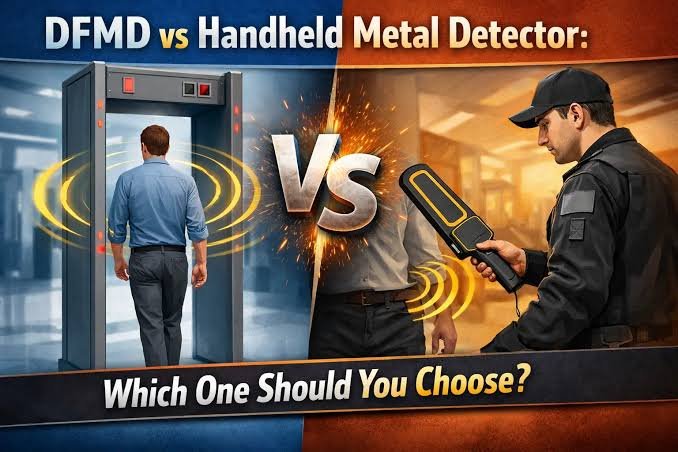
This guide covers everything you need to know — the full form of DFMD and HHMD, how each device works, their technical specifications, a detailed comparison, pricing in India, installation requirements, and how to decide which one is right for your premises.
What Is DFMD? Full Form, Meaning & Working
DFMD Full Form: Door Frame Metal Detector
A Door Frame Metal Detector (DFMD) is a walk-through security screening gate installed at entry points. It detects metallic objects — weapons, knives, guns, or other concealed items — on a person’s body as they walk through the frame, without requiring physical contact or stopping the individual.
The device looks like a rectangular frame or archway, typically around 2 metres tall, installed at the entrance of a building. A person walks through it the same way they walk through a door, and the machine automatically detects and alerts if any metal is found.
How Does a DFMD Work?
A DFMD operates on the principle of pulsed electromagnetic induction or continuous wave technology. Here is the step-by-step process:
- The two side panels of the DFMD constantly emit a low-frequency electromagnetic field between them.
- When a person walks through the gate, their body passes through this electromagnetic field.
- If the person is carrying a metallic object — a weapon, phone, keys, or belt buckle — the object disrupts the electromagnetic field.
- This disruption is detected by sensors within the panels.
- The DFMD triggers an alarm — a beep, a buzzer, or a flashing LED light — to alert the security guard.
- Advanced DFMD models also display the zone where the metal was detected (upper body, waist, lower body) so the guard knows exactly where to check.
DFMD Detection Zones
Basic DFMD models have 1 detection zone — they simply tell you that metal is present somewhere on the person. Advanced models have 6, 18, 33, or even 66 zones, which pinpoint the exact location of the metallic object on the body. High-zone models are used at airports and high-security government buildings.
Key Features of a DFMD
- Walk-through design — no physical contact required
- Multi-zone detection (6 to 66 zones depending on model)
- LED zone indicators showing the location of metal
- Adjustable sensitivity settings
- Side-panel or overhead alarm indicators
- Counts the number of people who pass through and the number of alarms triggered
- Can be networked with access control systems
- Weather-resistant models available for outdoor installation
- Battery backup options available for power outage scenarios
Where Is DFMD Used?
DFMDs are used wherever large numbers of people need to be screened quickly:
- Airports and railway stations — primary screening for all passengers
- Courts and government offices — mandatory installation as per government guidelines
- Malls and multiplexes — entry gate screening
- Schools and colleges — protecting students and staff
- Hospitals — controlling visitor access to sensitive areas
- Banks — entry screening for customers
- Corporate offices and IT parks — protecting employees and assets
- Hotels and resorts — high-security properties
- Places of worship — temples, mosques, and churches with high footfall
- Event venues — concerts, political rallies, sports events
What Is HHMD? Full Form, Meaning & Working
HHMD Full Form: Hand Held Metal Detector
A Hand Held Metal Detector (HHMD) is a compact, portable wand-style device operated by a security guard to manually scan a person’s body or an object for hidden metal. Unlike the DFMD which works passively as people walk through, the HHMD requires an active scan by the guard — they hold the wand and move it slowly around the person’s body.
The HHMD is the device you typically see a security guard using at a cinema hall entry, a bus stand, an event check-in, or as a secondary check when the DFMD alarm goes off.
How Does an HHMD Work?
An HHMD uses the principle of electromagnetic induction. Here is how:
- The HHMD generates a small electromagnetic field from its tip or sensing coil.
- The guard holds the device and slowly moves it over the surface of the person’s body or bag, keeping it 1–2 cm away.
- When the sensing coil comes close to a metallic object, the metal disturbs the field.
- The device responds with an audible beep, a vibration, or both.
- The guard identifies the location of the metal and investigates further.
Because the HHMD is handheld and directional, the guard can precisely locate the object — left pocket, waistband, ankle, or inside a bag.
Key Features of an HHMD
- Lightweight and portable — typically weighs 200–400 grams
- Battery operated (AA batteries or rechargeable)
- Audio alarm (beep) and/or vibration alert
- LED indicator light
- Adjustable sensitivity
- One-handed operation
- Some models have a mute/vibration-only mode for discreet scanning
- Ergonomic grip design for extended use
- Some models include a holster for the guard’s belt
Where Is HHMD Used?
- Secondary screening at airports — after DFMD triggers, HHMD pinpoints the location
- Entry at events — concerts, exhibitions, political events
- Small offices and shops — where DFMD installation is not practical
- Vehicle checkpoints — scanning vehicle interiors and passengers
- Schools with budget constraints — basic security without a full DFMD setup
- Patrolling and spot checks — mobile security teams carry HHMDs
- Prisons and detention centres — inmate screening
- Warehouses and factories — preventing theft of metal components
DFMD vs HHMD — Detailed Comparison
| Feature | DFMD | HHMD |
|---|---|---|
| Full Form | Door Frame Metal Detector | Hand Held Metal Detector |
| Type | Fixed walk-through gate | Portable handheld wand |
| Operation | Automatic — no guard action needed | Manual — guard must actively scan |
| Screening Method | Person walks through the gate | Guard moves wand around person |
| Speed | Very fast — 30–60 persons per minute | Slow — 1–2 minutes per person |
| Physical Contact | Zero contact | Guard brings wand close to body |
| Detection Coverage | Full body simultaneously | One area at a time |
| Zone Detection | 1 to 66 zones (model dependent) | Single point detection |
| Accuracy | High — consistent, unbiased | Depends on guard’s skill and diligence |
| Portability | Fixed installation | Fully portable |
| Power Requirement | 230V AC power connection required | AA batteries or rechargeable battery |
| False Alarm Risk | Moderate (belt buckles, phones can trigger) | Lower — guard can adjust distance |
| Installation Required | Yes — professional installation needed | No — ready to use out of box |
| Maintenance | Regular calibration and AMC required | Minimal — battery replacement |
| Cost | ₹25,000 – ₹2,00,000+ | ₹1,500 – ₹15,000 |
| Best For | High footfall, permanent checkpoints | Secondary checks, temporary setups |
| Ideal Locations | Airports, malls, courts, schools | Events, small offices, vehicle checks |
DFMD vs HHMD — Sensitivity & Detection Capability
One of the most important differences is what each device can realistically detect.
A well-calibrated DFMD with 18+ zones can detect objects as small as a razor blade or a small knife concealed under clothing. High-end airport-grade DFMDs can detect items weighing as little as 2–3 grams of metal.
An HHMD in skilled hands can detect very small metallic objects too, but accuracy depends heavily on the guard’s technique, speed, and attentiveness. A tired or inattentive guard may miss a concealed item.
This is why the standard security protocol in high-risk environments is to use both — the DFMD for primary screening and the HHMD for secondary confirmation when the DFMD alerts.
DFMD and HHMD Price in India 2026
DFMD Price in India
| Model Type | Detection Zones | Price Range |
|---|---|---|
| Basic single-zone DFMD | 1 zone | ₹25,000 – ₹40,000 |
| Mid-range DFMD | 6–18 zones | ₹40,000 – ₹90,000 |
| Advanced DFMD | 18–33 zones | ₹90,000 – ₹1,50,000 |
| Airport-grade DFMD | 33–66 zones | ₹1,50,000 – ₹2,50,000+ |
Prices vary by brand, zone count, alarm type, weather resistance, and whether installation and AMC are included.
HHMD Price in India
| Model Type | Features | Price Range |
|---|---|---|
| Basic HHMD | Audio alarm only | ₹1,500 – ₹3,000 |
| Mid-range HHMD | Audio + vibration + LED | ₹3,000 – ₹7,000 |
| Professional HHMD | High sensitivity, rechargeable | ₹7,000 – ₹15,000 |
Top DFMD and HHMD Brands in India
DFMD Brands
- Garrett — among the most trusted globally, widely used at Indian airports and government offices
- Bosch — premium build quality, used in high-security environments
- IB Group — popular for government tenders and PSU installations
- Godrej Security Solutions — trusted Indian brand with strong service network
- Manta — good mid-range option for schools, malls, and offices
- Smiths Detection — used in defence and high-security government zones
HHMD Brands
- Garrett SuperScanner — industry standard, used in airports worldwide
- Godrej — reliable Indian option
- Zorpro — affordable and widely available
- L3 Technologies — professional grade for high-security use
- Meco — budget-friendly for basic office use
DFMD Installation — What to Know Before Buying
Installing a DFMD is not just placing a gate at the door. Proper installation involves several steps:
Site Assessment:
The installer measures the doorway width (minimum 700mm–900mm required), checks the power supply, and assesses traffic flow to determine the right model.
Mounting:
The two side panels are bolted to the floor and wall or ceiling. The top bar connects the two panels. Some models are freestanding and do not need wall fixings.
Power Connection:
A DFMD requires a stable 230V AC power connection. A UPS or battery backup is strongly recommended to keep the device running during power cuts.
Calibration:
This is the most critical step. The sensitivity must be calibrated for the environment. In an office where everyone carries phones and keys, the sensitivity is set to detect weapons while minimising false alarms from everyday objects. In an airport, sensitivity is set much higher.
Testing:
After installation, the system is tested with sample metallic objects of different sizes to confirm the detection threshold is working correctly.
AMC (Annual Maintenance Contract):
Professional AMC ensures regular recalibration, replacement of worn parts, firmware updates, and emergency service calls.
Which One Should You Choose — DFMD or HHMD?
Choose DFMD if:
- Your premises has high footfall and you cannot afford to slow down entry
- You want automated, contactless screening that does not rely on human diligence
- You are setting up a permanent security checkpoint
- You need to comply with government or insurance requirements for security screening
- You manage a school, mall, office building, hospital, or government facility
Choose HHMD if:
- You are setting up temporary security at an event or pop-up check post
- You need a secondary check tool after DFMD alerts (this is the most common use)
- Your budget is limited and footfall is low
- You need portable, battery-powered screening that guards can carry on patrol
- Your entry point is too narrow or irregular for a DFMD frame
Best Practice — Use Both Together
The most effective and professional security setup uses both devices in combination:
- DFMD at the main entry gate for fast, automatic, contactless screening of everyone
- HHMD in the guard’s hand for precise secondary scanning whenever the DFMD alarm is triggered
This combination is the standard at every major airport, court, government building, and high-security facility in India. The DFMD handles the volume. The HHMD handles the precision.
DFMD and HHMD — Frequently Asked Questions
Yes. A DFMD can detect mobile phones as they contain metallic components. However, in offices and public places, the sensitivity is usually set so that phones alone do not trigger an alarm, to reduce false alarms. The threshold is adjusted based on the security requirement of the location.
Individuals with pacemakers or metal implants should inform the security guard before walking through a DFMD. In such cases, the HHMD is used for manual scanning instead.
A standard DFMD can screen 20–60 persons per minute depending on the flow and the sensitivity setting. High-traffic airport models are designed for even faster throughput
DFMD and HHMD are not competing products — they are complementary security tools that serve different roles in a complete security ecosystem.
A DFMD is your first line of defence — fast, automatic, and consistent. It handles mass screening without slowing down entry.
An HHMD is your precision tool — portable, targeted, and flexible. It confirms what the DFMD flags and fills the gaps where a fixed gate cannot be installed.
For any serious security setup — whether at a school, office, mall, hospital, or event — the answer is not DFMD or HHMD. It is DFMD and HHMD, working together.
If you are looking to install a DFMD, procure HHMDs, or set up a complete security screening system for your premises in Andhra Pradesh or Telangana, Raise Solutions offers supply, installation, calibration, and AMC support.
📞 Call: 8522959096
🌐 raisesolutions.in