
Every school in India faces the same challenge: how do you keep 500 or 1,000 children safe when parents, vendors, visitors, and vehicles are constantly entering and leaving the campus?
The answer isn’t just a security guard at the gate. Modern schools — from CBSE schools in Tier 2 cities to international schools in metros — are now installing safety barriers that control who enters, how fast vehicles move, and where pedestrians can walk.
This guide covers everything: the types of safety barriers available for Indian schools, what they cost, how they’re installed, and how to choose the right one for your campus.
Why Schools in India Need Safety Barriers
School security incidents in India have increased awareness among school management, parents, and state governments. But beyond emergency situations, the everyday risks are just as real:
- Unauthorized vehicle entry during school hours
- Unknown visitors walking in unchecked
- Parents’ vehicles creating chaos at pickup time
- Vendors and delivery vehicles entering without authorization
- Students wandering out during school hours
Safety barriers address all of these — not by replacing security personnel, but by giving them a controlled system to work with.
Many states have also issued school safety guidelines that require physical access control at gates. Schools seeking CBSE affiliation or ISO certification are increasingly expected to demonstrate structured entry and exit management.
Types of Safety Barriers for Schools
1. Boom Barriers (Boom Gates)
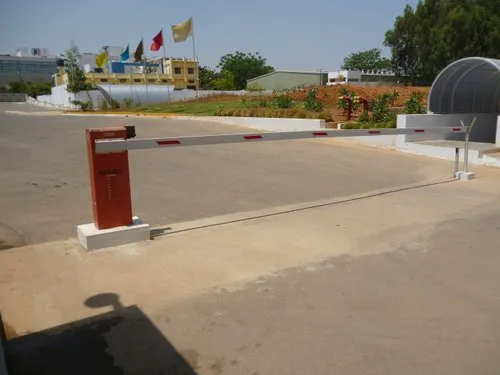
A boom barrier is a horizontal arm that rises and falls to allow or block vehicle entry. It is the most common vehicle access control system installed at school gates in India.
How it works at a school:
A security guard or automated RFID system triggers the boom arm to rise when an authorized vehicle approaches. The arm drops after the vehicle passes, blocking the next vehicle until it is cleared.
Best for:
- Main vehicle entry gates
- Staff parking entrances
- School bus bay entry points
Features schools commonly add:
- RFID cards for staff vehicles
- Remote control for guards
- Automatic boom with sensor (no guard needed)
- Long arm boom (up to 6 metres) for wide school gates
Price range: ₹30,000 – ₹80,000 installed
2. Flap Barriers (Turnstiles)
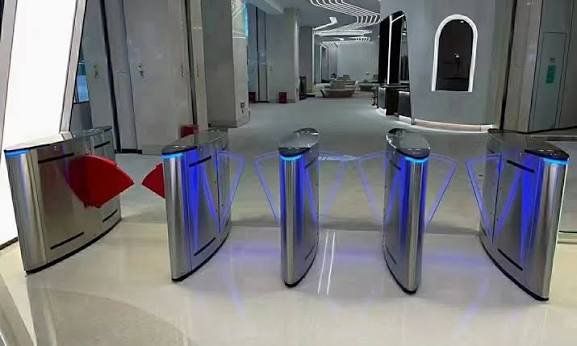
A flap barrier is a pedestrian access control system. It consists of a waist-high unit with swinging flap arms that open only when an authorized person taps an RFID card, uses biometric verification, or scans a QR code.
How it works at a school:
Students, teachers, and staff tap their ID cards or use facial recognition at the flap barrier unit. The flaps open, they walk through, and the flaps close behind them. Visitors must check in at reception and receive a visitor pass before being allowed through.
Best for:
- Main pedestrian entrance
- Canteen access control
- Library entry
- Hostel entry points
Why schools prefer flap barriers:
Unlike a boom barrier, a flap barrier controls individual people — not just vehicles. It also automatically records entry and exit timestamps, which feeds directly into attendance systems.
Price range: ₹60,000 – ₹1,50,000 per lane installed
Read more: What Is a Flap Barrier? Complete Guide
3. Full-Height Turnstiles
A full-height turnstile is a rotating metal cage — floor to ceiling — that allows only one person to pass at a time. It is far more secure than a flap barrier because it cannot be jumped over or tailgated.
Best for:
- High-security boarding schools
- International schools with strict perimeter control
- Exam centres and government schools in sensitive areas
Trade-off:
Full-height turnstiles are slower and more intimidating. They’re not recommended for primary schools where young children are moving in groups. For most regular schools, a flap barrier is sufficient.
Price range: ₹80,000 – ₹1,80,000 per unit installed
4. Sliding Gates (Motorized)
A motorized sliding gate covers the full width of an entrance and slides horizontally to open. Unlike a boom barrier (which only blocks vehicles with an arm), a sliding gate provides complete physical closure.
Best for:
- Main school entrance that closes completely after school hours
- Side entrances and emergency exits
- Hostels and residential school perimeters
When schools use it alongside a boom barrier:
Many schools keep their main entrance open during the day with a boom barrier for vehicle control — and close the sliding gate completely in the evening for full perimeter security.
Price range: ₹70,000 – ₹2,50,000 installed (depends on gate width)
5. Bollards
Bollards are short, sturdy vertical posts installed in front of an entrance or along a pathway. They prevent vehicles from driving into pedestrian areas — intentionally or accidentally.
Best for:
- Drop-off zones where parents stop to let children out
- Footpaths inside campus where vehicles shouldn’t enter
- School building entrances
- Playgrounds near vehicle access roads
Types:
- Fixed bollards — permanent, cannot be moved
- Removable bollards — can be unlocked and taken out for emergency vehicle access
- Rising bollards — electrically operated, rise from the ground when activated (expensive, used at premium schools)
Price range: ₹3,000 – ₹8,000 per fixed bollard installed; ₹50,000 – ₹1,50,000 per rising bollard
6. Speed Bumps and Rumble Strips
Inside the school campus, vehicles must move slowly. Speed bumps (also called speed breakers) and rumble strips are the simplest and most cost-effective way to enforce this.
Recommended placement:
- Just inside the main gate
- Near the drop-off and pickup zone
- Crossing points where students walk across vehicle paths
- Before the building entrance
Price range: ₹500 – ₹2,500 per speed bump (rubber or concrete)
7. Pedestrian Guardrails and Crowd Control Barriers
Guardrails and crowd control barriers are metal railings that channel pedestrians through a defined path. Schools use them to separate vehicle lanes from walking paths, queue children at the gate during pickup time, and prevent students from running onto the road.
Best for:
- Main gate area where parents and buses arrive simultaneously
- School bus waiting areas
- Canteen queues
Price range: ₹800 – ₹2,500 per metre installed
How Many Barriers Does a School Need?
This depends on the size of your school and the number of entry/exit points. Here’s a practical framework:
| School Size | Recommended Setup |
|---|---|
| Under 300 students | 1 boom barrier (vehicles) + guardrails at gate |
| 300–700 students | 1 boom barrier + 1–2 flap barrier lanes + sliding gate |
| 700–1,500 students | 2 boom barriers + 2–4 flap barrier lanes + bollards + sliding gate |
| 1,500+ students | 2–4 boom barriers + 4–6 flap barrier lanes + full perimeter solution |
For schools with separate staff and student entry points, install independent barrier systems at each gate rather than trying to manage both flows through one entry.
Biometric Integration — Attendance Tracking at the Gate
The real power of flap barriers for schools isn’t just access control — it’s automated attendance.
When a student taps their RFID card or scans their face at the flap barrier, the system logs the timestamp. This data syncs with your school management software and:
- Marks attendance automatically — no manual register needed
- Sends SMS or app notification to parents when the child enters or exits
- Flags late arrivals or early departures
- Generates monthly attendance reports for teachers
For boarding schools, this is particularly powerful — the system tracks when students return from leave, enter the hostel at night, and exit in the morning.
Compatible systems:
Most flap barriers can integrate with eSSL, ZKTeco, BIOMAX, and other Indian attendance software platforms that schools already use.
Visitor Management at School Gates
A barrier alone doesn’t stop unauthorized visitors — it stops unauthorized vehicles. For people, you need a visitor management process paired with your barrier system.
Basic visitor flow with a flap barrier:
- Visitor approaches the pedestrian entry
- Security guard logs visitor details (name, phone, purpose, whom to meet)
- Visitor receives a temporary RFID pass or visitor badge
- Flap barrier opens for the visitor to enter
- Visitor surrenders pass on exit
- System records entry and exit time
Some schools use a tablet-based visitor management system at the reception that prints a visitor sticker with a photo and QR code — making it easy for any teacher or guard to verify authorization at a glance.
Installation Process — What to Expect
Here’s what a typical school safety barrier installation looks like from start to finish:
Step 1: Site Assessment (Day 1)
A technician visits the school, measures gate widths, checks flooring type, assesses power supply availability, and maps pedestrian and vehicle flow patterns.
Step 2: Layout Planning (Day 2–3)
The layout is finalized — where each barrier goes, cable routing for power and network, placement of RFID readers and cameras, and integration with existing systems.
Step 3: Civil Work (Day 3–5)
Foundation trenches are dug for barrier posts, cable conduits are laid underground, and power points are installed if not already present.
Step 4: Equipment Installation (Day 5–8)
Boom barriers, flap barrier units, and sliding gates are installed and fixed to their foundations.
Step 5: Wiring and Integration (Day 8–10)
Power connections, network cables, RFID readers, and cameras are wired and connected to the control panel.
Step 6: Software Setup and Testing (Day 10–12)
RFID cards are programmed for staff and students, the attendance software is configured, and the entire system is tested end-to-end.
Step 7: Staff Training and Handover (Day 12–14)
Security staff are trained on operating the system, and the school admin team is shown how to use the software for attendance and reports.
Total installation time: 12–14 working days for a mid-sized school.
Cost Summary — School Safety Barriers in India 2026
| Barrier Type | Unit Cost (Installed) | Typical Qty for Mid-Size School | Approx Total |
|---|---|---|---|
| Boom barrier | ₹40,000 – ₹60,000 | 1–2 | ₹40,000 – ₹1,20,000 |
| Flap barrier (per lane) | ₹70,000 – ₹1,20,000 | 2–4 lanes | ₹1,40,000 – ₹4,80,000 |
| Sliding gate | ₹80,000 – ₹1,50,000 | 1 | ₹80,000 – ₹1,50,000 |
| Bollards | ₹4,000 – ₹6,000 | 6–10 | ₹24,000 – ₹60,000 |
| Speed bumps | ₹1,000 – ₹2,000 | 4–6 | ₹4,000 – ₹12,000 |
| Guardrails | ₹1,200/metre | 20–30 metres | ₹24,000 – ₹36,000 |
| Total (mid-size school) | ₹3,00,000 – ₹8,50,000 |
This is a one-time capital expenditure. With proper maintenance, this infrastructure lasts 7–10 years.
Government Guidelines and Compliance
Several Indian states have issued school safety guidelines that touch on physical infrastructure. Key points relevant to safety barriers:
- CBSE affiliation norms require schools to have proper security arrangements at entry and exit points
- State-level directives (issued in several states post-2018) recommend CCTV, visitor registers, and controlled gate access
- ISO 9001 certified schools often include access control as part of their documented safety procedures
Installing a structured barrier system also helps during school inspections and annual safety audits — it demonstrates proactive security management to parents, trustees, and regulators.
Choosing the Right Vendor in India
When selecting a vendor for school safety barriers, look for:
Experience with educational institutions
School environments are different from offices and factories. A good vendor understands peak-hour rush management, child-safe design (no sharp edges, appropriate flap speeds), and integration with school management software.
After-sales service
Barriers are mechanical systems — they will need maintenance. Choose a vendor with a local service team that can respond within 24 hours, not one that ships parts from a central warehouse 500 kilometres away.
RFID card supply and programming
Schools need to issue RFID cards to hundreds or thousands of students. Your vendor should offer card printing, programming, and replacement services locally.
Warranty
Look for a minimum 1-year comprehensive warranty on equipment and labour, with annual maintenance contracts available thereafter.
Why Raise Solutions for School Safety Barriers
At Raise Solutions, we have installed access control systems across schools, colleges, offices, hospitals, and industrial facilities in Andhra Pradesh and Telangana.
For schools specifically, we offer:
- Boom barriers for vehicle control at school gates
- Flap barriers for pedestrian entry with biometric attendance integration
- Sliding gates for complete perimeter closure
- Bollards and guardrails for internal campus safety
- RFID card issuance and programming for students and staff
- Integration with your existing school management software
- Local service team in Vijayawada with same-day response
We do a free site assessment before recommending any system — because every school campus is different, and a solution that works for a 400-student school in Vijayawada may not be right for a 1,500-student residential school in Guntur.
Call us or visit our website to schedule a free assessment: raisesolutions.in
Safety barriers for schools aren’t a luxury — they’re an infrastructure investment that pays back every day in reduced incidents, faster entry management, accurate attendance, and peace of mind for parents and school management alike.
The right combination of boom barriers, flap barriers, sliding gates, and bollards can transform a chaotic school gate into a calm, controlled entry point — without making the school feel like a fortress.
If you’re planning a school safety barrier project in Andhra Pradesh or Telangana, Raise Solutions can help you design and install the right system for your campus size, budget, and security requirements.