
By Raise Solutions | Security & Surveillance | August 2026 | 12 min read
Walk into any court, government office, airport, hotel, school, or shopping mall in India and the first thing you encounter before the security desk is a rectangular frame — usually grey or black — that you walk through while a guard watches a light or listens for a beep.
That frame is a DFMD — Door Frame Metal Detector.
It is one of the most widely deployed security devices in India, yet most people know very little about how it actually works, what it can and cannot detect, and why choosing the right one matters enormously for your premises.
This guide covers everything — what a DFMD is, how it works, the different types available in India, what to look for before buying, and how much it costs.
💡 Raise Solutions supplies and installs DFMD systems for government offices, courts, hotels, malls, schools and corporate campuses across Vijayawada and Andhra Pradesh. Call +91 8522959096 for specifications and a free site assessment.
What is a DFMD?
DFMD stands for Door Frame Metal Detector. It is a walk-through security screening device shaped like a rectangular archway or frame — typically 200 to 220 centimetres tall and 70 to 80 centimetres wide — that detects metallic objects on a person’s body as they walk through it.
When a person carrying a metal object — a weapon, a phone, keys, a belt buckle, coins — passes through the DFMD, the device detects the metal and triggers an alert. The alert can be an audible beep, a flashing light, a vibration indicator, or all three simultaneously.
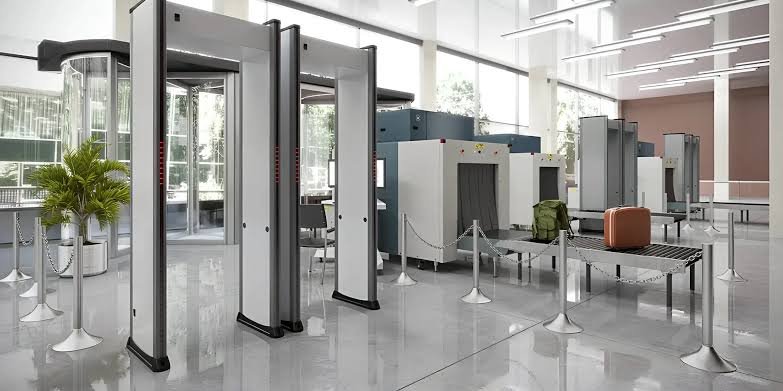
A DFMD is specifically designed to screen people — not bags or luggage. Bags and parcels go through a separate baggage X-ray scanner. The person walks through the DFMD while their bag travels through the scanner on the conveyor belt.
Together, the DFMD and the baggage scanner form the two-layer entry screening system used at airports, courts, government buildings, hotels, and major institutions across India.
Want to know how DFMD compares with HHMD? See our DFMD vs HHMD — Difference & Which One to Choose guide
How Does a DFMD Work?
A DFMD operates on the principle of electromagnetic induction — the same fundamental physics principle used in metal detectors worldwide since the 1960s.
The Physics — Simplified
Inside the frame of a DFMD, there are two sets of coils — a transmitter coil and a receiver coil — embedded in the left and right panels of the frame.
Step 1 — Electromagnetic Field Generation
The transmitter coil carries an alternating electrical current, which generates a pulsing electromagnetic field that fills the space inside the frame — the area a person walks through.
Step 2 — Person Walks Through
As a person walks through the electromagnetic field, their body passes through it without any disruption. The field simply passes through non-metallic materials — clothing, skin, plastic, fabric — without any effect.
Step 3 — Metal Disrupts the Field
When a metallic object — a gun, a knife, a phone, keys — enters the electromagnetic field, it disturbs the field. Metal is a conductor and it induces its own secondary electromagnetic field (called an eddy current) that interferes with the original field from the transmitter coil.
Step 4 — Receiver Coil Detects the Disturbance
The receiver coil continuously monitors the electromagnetic field inside the frame. When it detects a disturbance caused by metal — even metal hidden under clothing, inside a shoe sole, or taped to the body — it sends a signal to the control unit.
Step 5 — Alert Triggered
The control unit processes the signal and triggers the alert — a beep, a flashing LED panel, a digital display, or a combination — within milliseconds of the metal entering the field.
Step 6 — Zone Indication
Advanced DFMDs divide the frame into multiple zones — typically 6 to 33 zones from head to foot — and indicate exactly which zone the metal was detected in. This tells the security guard precisely where to focus their handheld metal detector (HHMD) for secondary screening, dramatically speeding up the process.
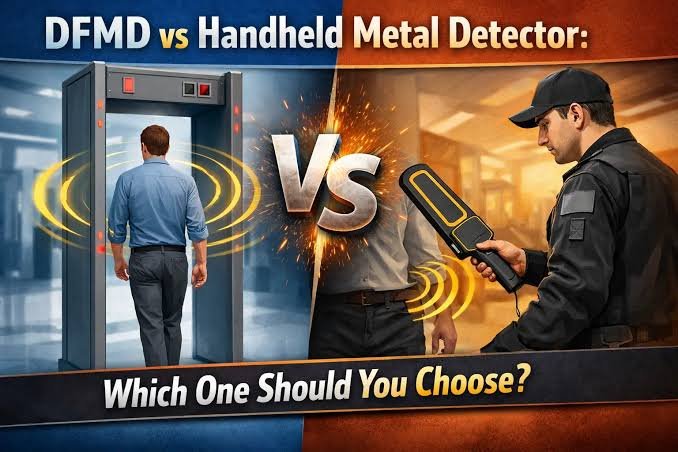
DFMD vs HHMD — What is the Difference?
These two devices are often used together but they serve different purposes.
| Feature | DFMD (Door Frame) | HHMD (Handheld) |
|---|---|---|
| How Used | Person walks through | Guard waves over body |
| Purpose | First-pass full-body scan | Secondary zone-specific scan |
| Speed | 1–2 seconds per person | 20–30 seconds per person |
| Accuracy | High for full body | High for specific area |
| Operator Needed | Minimal — watches indicator | Active — guard holds device |
| Best For | High-footfall entry points | Secondary screening, spot checks |
Standard practice at any well-secured entry point in India: the person walks through the DFMD first. If it beeps, the guard uses the HHMD to identify exactly which body part or pocket triggered the alert. Both devices working together give thorough, fast screening without slowing down legitimate visitors.
“If you are confused between a DFMD and HHMD, read our complete DFMD vs HHMD comparison guide to understand the difference.”
Types of DFMD Available in India
Single Zone DFMD
The most basic type. The entire frame is one detection zone — when metal is detected anywhere on the body, a single alert sounds. The guard cannot determine from the device alone where on the body the metal is located.
Best for: Low-footfall entry points, small offices, budget-constrained deployments
Price range: ₹18,000 – ₹35,000
Multi-Zone DFMD (6 to 18 Zones)
The frame is divided into 6 to 18 detection zones from head to foot. When metal is detected, the device indicates which zone or zones triggered the alert — head, shoulders, chest, waist, thighs, feet. LED panels on the side of the frame illuminate the relevant zone visually.
Best for: Courts, government offices, hotels, malls, corporate offices — any medium to high footfall environment
Price range: ₹35,000 – ₹85,000
High-Sensitivity Multi-Zone DFMD (19 to 33 Zones)
The most advanced walk-through metal detector. 19 to 33 independent detection zones provide extremely precise localisation of metal objects. Can distinguish between multiple metal objects on the same person and identify each independently. High immunity to environmental interference.
Best for: Airports, high courts, legislative assembly buildings, defence installations, embassies
Price range: ₹85,000 – ₹2,50,000+
Portable / Foldable DFMD
Lightweight frame that can be assembled and disassembled quickly for temporary or mobile deployment. Used at events, rallies, exhibitions, and temporary checkpoints. Battery-operated options available.
Best for: Events, elections, religious gatherings, political rallies, trade exhibitions
Price range: ₹25,000 – ₹70,000
Where is DFMD Used in India?
Courts and Tribunals
The Supreme Court, all High Courts, and district courts across India have DFMD systems at entry gates — mandated under Supreme Court security directives. All visitors, lawyers, and staff pass through the DFMD before entering court premises.
Government Offices and Secretariats
State secretariats, collectorate offices, government department buildings, PSU headquarters — all operate DFMD systems at main entry points. CISF-protected central government buildings have DFMD at every access point.
Airports
All commercial airports in India operate DFMD systems at multiple checkpoints — passenger entry, security check before boarding, staff entry, cargo access points.
Hotels — 5-Star and Business Hotels
Five-star hotels and large business hotels in metros and tier-2 cities including Vijayawada operate DFMD at main guest entrances — part of their comprehensive lobby security system alongside baggage scanners and CCTV.
Shopping Malls
Large malls operate DFMD at main entry points, particularly after incidents in Indian cities raised security awareness among mall operators and local police.
Corporate Offices and IT Parks
Large corporate campuses and IT parks with government contracts or defence sector clients operate DFMD at their main security checkpoints. Data centres and server room access points also use DFMD.
Hospitals
Large multi-specialty hospitals use DFMD at main entry gates to restrict weapons and enhance general security — increasingly a requirement for NABH-accredited hospitals.
Schools and Universities
Premium private schools and universities are increasingly deploying DFMD at main gates, particularly in urban areas, as campus security standards rise.
Metro Stations
Hyderabad Metro, Delhi Metro, Bangalore Metro, Chennai Metro — all operate DFMD at station entry points alongside baggage scanners.
Examination Halls
DFMD is increasingly used at competitive examination centres — UPSC, state PSC, bank PO, JEE, NEET — to prevent electronic devices and unfair means materials from entering the hall.
Events, Rallies and Gatherings
Political rallies, religious congregations, sports events, concerts — any high-footfall public gathering where security is a requirement deploys portable DFMD systems at entry gates.
Key Technical Specifications to Compare
Number of Detection Zones
The most important specification. More zones = more precise location of metal = faster secondary screening = less disruption for legitimate visitors. For medium to high-security environments, never go below 6 zones. Courts and government buildings should use 18 zones minimum.
Sensitivity Levels
Good DFMDs offer multiple sensitivity settings — typically 0 to 99 or 1 to 255 — that can be adjusted by the security team. High sensitivity catches small metal items like knives and small firearms but may also trigger on large belt buckles and bra underwires. Operators need to calibrate sensitivity appropriately for the specific environment and threat profile.
Throughput Rate
How many people per minute the DFMD can screen without false positives building up queues. Standard DFMDs handle 30 to 40 persons per minute at normal walk pace. High-speed models used at airports handle 60+ per minute.
False Alarm Rate
The percentage of non-threatening metal objects (belt buckles, keys, coins, phones in pockets, medical implants) that trigger alerts. Lower false alarm rate = less disruption for visitors = more trust in the system. High-quality DFMDs have sophisticated discrimination algorithms that reduce nuisance alarms while maintaining genuine threat detection.
Immunity to Interference
In India, DFMDs are often installed near electrical panels, generators, fluorescent lighting, air conditioning units, and high-traffic steel-reinforced doors — all of which can create electromagnetic interference that causes false positives. A quality DFMD has strong EMI (Electromagnetic Interference) immunity. Always confirm this before purchasing for industrial or electrically busy environments.
Power Requirements
Standard DFMDs run on 220V AC mains power. Battery backup or UPS compatibility is essential in India given power fluctuation and outages. Confirm UPS compatibility and whether the device has internal battery backup for brief outages.
Operating Temperature
India’s climate is demanding — particularly in states like Andhra Pradesh, Telangana, and Rajasthan where outdoor temperatures can exceed 45°C in summer. Confirm the operating temperature range matches your deployment environment. For outdoor or semi-outdoor checkpoints, look for 0°C to 55°C operating range minimum.
Display and Alert System
LED zone indicators on the frame panel for visual zone identification. Audible alert volume should be adjustable — sufficient to be heard in a noisy outdoor checkpoint but not so loud it creates panic indoors. Digital throughput counters and alarm counters help security supervisors monitor activity levels.
Data Logging and Connectivity
Advanced DFMDs log every detection event with timestamp — useful for security audits, incident investigation, and compliance reporting. Some models connect to central security management software via RS-232 or TCP/IP for remote monitoring.
DFMD Buying Guide — What to Ask Before You Purchase
1. What is the false alarm rate at my required sensitivity?
Ask the vendor to demonstrate the device at the sensitivity level you plan to use. A device that beeps at every belt buckle in a high-footfall environment creates chaos and trains your guards to ignore alerts — which defeats the purpose entirely.
2. What happens during a power cut?
Confirm whether the device has internal battery backup and how long it lasts. In India, a DFMD that shuts down during a power cut leaves your entry point completely unscreened — a critical security gap.
3. How many zones do I actually need?
For a small office or private school with 50 to 100 daily visitors — 6 zones is sufficient. For a court, government building, or hotel with 500+ daily visitors — 18 zones minimum. For an airport or very high-security deployment — 33 zones.
4. Is installation included?
DFMD installation involves electrical connection, frame assembly, positioning, sensitivity calibration, and operator training. Always confirm whether the supplier includes installation and calibration in their quote — or charges separately.
5. What certification does the device carry?
Look for CE marking and BIS certification where applicable. For government procurement, confirm whether the device is on the approved vendor list for your specific government body.
6. What is the warranty and after-sales support?
A DFMD at your main entry gate cannot afford extended downtime. Confirm warranty duration (1 to 3 years), whether on-site service is included, and the vendor’s average response time for breakdown calls in your city.
DFMD Price in India — 2026
| Category | Price Range | Best For |
|---|---|---|
| Basic Single Zone | ₹18,000 – ₹35,000 | Small offices, private events |
| Mid-Range 6–12 Zone | ₹35,000 – ₹65,000 | Schools, hotels, corporate offices |
| Advanced 18 Zone | ₹65,000 – ₹1,20,000 | Courts, government, malls |
| Premium 33 Zone | ₹1,20,000 – ₹2,50,000 | Airports, high courts, defence |
| Portable / Foldable | ₹25,000 – ₹70,000 | Events, temporary checkpoints |
⚠️ These prices are for the DFMD unit. Installation, electrical connection, calibration, operator training, and AMC are additional. Always request an all-inclusive quote.
What affects the price:
Top DFMD Brands Available in India
Garrett (USA)
One of the most widely recognised metal detector brands globally. Their walk-through models are used at airports and government installations worldwide. Strong reputation for reliability and low false alarm rates. Premium pricing.
Rapiscan (USA/UK)
Used at international airports and high-security government installations. Very high accuracy with advanced discrimination technology. Typically government procurement grade.
ZKTeco (China/Global)
Strong presence in India across access control and security products. ZKTeco DFMD models offer competitive pricing with good zone accuracy — suitable for corporate, hotel, and institutional deployments. Raise Solutions is an authorised ZKTeco dealer.
ESSL (India)
Widely deployed across Indian government and institutional environments. Good value for mid-range deployments with reasonable false alarm management.
Magnasense / Nirdhan (India)
Indian manufacturers providing budget-to-mid-range options frequently used in state government procurement and examination centres.
Complete Entry Security System — DFMD + HHMD + Baggage Scanner
A DFMD alone is not a complete security solution. At any properly secured entry point, three devices work together:
Layer 1 — Baggage Scanner (X-Ray)
All bags, parcels, and carried items go through the X-ray baggage scanner on the conveyor belt. The operator views the X-ray image and clears or flags each bag.
Layer 2 — DFMD (Door Frame Metal Detector)
The person walks through the DFMD frame while their bag is on the conveyor. The DFMD screens the person for metal weapons or objects concealed on their body.
Layer 3 — HHMD (Handheld Metal Detector)
If the DFMD triggers an alert, the guard uses the HHMD to identify exactly which body zone holds the metal. The HHMD pinpoints the precise location — pocket, waistband, shoe, bra underwire — within seconds.
Optional Layer 4 — CCTV
Cameras covering the entry checkpoint create a visual record of every person passing through, linking timestamps with DFMD alert events for incident investigation.
Raise Solutions supplies and integrates all four layers as a complete entry security system — one vendor, one installation team, one AMC contract.
Installation — What to Expect
Site Assessment
Our engineer visits your entry point to assess the frame dimensions needed, floor mounting requirements, power availability, proximity to electrical interference sources, and guard positioning. This is provided free of charge.
Frame Assembly and Positioning
The DFMD frame is assembled and positioned at the entry point. Floor anchoring bolts are installed for stability — important at outdoor and semi-outdoor checkpoints where wind or accidental contact could displace the frame.
Power Connection
Electrical connection to the nearest mains point is established with proper earthing. UPS or voltage stabiliser connection if specified.
Sensitivity Calibration
This is the most critical step and the one most often skipped by inexperienced installers. Our engineer calibrates the sensitivity level for your specific environment — testing with typical metal objects carried by your actual visitor demographic to find the optimal sensitivity that catches weapons without triggering constantly on belts and phones.
Operator Training
Your security guards are trained on reading zone indicators, adjusting sensitivity between duty shifts, using the HHMD for secondary screening, and basic troubleshooting.
Handover
Documentation, warranty card, calibration settings record, and AMC options are handed over.
🔧 Raise Solutions completes standard DFMD installations in 2 to 4 hours for single-frame deployments. Multi-frame or integrated system installations take 1 full working day.
Maintenance and AMC
A DFMD at your main entry gate operates continuously — sometimes 12 to 16 hours daily, 365 days a year. Like any electronic device under heavy continuous use, it requires periodic maintenance.
Monthly — Clean sensor panels and LED indicators. Test alert system and zone accuracy. Check power connections and earthing.
Quarterly — Full sensitivity recalibration. Inspect frame for physical damage. Test UPS battery if applicable.
Annually — Complete electronic inspection of transmitter and receiver coils. Firmware update if available. Full zone accuracy verification test.
An Annual Maintenance Contract with Raise Solutions covers all scheduled maintenance visits, priority breakdown response, and discounted spare parts — ensuring your entry checkpoint is never left unprotected due to a technical fault.
Frequently Asked Questions
A DFMD does not harm medical implants — the electromagnetic field it generates is far too weak to affect pacemakers, cochlear implants, or orthopaedic metal implants. However, a person with a large metal implant (hip replacement, spinal rod) will trigger the DFMD. They should inform security and carry their medical documentation for secondary screening via HHMD.
No. A DFMD detects only metallic objects. Non-metallic threats — ceramic blades, plastic weapons, explosives, narcotics — cannot be detected by a metal detector. This is why baggage X-ray scanners and ETD (Explosive Trace Detection) systems are used alongside DFMDs at high-security installations.
At most sensitivity settings used in hotels, offices, and malls — yes, a mobile phone will trigger the DFMD. Visitors are typically asked to place phones in a tray before walking through, or security accepts the phone trigger and uses HHMD to confirm. At lower sensitivity settings calibrated for specific environments, phones may not always trigge
Q: How many people can a DFMD screen per hour?
At normal walk-through pace with minimal false alarms, a standard DFMD screens 200 to 400 persons per hour. At high-footfall events with simple calibration and experienced guards, throughput can exceed 600 per hour per lane.
Q: Is DFMD mandatory for hotels and corporate offices in India?
Mandatory requirements vary by state and establishment category. Five-star hotels, courts, government buildings, airports, and metro stations have regulatory requirements. For hotels, malls, and corporates it is increasingly a standard in their security policy, insurance requirement, and client contract — particularly for companies with government or defence sector clients.
Q: Can the DFMD be installed outdoors?
Yes, with the appropriate model. For outdoor or semi-outdoor installation, confirm IP rating (IP44 minimum for covered outdoor areas), operating temperature range, and frame material (stainless steel or weatherproof coated aluminium preferred over standard steel which can rust).
Q: What is the difference between DFMD and full-body scanner?
A DFMD is a walk-through metal detector — it detects metal objects only. A full-body scanner (millimetre wave scanner or backscatter X-ray) produces a detailed image of the person’s body outline showing all objects, including non-metallic ones. Full-body scanners are expensive, slower, and used only at airports and very high-security checkpoints. For all other environments in India, DFMD is the standard.
Why Choose Raise Solutions for Your DFMD?
We have been deploying integrated entry security systems — baggage scanners, DFMDs, HHMDs, and CCTV — for government offices, hotels, schools, corporate campuses, and event venues across Andhra Pradesh since 2012.
When you buy a DFMD from Raise Solutions, you are not just getting the device — you are getting calibration by engineers who understand your specific environment, training for your security guards, and an after-sales team that is physically in Vijayawada when something needs attention.
- ✅ Genuine products — manufacturer warranty, proper GST invoice
- ✅ Free site assessment — right model and sensitivity for your entry point
- ✅ Complete system supply — DFMD + HHMD + Baggage Scanner + CCTV integration
- ✅ Expert calibration — not just plug-in-and-go, but calibrated for your visitor profile
- ✅ Security guard training included
- ✅ AMC available — scheduled maintenance and priority breakdown response
- ✅ ISO Certified | MSME Registered | NSIC Recognised
- ✅ Local presence in Vijayawada — fast on-site response across AP
📞 Get Specifications and Pricing Today
Call: +91 8522959096
Email: info@raisesolutions.in
Website: raisesolutions.in
Visit: Nidamanuru Road, Poranki, Vijayawada, Andhra Pradesh – 521137
Tell us your premises type, daily footfall, and number of entry lanes — we will recommend the right DFMD configuration with full pricing within 24 hours.
© 2026 Raise Solutions | All Rights Reserved | ISO Certified | MSME Registered | NSIC Recognised
Pingback: Bag Checking Machine — Types, How It Works & Price India 2026