
Walk into any airport, hotel, corporate office, court, mall, or government building in India and the first thing you encounter at the entrance is a large machine with a conveyor belt — you place your bag on it, it disappears into a dark tunnel, and within seconds it comes out the other side while a security officer studies a screen.
That machine is a baggage scanner.
Most people use them every day without giving them a second thought. But for business owners, facility managers, security heads, and procurement teams — understanding exactly what a baggage scanner is, how it works, what types are available, and where it is legally or practically required is essential before making a purchase decision.
This guide covers everything — the meaning, the technology, the types, the applications across India, and what to look for when buying one for your premises in 2026.
What Is a Baggage Scanner? — The Complete Meaning
A baggage scanner — also called an X-ray baggage scanner, security scanner, or luggage scanner — is an electronic security device that uses X-ray technology to inspect the contents of bags, luggage, packages, and other items without physically opening them.
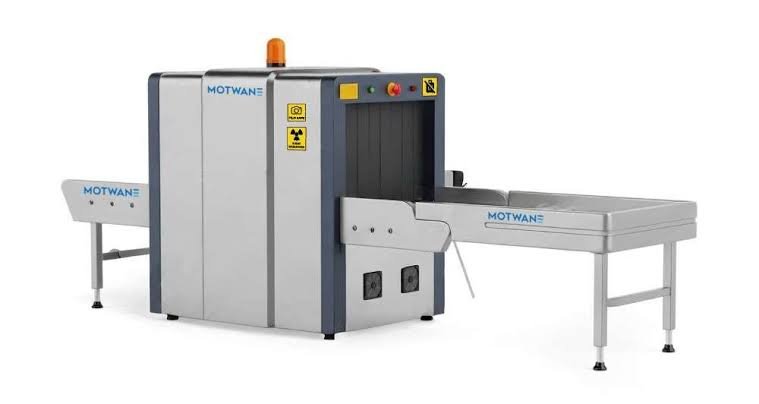
The machine passes the bag through a beam of X-rays. Different materials absorb X-rays at different rates. The scanner detects these differences and converts them into a colour-coded image on a monitor — allowing a trained security operator to identify the contents of the bag, including any suspicious, prohibited, or dangerous items such as weapons, explosives, or contraband.
The key advantage of a baggage scanner over a manual bag check is speed, accuracy, and non-invasiveness. A trained operator can screen dozens of bags per minute without touching any of them — dramatically faster and more effective than opening and manually inspecting each one.
In India, baggage scanners are deployed at airports, railway stations, metro systems, hotels, courts, government offices, corporate campuses, hospitals, shopping malls, and increasingly at any commercial or institutional premises where security is a priority.
How Does a Baggage Scanner Work? — Step by Step
Understanding how a baggage scanner works helps you appreciate why it is so effective — and why it is far superior to manual checking for any serious security operation.
Step 1 — The Bag Is Placed on the Conveyor Belt
The passenger or visitor places their bag, laptop bag, briefcase, or package on the conveyor belt at the entry end of the machine. The conveyor belt is motor-driven and moves at a consistent, controlled speed.
Step 2 — The Bag Enters the Tunnel
The conveyor belt carries the bag into a lead-lined tunnel inside the machine. The lead lining serves two purposes — it prevents X-rays from escaping the machine (protecting operators and bystanders), and it blocks external interference that could distort the image.
Step 3 — X-Rays Are Generated and Projected
Inside the tunnel, an X-ray generator (also called an X-ray tube) continuously emits a fan-shaped beam of X-rays. This beam is directed upward and sideways through the bag as it passes through on the belt.
The X-ray energies used in baggage scanners are carefully calibrated — powerful enough to penetrate most materials in a bag but far below levels that would cause any harm to the bag’s contents, electronics, photographic film, food, or medications at normal screening speeds.
Step 4 — X-Rays Pass Through the Bag and Hit Detectors
On the other side of the X-ray beam, a row of solid-state detectors (typically using photodiodes or scintillator crystals) measures the amount of X-ray energy that passes through the bag at each point. Objects inside the bag absorb different amounts of X-ray energy depending on their density and atomic composition.
Dense materials like metals absorb almost all X-rays — appearing dark or black on the image. Less dense materials like plastics, liquids, or organic matter absorb fewer X-rays — appearing in lighter shades. Organic materials like food, paper, drugs, and explosives appear in characteristic colours that trained operators learn to identify instantly.
Step 5 — The Image Is Processed and Colour-Coded
A computer processes the detector data in real time and generates a false-colour image on the operator’s monitor. The colour coding is standardised across most modern scanners:
Orange / Brown — organic materials. This includes food, paper, leather, wood, drugs, and most explosives. If an organic mass appears unusually dense, uniform, or in an unexpected shape, it warrants further inspection.
Blue / Dark Blue — inorganic non-metallic materials. This includes glass, plastics, some ceramics, and similar materials.
Green — materials of intermediate density. Often includes items like some plastics, certain metals mixed with organic materials.
Black / Dark — highly dense materials — typically metals. Guns, knives, tools, and dense metal objects appear in this range.
Red — some machines use red specifically for very high-density metals or dual-energy systems that identify specific material compositions.
The operator studies this colour image in real time as the bag passes through, looking for shapes, densities, and colour patterns that indicate potentially dangerous or prohibited items.
Step 6 — The Operator Makes a Decision
A trained operator watching the screen can identify suspicious items in a fraction of a second. If nothing is flagged, the bag emerges from the other end of the tunnel and the passenger collects it. If something is flagged, the operator stops the belt and requests a manual inspection or a secondary check.
Modern baggage scanners also include software features like automatic threat detection — algorithms that highlight suspicious shapes (gun shapes, knife profiles, bottle shapes) on the operator’s screen automatically, reducing operator fatigue and human error in high-volume environments.
Step 7 — The Bag Exits
The bag emerges from the exit end of the tunnel, the passenger collects their belongings, and the process is complete — typically in 5 to 15 seconds per bag depending on bag size and content complexity.
Types of Baggage Scanners Available in India
The baggage scanner market in India offers several distinct types, each designed for different use cases, throughput requirements, and security levels.
1. Single-View X-Ray Baggage Scanner
The most common type across India. Uses a single X-ray source and a single detector array to generate one view of the bag — typically from the top down or from the side.
Tunnel sizes: Typically 50x30cm to 65x50cm for standard models. Larger tunnel sizes (80x65cm and above) for industrial use.
Best for: Hotels, corporate offices, government buildings, small retail premises, and any location that needs reliable basic security screening without extremely high throughput demands.
Approximate price in India: ₹1,50,000 to ₹4,00,000 depending on tunnel size and brand.
2. Dual-View X-Ray Baggage Scanner
Uses two X-ray sources positioned at different angles — typically one from the top and one from the side — to generate two simultaneous views of the bag. The operator sees both views on screen simultaneously, making it far easier to identify items that might be hidden or obscured in a single-view image.
Best for: Airports, railway stations, metro systems, high-security government buildings, and any location where thoroughness is critical and throughput is high.
Approximate price in India: ₹4,00,000 to ₹10,00,000+
3. Dual-Energy X-Ray Baggage Scanner
An advanced version that uses two X-ray energy levels simultaneously — high energy and low energy. By comparing how much energy each material absorbs at each level, the scanner’s software can determine the atomic number (Z) of materials in the bag and automatically classify them as organic, inorganic, or metallic. This classification is shown in the colour coding — orange for organic, blue for inorganic, dark for metal — with much greater accuracy than single-energy systems.
Best for: Airports, border security, high-security corporate campuses, courts, and government buildings where accurate material classification is essential.
Approximate price in India: ₹5,00,000 to ₹15,00,000+
4. CT (Computed Tomography) Baggage Scanner
The most advanced technology — generates a full three-dimensional image of the bag’s contents by rotating the X-ray source 360° around the bag. The operator can rotate and examine the 3D image from any angle on screen. CT scanners are standard at major international airports because they can detect liquid explosives and complex threats that 2D scanners may miss.
Best for: International airports, very high security government facilities.
Approximate price in India: ₹30,00,000 to ₹1,00,00,000+ (imported, high-end)
5. Cabin Baggage / Compact Baggage Scanner
A smaller, more compact version of the standard single-view scanner. Designed for locations with space constraints — small hotel lobbies, boutique office buildings, residential complexes, and retail stores. Tunnel sizes typically start from 40x25cm.
Best for: Small offices, boutique hotels, residential buildings, retail stores.
Approximate price in India: ₹80,000 to ₹2,00,000
6. Parcel and Cargo Scanner
Large-format scanners designed to handle parcels, boxes, courier packages, and cargo rather than personal baggage. Tunnel sizes can be 100x100cm or larger. Used by courier companies, warehouses, logistics hubs, and manufacturing facilities.
Best for: Logistics centres, warehouses, large manufacturing facilities, customs checkpoints.
Approximate price in India: ₹8,00,000 to ₹50,00,000+ depending on size and throughput
7. Under-Vehicle Surveillance System (UVSS)
Not a baggage scanner in the traditional sense, but often deployed alongside baggage scanners as part of a complete security checkpoint. UVSS uses cameras and mirrors (or active scanning) to inspect the underside of vehicles entering a premises. Increasingly common at corporate campuses, hotels, and government buildings in India.
Where Are Baggage Scanners Used in India?
Baggage scanners are deployed across a wide range of sectors and facilities throughout India. Here is a comprehensive breakdown:
Airports
The most visible and mandated use of baggage scanners in India. All airports under the Airports Authority of India (AAI) and private operators are required by BCAS (Bureau of Civil Aviation Security) guidelines to screen all passenger baggage — both cabin baggage and checked-in baggage — using X-ray scanners. International airports use the most advanced dual-view and CT scanners for checked baggage, and high-throughput single-view and dual-energy scanners for cabin baggage at security checkpoints.
Railway Stations and Metro Systems
Major railway stations across India — particularly A1 and A category stations — are increasingly deploying baggage scanners at entry points, especially on high-security routes. The Delhi Metro, Mumbai Metro, Hyderabad Metro, Chennai Metro, and Bangalore Namma Metro all use baggage scanners at entry gates as standard. The Hyderabad Metro — operating through Andhra Pradesh and Telangana — uses X-ray baggage scanners at all major stations.
Hotels and Resorts
Four-star, five-star, and business hotels in India typically deploy baggage scanners and metal detector doors at main entrances. This is partly a security measure and partly a requirement under state government security guidelines for hotels above a certain category. In Vijayawada, hotels near the city centre and along the NH-16 corridor that cater to corporate and government clients routinely deploy security screening at their entrances.
Corporate Offices and IT Parks
Large corporate campuses, IT parks, SEZs, and business parks in India increasingly deploy baggage scanners at main security gates. This is particularly common in cities like Hyderabad, Bangalore, Pune, and — increasingly — Vijayawada, where corporate infrastructure is rapidly growing. The primary concerns are preventing theft, protecting sensitive equipment and data, and maintaining general workplace security.
Government Buildings and Courts
All district courts, high courts, and the Supreme Court of India require visitors to pass through X-ray baggage scanners. Similarly, government secretariats, collectorate buildings, state assembly buildings, and central government offices deploy mandatory baggage screening. In Andhra Pradesh, the Amaravati capital region buildings and all major government offices in Vijayawada use security scanning equipment.
Hospitals and Healthcare Facilities
Large hospitals and multi-speciality healthcare centres in India are deploying baggage scanners at main entrances — particularly those that handle high patient volumes or have security concerns. The primary purpose is preventing the entry of weapons, prohibited items, and theft of hospital equipment.
Shopping Malls and Retail Complexes
Most large shopping malls in India deploy baggage scanners and metal detector doors at main entry points — both as a genuine security measure and as a reassurance to shoppers. This is particularly common in Hyderabad, Vijayawada, and other Andhra Pradesh cities where large retail complexes have grown significantly in the past five years.
Educational Institutions
Universities, engineering colleges, medical colleges, and premium schools in India are increasingly deploying security scanning equipment at main gates — primarily to prevent the entry of weapons, alcohol, and contraband into campuses. Entrance examination centres and board examination halls also use portable baggage scanning equipment during high-stakes exams.
Industrial and Manufacturing Facilities
Factories, industrial plants, and manufacturing facilities deploy baggage scanners primarily to prevent theft of components, finished goods, tools, and intellectual property. In Andhra Pradesh’s industrial corridors — including the Krishnapatnam industrial zone, Visakhapatnam steel plant, and various pharmaceutical manufacturing clusters — security scanning at employee entry/exit points is standard.
Religious and Event Venues
Major religious sites that attract large crowds — temples, mosques, churches — deploy baggage scanners at entry points during major festivals and events. Similarly, large event venues, sports stadiums, and convention centres deploy mobile or permanent scanning equipment during events.
Key Specifications to Understand Before Buying
When evaluating a baggage scanner for your premises, these are the specifications that matter:
Tunnel Size — the dimensions of the opening through which bags pass. Match this to the largest bags you expect to screen. A hotel lobby scanner needs a different tunnel size than a parcel scanner at a warehouse.
Conveyor Speed — measured in metres per minute. Higher speed means faster throughput but less time for the operator to study each image. Standard for most applications: 0.2 to 0.5 m/s.
X-Ray Dose — measured in μGy. Modern scanners are designed to be extremely low dose — well below any level that would affect photographic film, medical implants, medications, or electronic devices.
Image Resolution — measured in wire gauge (AWG). A scanner that can detect a 40AWG wire has higher resolution than one limited to 38AWG. Higher resolution = better threat detection for fine wires, thin blades, and detonators.
Penetration Depth — measured in steel millimetres. This indicates how dense a material the scanner can see through. Typically 30–34mm steel for standard commercial scanners.
Dual Energy — yes or no. Dual energy provides colour-coded material classification — the difference between orange (organic/explosive risk) and blue (inorganic). Essential for serious security applications.
Automatic Threat Detection (ATD) — software that automatically highlights suspicious shapes on the operator’s screen. Significantly reduces operator fatigue in high-volume environments.
Image Storage — how many images the scanner stores. Useful for auditing, incident investigation, and compliance. Modern scanners store 100,000+ images with timestamps.
Baggage Scanner vs Manual Bag Check — Why It Matters
Many small offices, hotels, and commercial premises in India still rely on security guards to manually open and inspect bags at entry. Here is why that approach falls short compared to a baggage scanner:
A manual bag check requires the visitor to open every compartment and the security guard to physically touch and move the contents. It is time-consuming, invasive, and uncomfortable for visitors — particularly for women and for professionals carrying laptops and sensitive documents.
More critically, a manual check cannot see inside sealed compartments, electronic devices, shoes, or ordinary-looking items. A knife concealed inside a laptop case, a weapon inside a power bank, or contraband inside a food container will pass a manual check undetected. A baggage scanner catches all of these in seconds.
For any premises where security is taken seriously — and particularly in Vijayawada and Andhra Pradesh where corporate, government, and institutional infrastructure is rapidly expanding — a baggage scanner is not a luxury. It is the baseline standard for professional security.
Where to Buy a Baggage Scanner in Vijayawada
Raise Solutions supplies, installs, and maintains baggage scanners across Vijayawada and Andhra Pradesh. We work with leading security equipment brands and provide:
- Free site survey and product recommendation
- Supply of single-view, dual-view, and dual-energy baggage scanners
- Professional installation including civil work if required
- Operator training for your security team
- Annual Maintenance Contract (AMC) with fast local response
- EMI options available
Whether you need a compact scanner for a small office lobby or a high-throughput dual-energy system for a large corporate campus — Raise Solutions has the right solution and the right team.
Raise Solutions Experience Center
1st Floor, Pradham Building, beside Indian Oil Petrol Pump
Nidamanuru Road, Poranki-521137, Vijayawada, Andhra Pradesh
📞 94926 67817 | 85229 59096
🌐 www.raisesolutions.in
A baggage scanner is one of the most effective security tools available for any business, institution, or public facility in India. It uses X-ray technology to inspect the contents of bags in seconds — without physical contact, without invasion of privacy, and with far greater accuracy than any manual check.
Whether you run a hotel in Vijayawada, manage a corporate office in Amaravati, operate a school in Guntur, or oversee security at a manufacturing facility in Krishna district — a baggage scanner is the professional standard for entry security in 2026.
The technology is accessible, the price points have come down significantly, and with a trusted local supplier like Raise Solutions providing installation, training, and AMC support — deploying a baggage scanner at your premises has never been more straightforward.
Published by Raise Solutions | Authorised Security Equipment Dealer — Vijayawada, Andhra Pradesh
94926 67817 | raisesolutions.in | Poranki-521137, Vijayawada
Pingback: Baggage Scanner Price in India 2026 — By Tunnel Size, Brand & Sector
Pingback: How Does a Baggage Scanner Work? X-Ray Technology Explained
Pingback: What is a DFMD? Door Frame Metal Detector — India 2026