
Imagine driving into your office campus and watching the gate lift automatically before you even slow down. No guard waving you through. No stopping to show a card. No rolling down your window in the rain. That smooth, effortless experience is exactly what a boom barrier with RFID delivers — and businesses across India are adopting it fast.
In this guide, we explain what this technology is, how it works from start to finish, and why your business genuinely needs one right now.
What Is a Boom Barrier?
A boom barrier — also called a barrier gate or parking barrier — is an automated horizontal arm that rises and falls to control vehicle entry and exit at a specific point. You will find boom barriers at apartment complexes, corporate offices, hospitals, schools, shopping malls, factories, toll plazas, and hotels.
On its own, a boom barrier is simply a physical gate. However, when you connect it to an intelligent access control system, it becomes a powerful security tool. RFID is the technology that makes this possible.
What Is RFID?
RFID stands for Radio Frequency Identification. Essentially, it is a wireless technology that uses radio waves to identify a tagged object — in this case, a vehicle or an authorised person.
Every RFID system relies on three components working together:
The RFID Tag — A small chip inside a card, sticker, or key fob that stores a unique identification number. Tags are either passive (powered by the reader’s signal, no battery needed) or active (battery-powered, longer detection range).
The RFID Reader — A device fixed at the entry or exit point that constantly emits radio waves and reads the tag’s unique ID the moment a vehicle enters its detection range.
The Control Software — The brain of the system. It checks whether the detected ID belongs to an authorised user, logs the event, and then triggers the boom barrier to open or stay closed accordingly.
What Is a Boom Barrier with RFID?
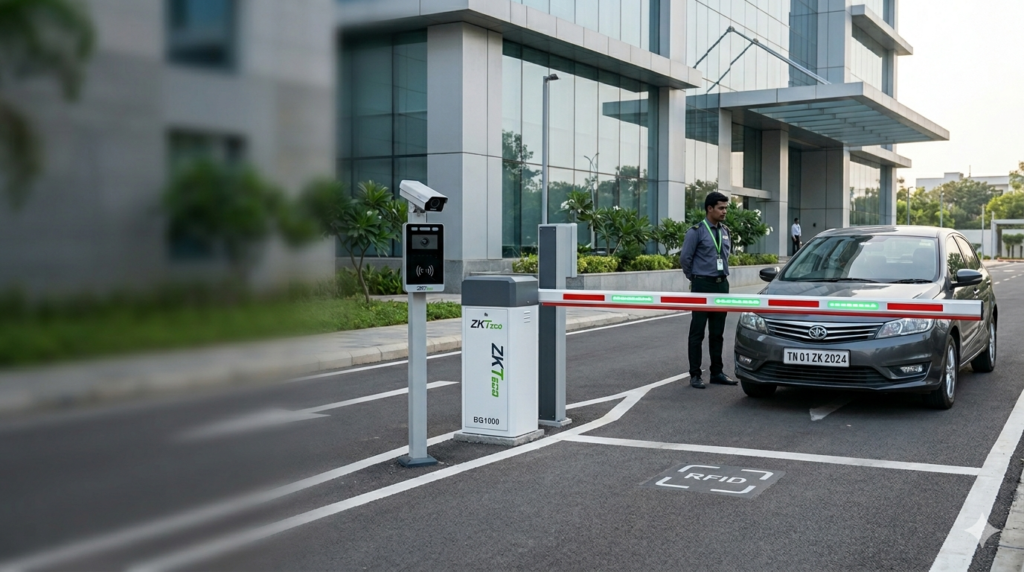
Simply put, a boom barrier with RFID combines an automated barrier gate with an RFID reader to create a fully contactless vehicle access system. When an authorised vehicle approaches, the reader detects the RFID tag and the barrier lifts automatically — without any human involvement.
The result is fast, secure, and completely hands-free vehicle access for every authorised vehicle on your premises.
How Does It Work? A Step-by-Step Breakdown
Understanding the process makes it much easier to see why this technology is so reliable. Here is exactly what happens from the moment a vehicle approaches to the moment it clears the gate:
Step 1 — The vehicle approaches the entry point. The driver moves toward the boom barrier. An RFID tag is already fixed to the vehicle’s windscreen, dashboard, or number plate. Alternatively, the driver carries an RFID card or key fob.
Step 2 — The reader detects the tag instantly. The RFID reader mounted near the barrier continuously emits radio frequency signals. As soon as the tag enters the detection range — anywhere from half a metre to ten metres depending on the frequency — the reader captures the tag’s unique ID in milliseconds.
Step 3 — The system verifies the ID in real time. Next, the control software checks the captured ID against the database of authorised users. This verification happens in under one second, so the driver barely notices any delay.
Step 4 — The barrier opens for authorised vehicles. Once the system confirms the ID, it sends a signal to the boom barrier motor and the arm rises immediately. The vehicle passes through without stopping.
Step 5 — The barrier closes automatically. After the vehicle clears the gate — confirmed by a loop detector in the road or a photocell sensor — the arm lowers back into position on its own, ready for the next vehicle.
Step 6 — The system records everything. Finally, the software logs every single entry and exit with a timestamp, vehicle ID, and gate location. This creates a complete digital audit trail that you can review anytime.
Which RFID Frequency Should You Choose?
Different RFID frequencies suit different applications. Choosing the right one for your site makes a significant difference in performance.
Low Frequency (LF) — 125 kHz Detection range is up to 10 centimetres. Because the range is very short, LF works best for pedestrian access cards and slow-lane vehicle barriers where the driver must stop and present a card.
High Frequency (HF) — 13.56 MHz Detection range extends up to one metre. HF is commonly used in smart cards and NFC-based systems, making it suitable for controlled vehicle entry at manned checkpoints.
Ultra High Frequency (UHF) — 860–960 MHz Detection range reaches up to ten metres. Since vehicles do not need to stop for the reader to detect them, UHF is by far the most popular choice for vehicle access control, apartment parking, and large campus environments.
For most business applications in India, UHF RFID delivers the best combination of speed, convenience, and reliability.
Types of RFID Tags for Vehicle Systems
Windscreen RFID Sticker — A thin passive UHF tag that sticks to the inside of the windscreen. Most apartment complexes and office parking systems use this format because it is low-cost, tamper-evident, and specific to one vehicle.
RFID Card — A standard card issued to authorised staff or residents. Many organisations use the same card for both vehicle access and building entry, making it highly convenient.
RFID Key Fob — A small handheld device the driver presents to the reader. While convenient, key fobs offer a shorter detection range than windscreen stickers.
RFID Number Plate Tag — A tag built into or fixed to the vehicle’s number plate. Because it is durable and weather-resistant, this format works well in toll booth and premium parking applications.
What Other Systems Can RFID Boom Barriers Connect With?
One of the strongest reasons businesses prefer RFID boom barriers is their ability to integrate with a wide range of other technologies.
Parking Management Software automates entry, exit, duration tracking, and fee collection completely. Raise Solutions offers an integrated Parking Management System that connects directly with RFID boom barriers.
ANPR Cameras read the vehicle’s number plate and cross-reference it with the database, adding a second layer of verification on top of the RFID tag.
Biometric Systems such as face recognition or fingerprint scanners add dual-factor authentication — the vehicle needs both a valid RFID tag and a biometric match to enter.
CCTV and Surveillance Systems automatically link entry and exit events to live footage, so reviewing any incident becomes fast and straightforward.
Visitor Management Systems let your team issue temporary RFID passes to guests, with automatic deactivation after the visit ends.
Video Intercom Systems allow security staff to communicate with unregistered vehicles remotely and grant or deny access from the control room without leaving their post.
Key Benefits for Your Business
1. Completely Contactless Entry
Because drivers do not need to stop, press buttons, or show cards manually, entry is smooth and frictionless even during peak hours. This noticeably improves the experience for staff, residents, and visitors alike.
2. Zero Unauthorised Vehicle Access
Only registered RFID tags can open the barrier. As a result, unregistered vehicles cannot enter — eliminating tailgating and unauthorised parking that are common problems in apartments and office campuses.
3. Lower Dependence on Security Guards
Since the system handles routine vehicle access automatically, your security team can focus on monitoring and real emergencies rather than manually managing every vehicle at the gate.
4. Full Digital Audit Trail
Every vehicle movement is logged with date, time, and identity. This data proves invaluable during security investigations, compliance audits, and operational reviews.
5. Strong Return on Investment
A single security guard typically costs ₹15,000–₹25,000 per month including salary and replacement costs. Most RFID boom barrier systems pay for themselves within 12 to 18 months purely through manpower savings.
6. Easily Scalable
Whether you manage one gate or a multi-entry campus with hundreds of registered vehicles, the system scales without complexity. Adding new vehicles, blocking lost tags, and pulling reports all happen from one central dashboard.
7. Reliable in All Weather
Because quality RFID readers and barrier units carry IP ratings for outdoor use, they perform consistently through heavy rain, dust storms, and the intense heat common across Andhra Pradesh and Telangana.
Which Businesses Need This the Most?
Apartment Complexes and Gated Communities: Residents get automatic entry through windscreen stickers, while visitors are handled separately via intercom or temporary passes. Consequently, the security guard at the gate is free to focus on monitoring rather than lifting barriers manually all day.
Corporate Offices and IT Parks Employee vehicles are pre-registered, visitors receive temporary passes, and the system logs all movements across multiple entry points. Furthermore, the data integrates easily with HR and attendance platforms.
Hospitals and Healthcare Facilities Fast, uninterrupted access for staff vehicles and ambulances makes a genuine difference in emergency situations, where every second counts.
Schools and Colleges Parent and staff vehicles are registered in advance. Since unregistered vehicles cannot enter, campus safety improves significantly without requiring additional security personnel.
Factories and Warehouses Authorised vendor vehicles enter automatically while deliveries are managed on pre-approved schedules. Moreover, the complete vehicle movement log supports compliance reporting and internal audits.
Shopping Malls and Hotels RFID integrates with ticketing and payment systems so that paid parking runs fully automatically, while VIP and staff vehicles access dedicated zones without stopping.
Frequently Asked Questions
UHF RFID readers typically detect vehicle tags from one metre up to ten metres. However, most apartment and office installations use a three to five metre range, which provides smooth entry without the vehicle needing to stop.
Why Raise Solutions?
Raise Solutions is Vijayawada’s trusted partner for security, surveillance, and office automation. Rather than just supplying equipment, we design the right system for your specific site, install it professionally, and support it with reliable after-sales service.
When you choose Raise Solutions, you get:
- Authorised dealership for ZKTeco, Essl, and Autozone boom barriers
- UHF RFID reader supply, installation, and tag programming
- Full integration with parking software, CCTV, and biometric systems
- Free site survey with a customised system design
- Transparent, all-inclusive pricing with no hidden charges
- Annual Maintenance Contract (AMC) for long-term peace of mind
- MSME registered, ISO certified, and NSIC recognised
Ready to Automate Your Vehicle Entry?
A boom barrier with RFID is one of the most practical investments you can make for your premises. It strengthens security, cuts manpower costs, and delivers a smooth, modern experience for every vehicle that enters your gate.
Contact Raise Solutions today for a free site survey and quote.
📞 Call: +91 85229 59096 📧 Email: info@raisesolutions.in 🌐 Website: www.raisesolutions.in 📍 Location: Poranki, Vijayawada, Andhra Pradesh
Smart entry starts here.