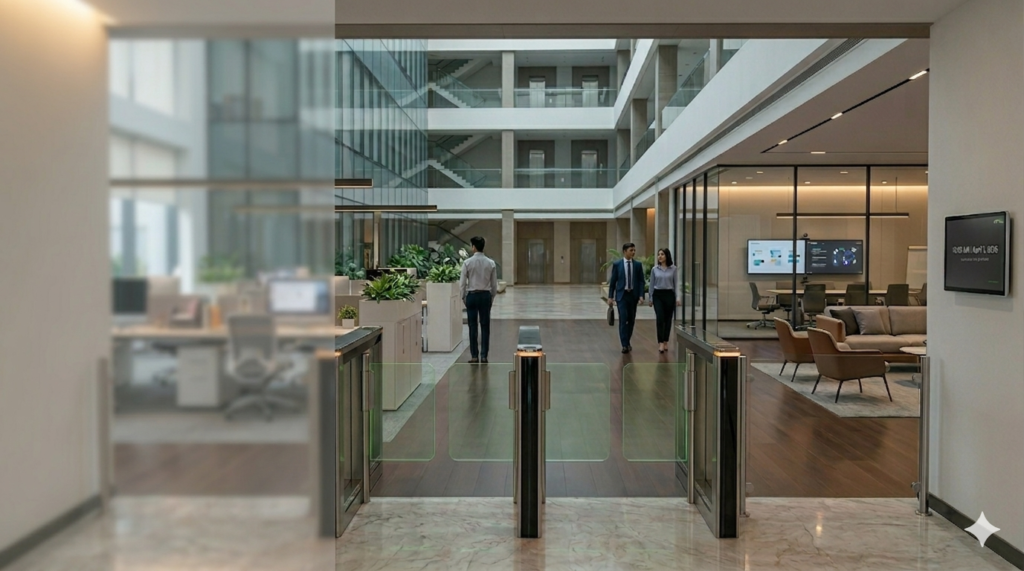
You have decided that a flap barrier is the right access control solution for your office, institution, or facility in Vijayawada. Good decision. Now comes the part that most vendors gloss over — the actual installation.
What does the process look like from start to finish? How long does it take? What will it cost — not just the device, but everything? What do you need to prepare before the installation team arrives? And what should your system look like once it is up and running?
These are the questions this guide answers in full. If you are a facility manager, business owner, HR head, or admin decision-maker in Vijayawada or anywhere in the Krishna and Guntur districts, this is your complete on-the-ground reference for flap barrier installation in 2026.
Why Vijayawada Businesses Are Installing Flap Barriers Right Now
Vijayawada is no longer just a commercial transit hub. The city is growing rapidly as a business destination — with expanding IT parks, corporate offices, private hospitals, engineering colleges, and government institutions all concentrating in areas like Benz Circle, Kanuru, MG Road, Poranki, Moghalrajpuram, and the emerging Amaravati corridor.
With this growth comes a very real and pressing problem — managing who enters your premises, when, and how. Security guards at reception desks are expensive, inconsistent, and easy to bypass. Manual registers are unreliable. Visitor logs are incomplete. And in a city where office complexes, hospitals, and educational institutions are handling hundreds to thousands of footfalls daily, the need for automated, audit-ready pedestrian access control has never been more urgent.
Flap barriers solve all of this in a single installation. They control entry, log every access event, integrate with biometric attendance, and project the kind of professional image that modern Vijayawada businesses want to project to clients, visitors, and employees.
But installation is where the difference between a system that works beautifully and one that causes daily headaches is made or lost.

Step 1 — The Site Survey (Before Anything Is Purchased)
The single most important step in a flap barrier installation is one that happens before you spend a single rupee on hardware. It is the site survey.
A proper site survey involves a trained engineer visiting your premises in Vijayawada, walking through your entry and exit points, understanding your daily footfall, assessing your floor layout and structural conditions, and designing a system that actually fits your space and your requirement.
Here is what a thorough site survey covers:
The number and width of entry and exit lanes required based on your peak-hour footfall. The floor type — granite, marble, tiles, or concrete — because this determines anchoring method and civil work requirements. The availability and routing of electrical power at the installation point. Whether the installation is indoor or semi-outdoor, which determines the IP rating of barriers needed. The distance between the barrier location and the access control server or biometric device. Whether existing CCTV, door locks, or HR software needs to be integrated with the new system. Any structural obstacles — pillars, drainage channels, uneven floors — that affect positioning.
Without this survey, any quote you receive is essentially a guess. The price may look attractive on paper, but it will not reflect the actual cost of delivering a working system at your specific site.
At Raise Solutions, we provide free site surveys across Vijayawada, Guntur, Krishna district, and nearby areas. No commitment required. We visit, assess, and give you a complete and transparent quotation covering hardware, installation, civil work, integration, and commissioning — all in one number.
Step 2 — System Design and Selection
Once the site survey is complete, the next step is selecting the right configuration for your premises. This is where many buyers make mistakes by either overspecifying an expensive system they do not need, or underspecifying a cheap one that will not perform.
Here is what the system design process covers for a Vijayawada installation:
Number of lanes — A typical small corporate office with 50 to 100 employees and one entry point needs two lanes — one for entry and one for exit, or one bidirectional lane. A hospital or campus with 300 to 1,000 daily users typically needs three to six lanes. An IT park or large institution with 1,000 plus daily footfalls needs a multi-lane installation with a dedicated wide-access lane for disabled persons, delivery staff, and equipment.
Lane width — Standard lanes are 550 to 600 mm wide, suitable for regular pedestrian flow. Wide-lane barriers at 900 to 1,000 mm are required where wheelchairs, trolleys, or large equipment need to pass through.
Flap material — Tempered glass flaps give a premium, modern look ideal for corporate lobbies. Acrylic flaps are lighter and more impact-resistant, suitable for high-traffic environments. Stainless steel flaps offer maximum durability for industrial or outdoor-adjacent installations.
Credential type — This is the access credential that will open the barrier. The options are RFID card or key fob, fingerprint, face recognition, QR code, NFC mobile, or a combination of multiple types for enhanced security. Your credential choice determines which reader is mounted on the barrier post.
Direction mode — Entry-only, exit-only, or bidirectional. Bidirectional lanes are convenient but reduce peak-hour throughput because the same lane serves both directions.
Integration requirements — If you want the flap barrier to also log attendance and feed data into your payroll system, the barrier must be configured to communicate with your biometric device and HR software. At Raise Solutions, we integrate ZKTeco and Essl flap barriers directly with Easy Paypro payroll software for a fully automated attendance-to-payroll workflow.
Emergency mode — All flap barriers must be configured to fail-safe, meaning the flaps automatically open during a power cut or fire alarm trigger to allow free evacuation. Confirm this is included in your system design.
Step 3 — Complete Cost Breakdown for Flap Barrier Installation in Vijayawada (2026)
This is the section most buyers struggle to find clear answers on. Let us break it down completely.
The total cost of a flap barrier installation in Vijayawada has five components: the barrier unit itself, the credential reader, civil and electrical work, software and integration, and the annual maintenance contract.
Barrier Unit Cost
Entry-level flap barrier (basic RFID, single lane) — Rs. 35,000 to Rs. 55,000 per lane
Mid-range flap barrier (glass or acrylic flap, RFID plus biometric integration) — Rs. 55,000 to Rs. 1,20,000 per lane
Premium flap barrier (ZKTeco SpeedFace series, full integration, face recognition) — Rs. 1,20,000 to Rs. 2,50,000 per lane
Wide-lane barrier (for wheelchair and equipment access) — Add Rs. 15,000 to Rs. 40,000 over standard lane cost depending on model
Credential Reader Cost
Basic RFID reader (already built into most barrier units) — Included in barrier price for most mid and premium models
Standalone fingerprint biometric reader — Rs. 4,000 to Rs. 10,000 per unit
Face recognition terminal (ZKTeco SpeedFace or similar) — Rs. 15,000 to Rs. 35,000 per unit
QR code reader — Rs. 3,000 to Rs. 8,000 per unit
Civil and Electrical Work
Floor anchoring and conduit laying for a 2-lane installation — Rs. 3,000 to Rs. 8,000
Floor anchoring for a 4 to 6 lane installation — Rs. 8,000 to Rs. 20,000
Electrical point extension from nearest distribution board — Rs. 1,500 to Rs. 5,000 depending on distance
Grouting and finishing if tiles need to be cut and restored — Rs. 2,000 to Rs. 6,000 depending on floor type and area
Software and Integration
Access control software licence (one-time or annual) — Rs. 5,000 to Rs. 20,000 depending on user count and features
Integration with existing HRMS or payroll software — Rs. 3,000 to Rs. 10,000 one-time configuration charge
CCTV integration and synchronisation — Rs. 2,000 to Rs. 8,000 depending on system complexity
Practical Total Cost Estimate for Vijayawada Installations
Small office, 2 lanes, RFID, no biometric, basic software — Rs. 80,000 to Rs. 1,30,000 all-inclusive
Mid-size office or school, 4 lanes, fingerprint biometric integration, attendance software — Rs. 2,50,000 to Rs. 4,50,000 all-inclusive
Hospital or large campus, 6 to 8 lanes, face recognition, wide-lane, full HRMS integration — Rs. 6,00,000 to Rs. 12,00,000 all-inclusive
These are complete, realistic installed costs — not just device prices. Any quote significantly below these ranges should be questioned carefully, because corners will have been cut somewhere.
Step 4 — The Installation Process, Day by Day
Once your system design is confirmed and the order is placed, here is exactly what the installation process looks like for a standard 2 to 4 lane flap barrier installation in Vijayawada.
Day 1 — Site Preparation and Civil Work
The installation team arrives with all equipment. The first activity is marking the exact floor positions for each barrier unit. This must be done with precision because once the barriers are anchored, repositioning them is expensive.
After marking, conduit channels are cut into the floor for power and data cabling. In most Vijayawada office buildings with standard concrete or tile floors, this takes 2 to 4 hours for a 2-lane installation.
Anchor bolts are fitted into the floor at each marked position. The cabling — power cable, RS-485 data cable or Ethernet, and alarm wiring — is laid through the conduit channels and routed to the nearest electrical distribution board and access control panel.
Once cabling is complete, the floor channels are sealed and the tile or concrete surface is restored as close to original condition as possible.
Day 2 — Barrier Mounting and Hardware Setup
The barrier units are bolted onto the anchor points. A standard 2-lane installation with two barrier cabinets and one central controller typically takes 3 to 5 hours for mechanical assembly.
The flap panels are fitted and aligned. Alignment is critical — even a few millimetres of misalignment will cause the flap to catch or not close fully, which compromises both operation and appearance.
The credential readers — RFID antennas, fingerprint scanners, or face recognition cameras — are mounted on the barrier posts or on adjacent wall brackets, at the correct height for your average user height.
The access control panel or controller board is installed at a secure nearby location — typically inside a wall-mounted enclosure near the reception desk or security station.
All wiring connections are made and verified. Power is connected and the system is energised for the first time.
Day 3 — Software Configuration, Integration and Testing
With the hardware in place, the installation team installs and configures the access control software on your server or management PC. User database setup begins — this is where your employee list is entered into the system and each person’s access credential is enrolled.
For fingerprint biometric systems, finger enrollment happens at this stage — each employee places their finger on the reader and the system captures and stores their fingerprint template.
For face recognition systems, employees stand in front of the terminal and the system captures and stores their facial template. This typically takes 10 to 15 seconds per person.
For RFID card systems, each card is assigned to a user in the software and the database is programmed into the barrier controller.
Once enrollment is complete, the system is tested thoroughly:
Authorised credential — system must open the flap within 0.5 seconds and close cleanly after the person passes. Unauthorised attempt — system must keep flaps closed and display red indicator. Tailgating attempt — two people attempting to pass on one credential — the infrared sensor must detect the second person and trigger the alarm. Emergency test — power is disconnected to verify fail-safe mode opens the flaps immediately. Integration test — an entry event is logged and verified in the attendance software and payroll system to confirm data is flowing correctly.
Day 4 — Handover, Training and Documentation
The final day is dedicated to handover. The installation team walks your admin team and security personnel through the complete system operation. This includes how to add new users, deactivate lost cards, pull attendance reports, manage visitor access, and respond to alarm events.
Full documentation is provided — wiring diagrams, device serial numbers, warranty cards, software licence details, and the AMC contract.
For a standard 2 to 4 lane installation in a Vijayawada office, the complete process from Day 1 to handover typically takes 3 to 4 working days. Larger installations with 6 or more lanes and complex integrations may take 5 to 7 working days.
Step 5 — What to Prepare Before the Installation Team Arrives
A well-prepared site means faster installation, cleaner work, and fewer surprises. Here is what you should have ready before the team arrives:
A confirmed floor plan showing the exact entry and exit points where barriers will be installed. Cleared space around the installation area — furniture, carpets, and movable items shifted away. A dedicated electrical point within 5 metres of the installation area, or confirmation that the electrician will extend one. A list of all employees and visitors who need to be enrolled, along with their designations and access levels. A decision on credential type — RFID cards, fingerprint, face recognition, or a combination. If you are integrating with existing software — HRMS, payroll, CCTV — login credentials and technical access for your systems administrator to be available during Day 3. Written confirmation of your AMC requirement so the contract can be finalised on Day 4.
Common Mistakes Vijayawada Businesses Make During Flap Barrier Installation
After installing flap barrier systems across hundreds of sites in Vijayawada, Guntur, and the wider Andhra Pradesh region, we have seen the same mistakes come up repeatedly. Here is how to avoid them.
Choosing the wrong number of lanes. The most common and costly mistake. Businesses calculate their total employee count but forget to account for peak-hour rush — typically the 15 minutes before and after shift start times. If 200 employees arrive between 9:00 and 9:15 AM, you need enough lanes to process that volume without creating a dangerous bottleneck. A rough rule: one standard lane handles 25 to 40 persons per minute under normal conditions.
Ignoring the floor condition. Vijayawada offices often have polished granite or marble floors that are beautiful but require specialised anchoring techniques. If the installation team does not assess the floor type in advance, the anchoring may be inadequate and the barrier will develop a wobble within months.
Buying the device without budgeting for integration. The barrier hardware is only one part of the investment. If you plan to use the barrier for attendance tracking, visitor management, or access level control, budget for the software and integration work from day one. Retrofitting these later is always more expensive.
Skipping the wide-lane requirement. If your premises receive visitors with physical disabilities, patients with wheelchairs, or delivery personnel with trolleys, a wide-lane barrier is not an optional upgrade — it is a legal requirement under Indian accessibility norms for public and semi-public buildings.
Choosing a vendor without local service. This is the biggest risk of all in Vijayawada. A flap barrier that breaks down on a Monday morning at a busy office entrance brings your entire access control to a halt. Always choose a vendor with a local service team and a clear SLA — Service Level Agreement — for breakdown response. A vendor based in Bengaluru or Chennai who ships the product but has no local team is a liability, not a solution.
What a Good AMC Looks Like for Vijayawada Installations
Your flap barrier will last 8 to 12 years with proper maintenance. An Annual Maintenance Contract is what makes that longevity possible.
A good AMC for a flap barrier installation in Vijayawada should include:
Scheduled preventive maintenance visits — at least once every 6 months. Cleaning of infrared sensors, lubrication of flap mechanism, and tightening of mechanical joints. Firmware and software updates for the access control system. Priority breakdown response — ideally within 4 to 8 business hours for a Vijayawada location. Replacement of consumable parts — sensor bulbs, rubber gaskets, minor electronic components — at no additional charge during the AMC period. Telephone and remote support for software-level issues.
AMC pricing for a 2-lane standard installation in Vijayawada typically ranges from Rs. 6,000 to Rs. 15,000 per year depending on the number of units, brand, and response time commitment.
Never treat the AMC as optional. A barrier with no maintenance contract has no support when it fails — and every mechanical system will eventually need attention.
Why Businesses Across Vijayawada Choose Raise Solutions for Flap Barrier Installation
Raise Solutions is headquartered right here in Vijayawada — at our Experience Centre in Poranki — and we have been installing, servicing, and maintaining security and automation systems across Vijayawada, Guntur, Machilipatnam, Eluru, and the wider Andhra Pradesh region for years.
When you call us for a flap barrier installation, here is what you actually get:
A free site survey by a trained engineer — not a sales call, but a technical assessment of your exact premises.
A complete, transparent quotation covering hardware, readers, civil work, software, integration, and commissioning — all in one number with no hidden charges.
Authorised supply of ZKTeco and Essl flap barriers — genuine products with valid manufacturer warranty, not grey-market imports.
Professional installation by our in-house engineers who know Vijayawada’s building types, floor conditions, and power infrastructure.
Integration with biometric attendance systems, face recognition terminals, CCTV, and Easy Paypro payroll software — your barrier becomes part of a fully connected security and HR ecosystem.
A local AMC team that can be on-site in Vijayawada within hours of a breakdown call — not days.
MSME registered, ISO certified, and NSIC recognised — a vendor you can trust and account for.
Frequently Asked Questions — Flap Barrier Installation in Vijayawada
How long does a flap barrier installation take in Vijayawada?
A standard 2 to 4 lane installation takes 3 to 4 working days from arrival to handover. Larger multi-lane installations with complex integrations take 5 to 7 working days.
Do I need to do any civil work before the installation team arrives?
No. Our installation team handles all civil work — floor marking, conduit cutting, anchoring, and finishing. You do not need to engage a separate civil contractor.
Can the flap barrier be integrated with my existing CCTV system?
Yes. Modern flap barriers from ZKTeco and Essl support integration with IP camera systems through standard protocols. Every access event can trigger a CCTV snapshot or video clip for a complete visual audit trail.
What happens to the barrier during a power cut?
Quality flap barriers operate in fail-safe mode — when power is cut, the flaps open automatically to allow free movement and emergency evacuation. Battery backup options are also available for locations that require the barrier to remain operational during brief power interruptions.
Can the system be expanded later if I add more employees or open more entry points?
Yes. The access control software supports unlimited user additions and most controllers can manage multiple lanes through a single platform. New lanes can be added to an existing installation without replacing the original hardware.
Is Raise Solutions able to install flap barriers outside Vijayawada?
Yes. We serve clients across Guntur, Krishna district, Eluru, Machilipatnam, and the Amaravati corridor. Contact us to confirm serviceability for your specific location.
Get a Free Site Survey from Raise Solutions Today
Whether you are planning a 2-lane installation for a small office in Benz Circle or a 10-lane multi-credential system for a hospital campus in Kanuru, Raise Solutions will design, supply, install, and maintain the right flap barrier solution for your requirement.
Call us at +91 8522959096 Email us at info@raisesolutions.in Visit our Experience Centre at Poranki, Vijayawada Explore our full range at raisesolutions.in/turnstiles-flap-barrier/
Smart access. Professional installation. Local support — from Vijayawada, for Vijayawada.