
Why Your Housing Society Needs to Get This Decision Right
Every day, dozens of vehicles enter and exit your apartment complex. Delivery boys, cab drivers, guests, residents, service staff — all moving through the same gate, with a guard trying to manage everything manually.
The result? Tailgating. Unauthorised parking. Zero vehicle records. Security incidents at 2am when the guard dozed off.
A boom barrier solves all of this automatically. But buying the wrong one — or buying the right one from the wrong vendor — costs your society two to three times more in the long run.
This guide covers everything your RWA committee needs to know before spending a rupee: real costs, what questions to ask, how to evaluate vendors, what’s included in a proper installation, and what other societies got wrong.
First: What Does a Boom Barrier Actually Do for a Society?
Before getting into costs, understand what you’re actually buying.
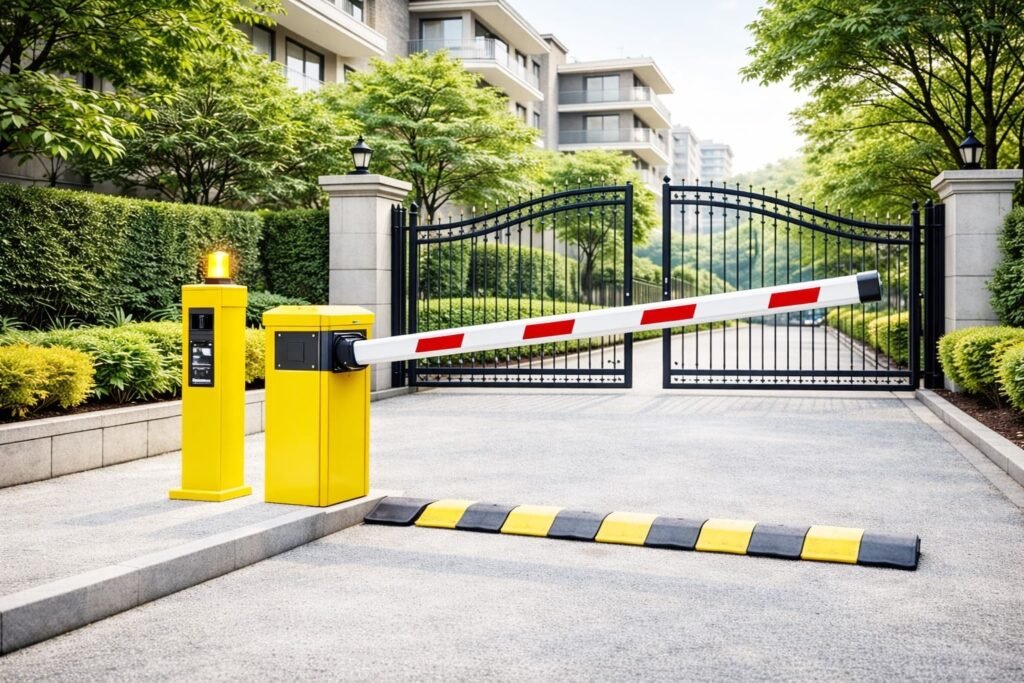
A boom barrier is a horizontal arm (3 to 6 metres long) mounted on an electric motor unit. When triggered — by an RFID card, remote, or vehicle sensor — the arm rises to 90 degrees, lets the vehicle through, then closes automatically.
For a housing society, this means:
Every vehicle that enters or exits is logged — time, date, and if you have an ANPR camera, the number plate. Your committee has a complete record accessible anytime.
Residents don’t need to interact with a guard — they tap their RFID card or the boom opens automatically as their car approaches (via loop detector). No stopping, no window rolling down.
Unauthorised vehicles cannot enter — delivery boys, cabs, and guests are stopped at the boom. They speak to the intercom or guard before the boom opens.
The barrier works 24/7 without fatigue — at 3am, at midnight during a festival, during a power cut (with UPS backup). A security guard cannot match this consistency.
How Much Does a Boom Barrier Cost for a Housing Society?
Cost depends on three variables: the barrier hardware itself, what you integrate it with, and the quality of installation. Here is how these combine into real-world packages:
Package 1 — Basic Entry Control (Small Societies, Up to 40 Flats)
Suitable for small gated communities with one entry point and a guard on duty.
What’s included:
- Full-automatic boom barrier with 3m or 4m arm
- Two remote controls for guard/committee
- Push-button for manual operation
- Basic wiring and installation
What’s not included: RFID, vehicle logging, power backup, intercom
Cost: ₹25,000 – ₹40,000 per lane
This works for small societies on a tight budget. The limitation: no vehicle log, no resident self-access, entirely guard-dependent operation.
Package 2 — RFID Resident Access System (Most Common, 50–200 Flats)
This is the standard installation for mid-size societies across Andhra Pradesh, Telangana, and Karnataka in 2026. Residents get RFID cards or stickers. The barrier opens automatically when a registered vehicle approaches.
What’s included:
- Full-automatic boom barrier with 4m arm
- RFID reader (long-range, reads from inside car)
- 50 proximity cards for residents
- Vehicle loop detector (auto-senses approaching car)
- UPS battery backup (4–6 hours during power cut)
- Full wiring, civil work, commissioning
- Staff training
Cost per lane: ₹55,000 – ₹80,000
For entry + exit (two lanes), budget ₹1,10,000 – ₹1,55,000 complete.
This is the sweet spot for most societies. Residents are happy because there’s no stopping at the gate. The committee is happy because every movement is logged.
Package 3 — Integrated Security System (Large Societies, 200+ Flats)
For large gated communities where vehicle volume is high, visitor management is complex, and the committee wants complete visibility.
What’s included:
- Fast-speed boom barrier (opens in under 2 seconds, rated for 500+ cycles/day)
- Long-range RFID reader (reads card from 3–5 metres away, no need to roll down window)
- ANPR camera (reads number plate automatically, logs every vehicle)
- Video intercom at gate (visitor presses button, resident sees on app/indoor unit, releases remotely)
- Visitor management software (pre-register visitors, OTP-based gate access)
- UPS with 8-hour backup
- Full civil, electrical, wiring, software setup
Cost per lane: ₹1,20,000 – ₹2,00,000
For a 300-flat society with 3 lanes (2 entry + 1 exit): budget ₹3,50,000 – ₹5,50,000 for a fully integrated system.
Cost by Arm Length
The arm length must match your gate opening. Getting this wrong means the barrier physically cannot close across the full width.
| Arm Length | Gate Width it Covers | Price Range (unit only) |
|---|---|---|
| 3 metres | Single narrow lane | ₹18,000 – ₹28,000 |
| 4 metres | Standard society gate | ₹25,000 – ₹38,000 |
| 4.5 metres | Wide lane, SUVs + trucks | ₹32,000 – ₹50,000 |
| 6 metres | Large commercial entry | ₹48,000 – ₹75,000 |
Measure your gate opening before calling any vendor. Most society gates fit a 4m arm.
The Real Cost Comparison: Boom Barrier vs Security Guard
This is the calculation most RWA committees do not run — and they should.
| Security Guard (1 shift) | Boom Barrier RFID System | |
|---|---|---|
| Monthly cost | ₹12,000 – ₹18,000 | ₹0 (post-install) |
| Annual cost | ₹1,44,000 – ₹2,16,000 | ₹5,000 – ₹8,000 (AMC) |
| 3-year cost | ₹4,32,000 – ₹6,48,000 | ₹85,000 – ₹1,15,000 |
| 5-year cost | ₹7,20,000 – ₹10,80,000 | ₹1,05,000 – ₹1,55,000 |
| Night coverage | Unreliable | Consistent |
| Vehicle log | Manual, inaccurate | Automatic, timestamped |
| Break-even point | — | 6–8 months |
A two-lane RFID boom barrier system pays for itself completely within 6 to 8 months compared to maintaining a guard at the gate. After that, your society saves ₹12,000–₹18,000 every single month.
Most societies keep one guard for visitor management and intercom response — but they eliminate the second guard at the gate, which is where the savings come from.
Hidden Costs That Societies Miss
Every vendor quote looks clean on paper. Here is what typically gets added later:
Civil and foundation work: The motor cabinet needs a concrete foundation (roughly 2ft x 2ft x 2ft). If your gate area is paved with tiles or concrete, breaking and relaying it costs ₹3,000 – ₹8,000 extra. Ask your vendor if this is included.
Dedicated power line: The barrier needs a dedicated 230V line from your DB board. If there is no line near the gate, adding one costs ₹5,000 – ₹15,000 depending on distance.
Conduit for cable protection: Underground or wall-mounted conduits protect wiring from damage. This is often quoted separately — ₹2,000 – ₹5,000.
Extra RFID cards: Most packages include 20–50 cards. A 100-flat society needs at minimum 200 cards (2 per flat), often more for vehicles. Extra cards cost ₹80 – ₹150 each. Budget ₹10,000 – ₹20,000 for a full resident card set.
RFID stickers for windshield: Long-range stickers that mount on the windshield (so residents never need to remove the card from their wallet) cost ₹150 – ₹250 each. Much better user experience.
Software for vehicle log access: Some systems give you a web dashboard or mobile app to view vehicle logs. This may be a one-time software cost (₹5,000 – ₹15,000) or a monthly SaaS fee.
Annual Maintenance Contract (AMC): Budget ₹5,000 – ₹10,000 per year per lane. Includes quarterly preventive maintenance, priority breakdown response, and minor spares.
How Many Barriers Does Your Society Need?
Getting the lane configuration right is as important as the barrier itself. An undersized setup creates bottlenecks that frustrate residents and defeat the purpose.
Up to 40 flats:
One combined entry+exit lane is workable if vehicle volume is low. One barrier, one lane.
40 to 100 flats:
Separate entry and exit lanes. Two barriers minimum. Residents entering on one side, exiting on the other prevents the morning rush bottleneck.
100 to 250 flats:
Two entry lanes + one exit lane. Morning peak (8–10am) sees simultaneous exits and entries — a single entry lane creates a 15-minute queue. Add a pedestrian flap barrier at the side gate for walkers so they don’t keep triggering the vehicle barrier.
250+ flats:
Full traffic study needed. Typically: two entry + two exit, dedicated visitor lane, separate service/delivery entry, ANPR on all lanes. Contact a professional for a site survey before deciding.
RFID Card Management — What Societies Get Wrong
This is the operational side that no vendor mentions during the sales pitch, and it causes the most friction after installation.
Who gets cards: Every registered vehicle gets one card or sticker. Residents typically get 2 cards per flat (resident + spouse). Facility staff (housekeeping, maintenance) get cards with time-restricted access (e.g., 7am–7pm only).
Lost card procedure: Lost cards must be deactivated immediately from the controller. If your vendor hasn’t trained someone in your committee to do this, you have a security gap. Every Raise Solutions installation includes full training on card management.
Visitor access: Visitors do not get RFID cards. They use intercom + guard release, or a time-limited OTP (available in advanced systems). Never issue resident cards to frequent visitors — this defeats the purpose of access control.
Card programming: Adding new residents, deactivating old ones, and adjusting access schedules should be something your security office can do without calling the vendor every time. Make sure the system you buy has an accessible admin panel.
What Happens When Things Go Wrong
A boom barrier is a mechanical+electrical device. Things will occasionally fail. What matters is how quickly you recover.
Power cut: Without a UPS, the barrier locks in whatever position it was in. With a UPS (strongly recommended), it runs for 4–8 hours on battery. When power resumes, it auto-syncs.
Arm collision: If a vehicle hits the barrier arm while it’s closing (common if loop detector isn’t set correctly), the arm flexes and may bend. Modern barriers have a safety torque limiter that stops the motor before the arm breaks. Budget barriers do not — you’ll need a new arm (₹3,000 – ₹8,000) plus emergency call-out.
Motor failure: Quality motors (branded units) typically last 7–10 years. Cheap motors fail in 12–18 months. When the motor fails, the barrier is stuck. If you have an AMC, the vendor responds within 24–48 hours. Without AMC, you’re finding a technician in an emergency.
Controller/software hang: The controller sometimes needs a restart — same as any electronics. Most installers program a watchdog timer that auto-restarts. If not, a manual reset takes 2 minutes.
RFID reader fault: If the reader stops responding, your residents are blocked. Keep 2–3 remote controls as backup with your security office so the guard can manually release the barrier while the reader is repaired.
Evaluating Vendors — 8 Questions to Ask Before You Commit
Most societies make their decision based entirely on price. These eight questions separate a good vendor from a bad one:
- What is the duty cycle rating of the barrier? (Should be minimum 100 cycles/hour for a society; high-rise needs 300+)
- What is the IP rating of the motor cabinet? (IP54 minimum for outdoor installation in Indian weather)
- Does the warranty cover both parts and labour? (Many cheap warranties cover parts only)
- Who does the service call if the barrier fails at 11pm? (Get a name and number, not “our team will come”)
- Can we see a live installation reference nearby? (Any credible vendor has local installations you can visit)
- What happens to the vehicle log data — where is it stored? (Cloud vs local controller — important for privacy and access)
- Is the RFID system open standard or proprietary? (Proprietary systems lock you to one vendor forever)
- What is the estimated total cost including civil, electrical, and cards — not just the barrier unit? (Ask for a written all-inclusive quote)
Boom Barrier vs Sliding Gate for Society — Which Is Better?
Some societies consider a sliding gate instead of a boom barrier. Here is how they compare for apartment use:
| Boom Barrier | Sliding Gate | |
|---|---|---|
| Speed | Opens in 1–3 seconds | Opens in 8–15 seconds |
| Cost | ₹35,000 – ₹80,000 | ₹80,000 – ₹2,00,000 |
| Space needed | Minimal | Gate needs run-back space |
| Allows tailgating | Yes (vehicle follows vehicle) | Yes |
| Maintenance | Low | Higher (track, rollers) |
| Best for | Apartment vehicle control | Full property perimeter closure |
For controlling vehicle entry and exit specifically, a boom barrier is faster, cheaper, and easier to maintain. Sliding gates make sense for full perimeter closure where you want to physically block the entire opening — not just control access.
Society Case Study: Before and After
A 120-flat gated community in Vijayawada (client of Raise Solutions):
Before installation:
- 1 security guard on day shift, 1 on night shift
- Monthly security cost: ₹28,000 (two guards)
- Zero vehicle records
- 3 reported unauthorised parking incidents in one quarter
- Residents complained about slow manual entry during morning rush
Installation:
- 2-lane RFID boom barrier (entry + exit)
- Long-range RFID stickers for all resident vehicles
- Video intercom at entry
- UPS backup
- Total cost: ₹1,28,000
After installation:
- Eliminated 1 gate guard — saving ₹14,000/month
- Full vehicle log accessible to committee via web dashboard
- Zero unauthorised parking incidents in 4 months post-installation
- Morning rush from 15-minute wait to under 3 minutes
- ROI achieved in 9 months
Frequently Asked Questions
Minimum for a functional automatic barrier with remote control is ₹25,000 – ₹35,000 per lane. For a complete RFID system recommended for most societies, budget ₹55,000 – ₹80,000 per lane.
Yes. Without an AMC, you are paying emergency rates (₹1,500 – ₹3,000 per call-out) every time something goes wrong. An AMC at ₹5,000 – ₹8,000 per year covers preventive maintenance and priority response — always the better economics.
Q: Can the boom barrier integrate with our existing CCTV?
A: Yes. The barrier trigger can sync with your CCTV DVR to auto-capture a screenshot of every vehicle entering or exiting. This requires a simple relay connection that any competent installer can configure.
Q: What is the life of a boom barrier motor?
A: Branded barriers (Roger, Came, BFT, or quality Indian brands) last 7–10 years with proper AMC. Budget barriers last 12–24 months. Always check the duty cycle rating — a motor rated for 20 cycles/hour will burn out fast on a busy society gate.
Q: Can delivery persons and cab drivers be given access without RFID cards?
A: Yes. Options include: guard-operated remote, intercom release, OTP-based access (visitor calls resident, resident sends OTP), or a separate pedestrian entry. Never give delivery personnel RFID cards.
Q: Is RWA approval needed to install a boom barrier?
A: This depends on your society’s bylaws and local municipal guidelines. In most cases, a resolution passed at an RWA general body meeting is sufficient. Check if your apartment’s association agreement covers gate modification rights.
Q: Does installation disturb existing infrastructure?
A: Minimal disturbance. Civil work (foundation drilling) takes 2–3 hours. Full installation including wiring is completed in 4–8 hours per lane. No major construction required.
Q: What if a vehicle breaks the barrier arm?
A: Modern barriers have a safety clutch or breakaway arm that absorbs the impact and prevents motor damage. Arm replacement costs ₹3,000 – ₹8,000. Report the vehicle using your CCTV footage.
Get a Free Site Survey for Your Society
Raise Solutions has installed boom barrier systems in apartment complexes and gated communities across Vijayawada, Hyderabad, Bangalore, Pune, and Mumbai.
We offer:
- Free on-site survey and gate measurement
- Written all-inclusive quote (no hidden costs)
- Reference visits to nearby installed sites
- Same-day or next-day installation in most cities
- 1-year hardware warranty + optional AMC
📞 Call or WhatsApp us to book your free site visit
📍 Serving: Vijayawada | Hyderabad | Bangalore | Pune | Mumbai
🌐 raisesolutions.in