
Every business in India tracks attendance. The question is not whether to track it — it is how.
For decades the answer was simple: a register on the front desk, a pen, and a signature. The watchman or receptionist would mark names, employees would sign in, and at the end of the month someone would count the entries and calculate payable days.
That system still exists in thousands of businesses across Andhra Pradesh today. And in thousands of those businesses it is quietly costing more money, more time and more trust than the owners realise.
This guide compares biometric attendance with manual attendance across every dimension that matters to an Indian business owner — accuracy, cost, compliance, scalability and return on investment — and gives you the honest answer about which system is right for your organisation in 2026.
What Is Manual Attendance?
Manual attendance is any system where employee presence is recorded by a human action that does not involve authentication technology. It includes:
Attendance registers — the traditional paper register where employees sign their name and time of arrival. The most widely used system in India across small businesses, shops, factories and government offices.
Excel-based attendance sheets — digital version of the register. HR or a supervisor enters attendance data into a spreadsheet at the end of each day or week. More organised than paper but equally dependent on manual input and equally vulnerable to errors and manipulation.
Punch cards — employees insert a card into a time clock that stamps the arrival and departure time. More accurate than registers for time recording but still vulnerable to buddy punching.
Supervisor-marked attendance — a team leader or department head marks attendance for their entire team on a sheet at the start or end of the day. Widely used in factories and construction sites.
All of these systems share the same fundamental weakness: they depend on human honesty and human accuracy, neither of which is perfectly reliable.
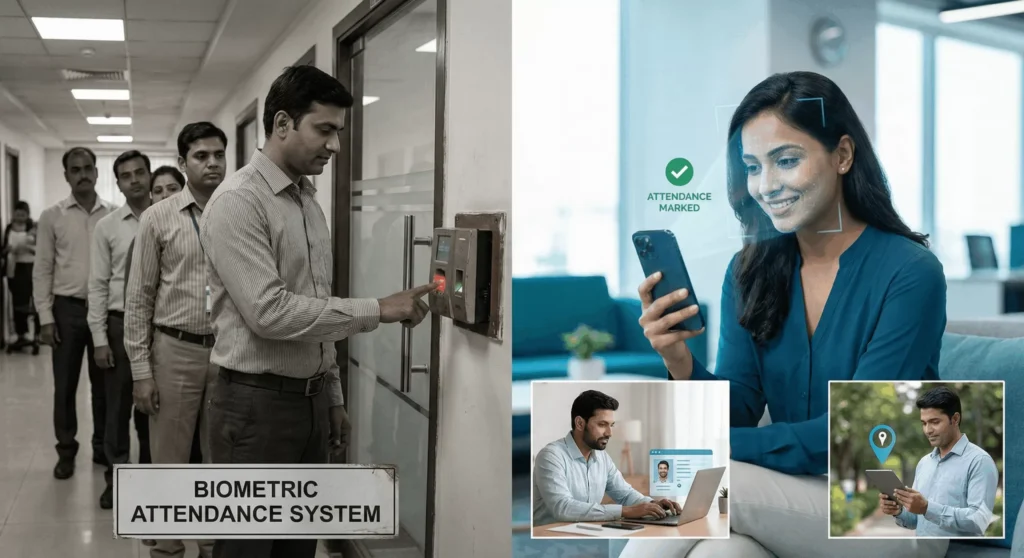
What Is a Biometric Attendance System?
A biometric attendance system records employee presence using a unique physical characteristic that cannot be shared, borrowed or faked. The most common biometric identifiers used in Indian workplaces are:
Fingerprint — the employee places their finger on a sensor. The system matches the fingerprint against the stored template and records the punch with a timestamp. The most widely used biometric method in India due to its low cost and high accuracy.
Face recognition — the employee looks at a camera. AI-powered recognition matches their face against the stored template in under one second. Completely touchless — increasingly preferred post-2020 in healthcare and food processing environments.
Iris recognition — scans the unique pattern of the iris. Highest accuracy among all biometric methods. Used in high-security environments and government installations.
Palm vein recognition — maps the vein pattern inside the palm using infrared. Touchless and highly accurate. Available on premium ZKTeco models.
In the Indian market, fingerprint and face recognition account for over 90% of all biometric attendance installations. Both are available from Raise Solutions in Vijayawada as authorised ZKTeco and eSSL dealers.
For a complete explanation of how biometric attendance systems work, read our guide: What Is a Biometric Attendance System? Complete Guide 2026
The Core Problem with Manual Attendance — Buddy Punching
Before comparing systems across every dimension, it is worth understanding the single biggest financial problem with manual attendance in Indian workplaces: buddy punching.
Buddy punching is when one employee marks attendance for a colleague who has not yet arrived or has already left. In a register-based system, Employee A signs Employee B’s name. In an Excel system, the supervisor marks everyone present regardless of actual arrival times. In a punch card system, Employee A punches Employee B’s card.
How widespread is buddy punching in India?
Studies across Indian manufacturing and services sectors consistently find that 5–10% of recorded attendance entries in manual systems are inaccurate — either due to buddy punching, rounding of arrival times, or supervisor leniency.
For a factory with 100 employees at an average salary of ₹15,000 per month:
- 5% inaccuracy = 5 employee-equivalents of salary paid without work
- Monthly loss = ₹75,000
- Annual loss = ₹9,00,000
That is nine lakhs per year lost to a problem that a ₹15,000 fingerprint terminal eliminates on day one.
Biometric vs Manual Attendance — Head-to-Head Comparison
1. Accuracy
Manual attendance: Dependent entirely on human honesty and diligence. A register can be signed by anyone with a pen. Excel sheets can be edited. Supervisors marking attendance for their teams creates a systematic bias toward over-reporting presence. Even well-intentioned manual systems have rounding errors — employees who arrive at 9:47 AM are typically marked as arriving at 9:30 AM or 10:00 AM depending on the supervisor’s preference.
Biometric attendance: Each punch is tied to a unique biological identifier. Only the registered person can clock in with their own fingerprint or face. The timestamp is recorded to the second by the device’s internal clock. There is no rounding, no approximation, no possibility of signing on someone else’s behalf.
Winner: Biometric — by a large margin
2. Buddy Punching Prevention
Manual attendance: Completely vulnerable. A register signature takes three seconds and requires nothing but a pen. Punch cards are marginally better but still easily abused — an employee can carry a colleague’s card and punch it. Excel sheets maintained by supervisors are the most vulnerable of all.
Biometric attendance: Eliminates buddy punching entirely. A fingerprint is unique to the individual and cannot be shared. A face recognition system cannot be fooled by a photograph (liveness detection is standard on modern systems). The employee who is not present simply cannot be marked present.
Winner: Biometric — eliminates the problem entirely.
3. Payroll Accuracy and Integration
Manual attendance: Attendance data must be manually transferred to payroll calculation. This introduces transcription errors. It also requires a dedicated HR resource — typically 2–4 days per month spent on attendance reconciliation for a 100-person workforce. Late submissions, disputes about arrival times and leave calculations add further complexity.
Biometric attendance: Attendance data is captured automatically and stored in the system. Most biometric attendance systems — including ZKTeco and eSSL — include software that calculates total working hours, overtime, late arrivals, early departures and absences automatically. This data exports directly to payroll software including Easy Paypro, GreytHR, Keka and SAP, eliminating manual transfer entirely.
For businesses using Easy Paypro payroll software, ZKTeco biometric terminals integrate natively — attendance data flows directly into salary calculation with no manual step. Read more: Easy Paypro Payroll Software — Raise Solutions
Winner: Biometric — saves 2–4 HR days per month, eliminates transcription errors.
4. Cost
Manual attendance — true cost breakdown:
The direct cost of a register and pens is negligible. The real costs are hidden:
| Cost Component | Monthly Estimate (100 employees) |
|---|---|
| HR time for attendance processing | ₹4,000 – ₹8,000 (2–4 days @ ₹2,000/day) |
| Buddy punching losses (5% estimate) | ₹37,500 – ₹75,000 |
| Payroll error corrections | ₹2,000 – ₹5,000 |
| Dispute resolution time | ₹1,000 – ₹3,000 |
| Total monthly hidden cost | ₹44,500 – ₹91,000 |
| Annual hidden cost | ₹5,34,000 – ₹10,92,000 |
Biometric attendance — true cost breakdown:
| Cost Component | One-time / Annual |
|---|---|
| ZKTeco fingerprint terminal (1 unit) | ₹8,000 – ₹15,000 |
| Software licence | ₹5,000 – ₹15,000 |
| Installation | ₹3,000 – ₹5,000 |
| Annual Maintenance Contract | ₹3,000 – ₹6,000/year |
| Total first-year cost (100 employees) | ₹19,000 – ₹41,000 |
| Annual recurring cost from year 2 | ₹3,000 – ₹6,000 |
Payback period: Under 1 month in most Indian businesses.
Winner: Biometric — dramatically lower true cost once hidden manual costs are counted.
5. Compliance with Indian Labour Laws
Manual attendance: Indian labour law — including the Shops and Establishments Act, the Factories Act and various state-level regulations — requires businesses to maintain accurate attendance records for each employee. A paper register technically satisfies the record-keeping requirement but provides no audit trail for disputes. If an employee claims they worked overtime that the employer disputes, a register signature provides minimal verifiable evidence.
Biometric attendance: Creates a timestamped, tamper-proof digital record of every entry and exit for every employee. This record can be produced as evidence in labour disputes, ESI and PF audits, factory inspections and tax assessments. In Andhra Pradesh, the AP Shops and Establishments Act requires employers to maintain accurate time records — biometric data satisfies this requirement with the highest possible evidentiary standard.
For government offices and PSUs in Andhra Pradesh — including APTRANSCO, APSPDCL and municipal corporations — biometric attendance is now mandatory under AP government directives.
Winner: Biometric — far stronger compliance and audit trail.
6. Scalability
Manual attendance: Works reasonably well for teams of 5 to 20. Above 50 employees, manual processing becomes a significant HR burden. Above 100 employees, multiple registers, multiple locations and shift management create a system that is genuinely difficult to manage accurately. Multi-site businesses with manual attendance typically have completely different attendance records at each location with no central view.
Biometric attendance: Scales seamlessly. The same software manages 10 terminals at 10 locations from one central dashboard. Adding a new location means adding a terminal and connecting it to the existing system — the central records update automatically. Multi-shift management, contractor attendance and guest employee tracking are all handled within the same platform.
Winner: Biometric — scales without adding HR headcount.
7. Leave Management
Manual attendance: Leave applications are typically paper-based or email-based. Cross-referencing leave records with attendance records to calculate net payable days is a manual process prone to errors. Calculating carry-forward leave balances, encashment eligibility and half-day leaves at the end of the year requires significant HR time.
Biometric attendance: Integrated leave management modules — standard in ZKTeco and eSSL software — allow employees to apply for leave digitally, managers to approve from their phone, and the system to automatically deduct approved leave from attendance calculations. Leave balances update in real time. Year-end leave reports generate automatically.
Winner: Biometric — eliminates the leave management burden.
8. Employee Disputes
Manual attendance: Disputes about attendance are common and difficult to resolve. An employee who believes they were incorrectly marked absent has no recourse beyond their own word against the supervisor’s record. These disputes damage morale, consume management time and occasionally escalate to labour complaints.
Biometric attendance: Every punch is timestamped and tied to the individual’s biometric identity. Disputes are resolved immediately by looking at the device log. There is no ambiguity — either the biometric was recorded at that time or it was not. Disputes virtually disappear after implementation.
Winner: Biometric — eliminates the source of disputes.
9. Hygiene (Post-2020 Context)
Manual attendance: A shared pen and a shared register are touched by every employee multiple times per day. In any outbreak context — COVID-19, influenza, seasonal illness — a shared-touch attendance system is a genuine hygiene risk.
Face recognition biometric: Completely touchless. No shared surface, no physical contact. The employee stands in front of the camera and the system records the punch. Increasingly specified as the standard for hospitals, food processing facilities, pharmaceutical companies and healthcare organisations.
Fingerprint biometric: Requires physical contact with the sensor. Standard hygiene protocols (sensor cleaning) address this in most environments, but for healthcare and food environments, face recognition is the better specification.
Winner: Face recognition biometric — zero contact
10. Implementation Difficulty
Manual attendance: Zero implementation effort. Buy a register, create a column format, brief the watchman. Running in ten minutes.
Biometric attendance: Requires installation of hardware, enrolment of all employees (fingerprint or face), software configuration and brief staff training. For a 50-person office, full implementation takes one working day. For a 200-person factory with multiple shift patterns, implementation may take 2–3 days.
Winner: Manual — lower implementation barrier.
This is the only category where manual attendance has a genuine advantage. And it is worth noting: the implementation effort for biometric attendance is a one-time event. The hidden costs of manual attendance recur every single month forever
Biometric vs Manual Attendance — Summary Scorecard
| Dimension | Manual | Biometric | Winner |
|---|---|---|---|
| Accuracy | Low | Very High | Biometric |
| Buddy punching | Vulnerable | Eliminated | Biometric |
| Payroll integration | Manual, error-prone | Automatic | Biometric |
| True monthly cost (100 employees) | ₹44,500–₹91,000 hidden | ₹250–₹500 | Biometric |
| Labour law compliance | Basic | Strong audit trail | Biometric |
| Scalability | Poor above 50 employees | Unlimited | Biometric |
| Leave management | Manual | Automated | Biometric |
| Dispute resolution | Difficult | Immediate | Biometric |
| Hygiene | Poor (shared pen/register) | Good to Excellent | Biometric |
| Implementation ease | Immediate | 1–3 days | Manual |
| Overall | Biometric — 9 out of 1 |
When Does Manual Attendance Still Make Sense?
Honest answer: for very small teams of under 10 people in a single location where the owner is present every day, manual attendance is adequate. The buddy punching risk is low when the owner can see who is present. The payroll processing burden is minimal. The compliance requirement is satisfied.
Beyond that threshold — more than 10 employees, multiple locations, shift work, or the owner not present on-site daily — the hidden costs of manual attendance reliably exceed the cost of biometric implementation within the first month
Which Biometric System Is Right for Your Business?
For Small Offices and Shops (5–30 employees)
Recommended: eSSL eTimeTrackLite fingerprint terminal
Price: ₹6,000 – ₹10,000 per terminal installed
Why: Entry-level fingerprint terminal with free software. Handles attendance and basic payroll calculation. Simple to install and operate.
For Medium Offices, Schools and Clinics (30–150 employees)
Recommended: ZKTeco K40 or ZKTeco uFace series
Price: ₹10,000 – ₹25,000 per terminal installed
Why: Larger fingerprint capacity, better software, multi-shift support. ZKTeco software integrates with most Indian payroll platforms including Easy Paypro.
For Factories and Manufacturing Units (50–500 employees)
Recommended: ZKTeco ProFace X or eSSL EtimeTrack Pro
Price: ₹18,000 – ₹40,000 per terminal installed
Why: Robust enclosure for factory environments, multi-shift patterns, overtime calculation, integration with factory ERP systems. Raise Solutions has completed installations across manufacturing units in Krishna and Guntur districts.
Read our sector-specific guide: Top 5 Biometric Attendance Machines for Factories in Andhra Pradesh
For Hospitals, Pharma and Food Processing (any size)
Recommended: ZKTeco ProFace X (face recognition, touchless)
Price: ₹25,000 – ₹45,000 per terminal installed
Why: Completely touchless. No shared surface. Liveness detection prevents spoofing. Meets hygiene standards for healthcare and food environments.
For Government Offices and PSUs in Andhra Pradesh
Recommended: ZKTeco or eSSL UIDAI-compliant terminals
Why: AP government mandates biometric attendance for all departments. Terminals must be UIDAI-compliant for Aadhaar-based authentication. Raise Solutions is MSME and NSIC registered — eligible for government procurement and GeM supply.
Frequently Asked Questions
Biometric attendance is mandatory for government employees in Andhra Pradesh under AP government directives, including APTRANSCO, APSPDCL, municipal corporations and all state government departments. For private businesses, it is not legally mandatory but is strongly encouraged by labour departments given its role in accurate compliance record-keeping. Many industries — pharmaceuticals, food processing, ITES — specify biometric attendance in their own internal HR policies.
Conclusion — The Answer Is Clear
Manual attendance was the right solution for Indian businesses in 1990. In 2026 it is a significant and unnecessary cost.
The hidden cost of manual attendance — buddy punching losses, HR processing time, payroll errors and dispute resolution — reliably exceeds the total cost of a biometric system within the first month of operation for any business with more than 10 employees. From month two onwards, the biometric system is paying for itself every day.
The implementation effort is one working day. The payback period is under four weeks. The ongoing cost is minimal. The compliance and audit trail benefit is permanent.
For any business owner in Andhra Pradesh who is still running a paper register or an Excel attendance sheet and wondering whether it is worth switching — the answer is unambiguously yes.
The only remaining question is which system to choose, which brand to trust, and who to call for installation.
Ready to Switch to Biometric Attendance?
Raise Solutions is Vijayawada’s authorised ZKTeco and eSSL dealer — supplying, installing and maintaining biometric attendance systems for offices, factories, hospitals, schools and government premises across Andhra Pradesh.
Free site visit. Transparent all-inclusive pricing. Genuine products with manufacturer warranty. Complete payroll integration. Local AMC team.
📞 +91 94926 67817
📞 +91 85229 59096
📧 info@raisesolutions.in
🌐 www.raisesolutions.in
📍 1st Floor, Pradham Building, beside Indian Oil Petrol Pump, Nidamanuru Road, Poranki-521137, Vijayawada
Serving Vijayawada · Guntur · Amaravati · Tirupati · Vizag · All of Andhra Pradesh