
If you’re securing a gate for your apartment complex, factory, office, or villa, you’ve probably come across two options: a boom barrier and a sliding gate. Both control vehicle access. Both look professional. But they work very differently — and choosing the wrong one can cost you money, space, and daily frustration.
This guide breaks down the difference clearly, so you can make the right call for your property.
What Is a Boom Barrier?
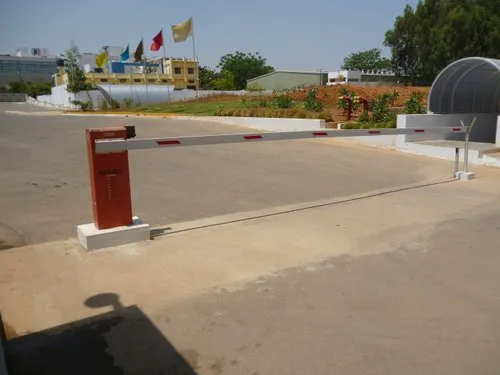
A boom barrier (also called a boom gate or barrier gate) is a horizontal arm that rises and falls to allow or block vehicle entry. The arm lifts up when a vehicle is authorized — through RFID, remote control, or a security guard — and comes back down after the vehicle passes.
You’ve seen these at:
- Apartment complexes and gated communities
- Office parking lots
- Toll plazas
- Hotels and hospitals
- Industrial facilities
Boom barriers are designed for high-frequency vehicle movement — they can cycle up and down hundreds of times a day without wearing out quickly.
What Is a Sliding Gate?
A sliding gate is a full gate panel — usually made of steel, iron, or aluminum — that slides horizontally along a track to open and close. It covers the entire width of the entrance and acts as a physical barrier.
Sliding gates are common at:
- Independent houses and villas
- Factories and warehouses
- Government buildings
- High-security facilities
Unlike a boom barrier, a sliding gate fully encloses the entrance when closed — no vehicle or person can pass through unless it’s open.
Boom Barrier vs Sliding Gate — Key Differences
| Feature | Boom Barrier | Sliding Gate |
|---|---|---|
| Physical barrier | Partial (arm only) | Full (complete closure) |
| Vehicle throughput | Very high | Moderate |
| Opening speed | 1–3 seconds | 5–15 seconds |
| Space required | Minimal | Needs side clearance for gate travel |
| Security level | Moderate | High |
| Cost | ₹25,000 – ₹80,000 | ₹60,000 – ₹3,00,000+ |
| Maintenance | Low | Moderate to high |
| Motor wear | Low (arm is lightweight) | Higher (heavy panel) |
| Pedestrian control | No | No (need separate gate) |
| Automation | Standard | Standard |
| Best for | High-traffic vehicle entry | Perimeter security, low-frequency entr |
When to Choose a Boom Barrier
A boom barrier is the right choice when:
1. You have high vehicle traffic
Apartments with 100+ flats, office buildings, shopping malls — anywhere vehicles enter and exit dozens of times per hour. A boom barrier can handle 600+ cycles per day. A sliding gate would wear out much faster under the same load.
2. Speed matters
A boom arm opens in 1–2 seconds. A sliding gate takes 8–12 seconds to fully open. At peak hours — morning office rush, apartment evening traffic — those extra seconds create long queues.
3. You have limited side space
Sliding gates need room beside the entrance to slide open. If your driveway is flanked by walls, pillars, or a compound wall, a sliding gate may not fit. A boom barrier only needs space above the lane.
4. Budget is a constraint
A good quality boom barrier with RFID automation costs ₹30,000–₹60,000 installed. A motorized sliding gate of similar width starts at ₹80,000 and can go up to ₹3 lakh for heavy-duty models.
5. You’re managing a parking lot or toll-style entry
Boom barriers are built for lane-by-lane vehicle management. They pair naturally with RFID cards, number plate recognition, and parking management systems.
When to Choose a Sliding Gate
A sliding gate is the right choice when:
1. You need complete perimeter closure
A boom barrier arm can be ducked under or driven around if someone is determined. A sliding gate physically blocks the entire entrance. For factories, warehouses, or government facilities where security is paramount, this matters.
2. Traffic is low frequency
An independent house or a small office with 10–20 vehicle movements per day doesn’t need the speed of a boom barrier. A sliding gate is more than adequate.
3. Aesthetics matter
For bungalows, farmhouses, and premium villas, a custom fabricated sliding gate looks far more elegant than a boom arm. It becomes part of the property’s visual identity.
4. You want to keep out pedestrians too
A boom barrier only stops vehicles — anyone on foot can walk right past it. A sliding gate with a separate pedestrian door controls both vehicle and foot traffic in the same entry point.
5. The entrance is wide
For entrances wider than 6 metres, fitting multiple boom barriers gets complicated. A single wide sliding gate may be a cleaner solution — though bi-parting sliding gates are available for very wide openings.
What About a Swing Gate?
Many properties also consider swing gates (gates that open inward or outward on hinges). Compared to sliding gates, swing gates need space in front of or behind the gate to swing open — which rules them out on busy roads or tight driveways. Sliding gates are almost always better in urban Indian settings where road space is at a premium.
Can You Use Both?
Yes — and many properties do. A common setup:
- Main vehicle entry: Boom barrier with RFID, for fast daily traffic
- Perimeter wall: Sliding gate that closes at night for full security
This gives you speed during the day and complete lockdown at night. Factories and large apartment complexes often use this combination.
Cost Comparison — India 2026
Boom Barrier
| Type | Price Range (Installed) |
|---|---|
| Basic boom barrier (manual remote) | ₹25,000 – ₹35,000 |
| RFID-integrated boom barrier | ₹40,000 – ₹60,000 |
| Long arm boom barrier (6m+) | ₹65,000 – ₹90,000 |
| Full HD camera + ANPR integration | ₹1,00,000 – ₹1,50,000 |
Sliding Gate
| Type | Price Range (Installed) |
|---|---|
| Basic motorized sliding gate (3–4m) | ₹60,000 – ₹90,000 |
| Heavy-duty industrial sliding gate | ₹1,20,000 – ₹2,00,000 |
| Stainless steel / designer gate | ₹1,50,000 – ₹3,00,000+ |
| Bi-parting sliding gate (wide entrance) | ₹2,00,000 – ₹4,00,000 |
Which One Does Raise Solutions Recommend?
At Raise Solutions, we’ve installed access control systems across apartments, factories, hospitals, and corporate offices in Andhra Pradesh and Telangana. Here’s what we tell our clients:
Choose a boom barrier if you have regular, high-frequency vehicle movement and need fast, automated entry — especially for apartment complexes, offices, and parking facilities.
Choose a sliding gate if you need full perimeter security, have low vehicle frequency, or the property requires a solid gate for aesthetic or safety reasons.
Not sure which fits your property? We assess your entrance width, daily vehicle count, security requirement, and budget — and recommend the right system. We supply and install both boom barriers and sliding gate motors across Vijayawada, Guntur, Hyderabad, and surrounding areas.
Quick Decision Guide
Answer these 3 questions:
- How many vehicles enter per day?
- Under 50 → Sliding gate is fine
- Over 50 → Boom barrier is better
- Do you need to block pedestrians too?
- Yes → Sliding gate (with pedestrian door)
- No → Boom barrier works
- What’s your budget?
- Under ₹60,000 → Boom barrier
- ₹60,000+ and need full closure → Sliding gate
FAQs
It deters most vehicles but isn’t a physical blockade. A determined driver can drive through or around a boom arm. For high-security sites, pair it with bollards or use a sliding gate instead.
A quality boom barrier lasts 5–8 years with regular maintenance. Motors from brands like FAAC, BFT, and Park Plus are rated for 1–2 million cycles.
Do sliding gates work during power cuts?
Yes — most motorized sliding gates have a manual release mechanism. You can also add a battery backup UPS to keep the motor running during outages.
Can I add RFID or face recognition to a sliding gate?
Absolutely. Sliding gates can be integrated with RFID readers, intercom systems, and face recognition access control — the gate motor is triggered by the access controller instead of a remote.
What maintenance does a sliding gate need?
Track cleaning, roller/wheel lubrication every 3–6 months, and motor servicing once a year. Sliding gates with ground tracks collect dirt and debris — budget for periodic cleaning.
Is a boom barrier suitable for an independent house?
Rarely. Most homeowners prefer a sliding or swing gate for aesthetics and full closure. Boom barriers suit multi-vehicle, high-frequency entry points.
Both boom barriers and sliding gates have their place — the right answer depends on your traffic volume, security need, space, and budget. For most apartment complexes and offices in India, a boom barrier with RFID automation is the practical choice. For independent properties, factories, and sites where full perimeter control matters, a sliding gate wins.
If you’re in Vijayawada or anywhere in Andhra Pradesh and want an expert to assess your property before you invest, contact Raise Solutions — we’ll give you a straight recommendation with no upselling.