APTRANSCO manages thousands of employees across substations, division offices, circle offices, and project sites spread across the entire state of Andhra Pradesh. Tracking attendance across this geography — with staff working in shifts, across remote locations, and under strict government accountability requirements — is one of the most persistent operational challenges the organisation faces.
Manual attendance registers have well-documented problems in large government utilities. Proxy attendance, inaccurate shift records, delays in payroll processing, and the absence of a real-time audit trail are issues that surface in government audits and departmental reviews with regularity. APTRANSCO, like every major state government utility, is under consistent pressure from the state government and from its own internal audit functions to modernise its workforce management systems.
Biometric attendance systems directly address every one of these problems. This guide explains how, what systems are appropriate for APTRANSCO’s specific operational environment, what the implementation looks like in practice, and what Raise Solutions can provide for APTRANSCO divisions and sub-offices across Andhra Pradesh.
Why Manual Attendance Fails at APTRANSCO Scale
APTRANSCO operates across five transmission circles — Vijayawada, Visakhapatnam, Tirupati, Kurnool, and Nellore — with hundreds of substations, division offices, and construction project sites beneath them. The workforce includes engineers, supervisors, linemen, security staff, administrative personnel, and contract workers, spread across both urban offices and remote rural substations.
In this environment, a manual attendance register produces several predictable failures.
Proxy attendance is the most common. A colleague signs in for someone who arrives late or is absent. At a remote substation where supervisory oversight is limited, this happens regularly and is nearly impossible to detect after the fact.
Shift record inaccuracies are equally common. In a three-shift power utility environment, handover records and attendance registers are maintained separately and manually reconciled at the end of each month. Errors accumulate. Payroll processing based on inaccurate shift records produces salary discrepancies that take weeks to resolve through departmental channels.
There is no real-time visibility. A division superintendent in Vijayawada cannot see whether the lineman team at a substation in Krishna district actually reported for duty this morning without making a phone call. During grid emergencies and storm response operations, this lack of real-time deployment visibility is a genuine operational problem.
Audit trails are paper-based and incomplete. Government audits require detailed records of attendance, leave, and overtime. Paper registers are incomplete, sometimes altered, and difficult to search or compile into reports on short notice.
How Biometric Attendance Solves These Problems for APTRANSCO
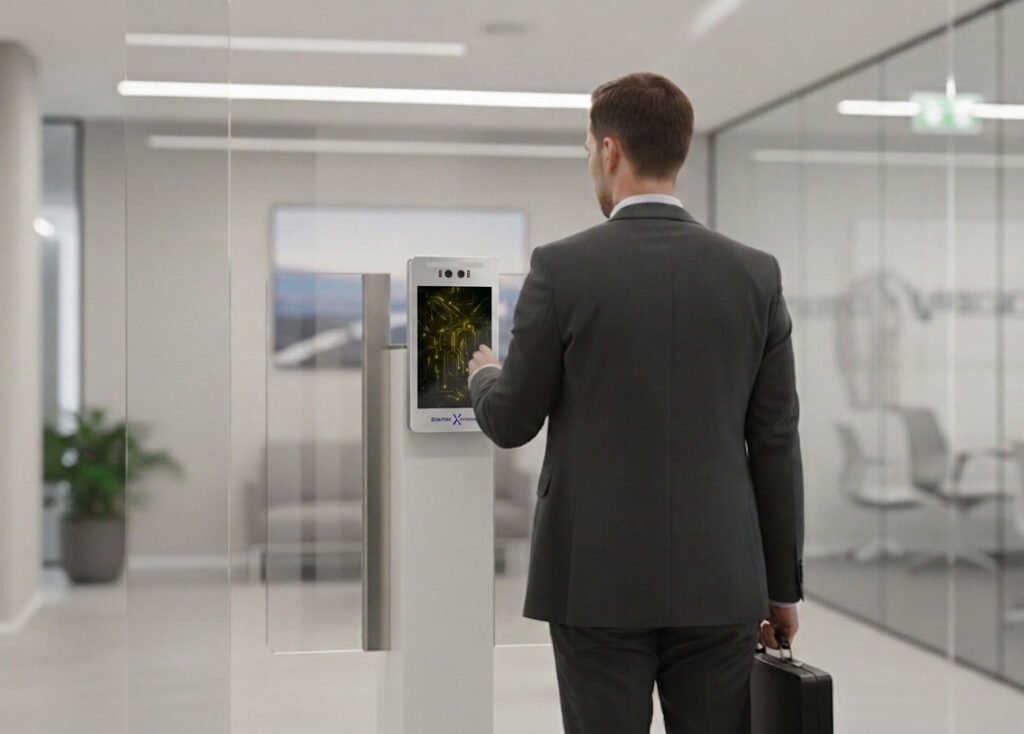
A biometric attendance system replaces the paper register with a wall-mounted device that reads a unique physical characteristic — a fingerprint, a face, or an iris — that cannot be shared, forged, or proxied. The person must physically be present at the device to mark attendance.
Every transaction — clock-in, clock-out, break, shift handover — is recorded digitally with a timestamp, a biometric verification, and the device location. This data flows in real time to a central server or cloud platform where supervisors, HR managers, and payroll administrators can access it from any internet-connected device.
For APTRANSCO specifically, this means several immediate and measurable improvements.
Proxy attendance is eliminated completely. A fingerprint or face cannot be shared. The person is either present or not, and the record is conclusive.
Shift records are automatically accurate. The system records clock-in and clock-out times precisely, calculates shift duration, flags absences, and generates overtime records automatically — without manual reconciliation at month-end.
Real-time deployment visibility becomes possible. A division office can see which substations have full staff reporting, which have absences, and which have overtime accumulating — in real time from a dashboard rather than through phone calls and paper reports.
Payroll integration is direct and automatic. Attendance data flows into payroll software — including Easy Paypro, which Raise Solutions supplies — and calculates monthly salaries, deductions, and arrears without manual data entry.
Audit readiness is built in. Every attendance record carries a biometric verification, a timestamp, and a device identifier. Reports can be generated and exported within minutes rather than compiled from paper registers over days
What Types of Biometric Systems Are Suitable for APTRANSCO Offices
APTRANSCO’s environment is not uniform. A circle office in Vijayawada with 50 administrative staff has different requirements from a remote 220 kV substation with a three-person shift team. The right system matches the environment.
Fingerprint-based attendance terminals
The most widely deployed and cost-effective option. ZKTeco and eSSL fingerprint terminals are the two most common brands in Indian government and utility deployments. They are robust, reliable, and integrate with standard HR and payroll software.
Fingerprint terminals work well for office environments, division offices, and substations where staff are indoor-based and not working with chemicals or heavy machinery that damages fingertips. Prices start from ₹5,000 to ₹15,000 per terminal depending on capacity and connectivity.
One consideration for APTRANSCO field staff: linemen and electrical maintenance teams who regularly work with cables, grease, and tools sometimes develop worn or damaged fingerprints that cause recognition failures. For these teams, face recognition or an RFID card backup option is recommended alongside fingerprint.
Face recognition terminals
Face recognition terminals do not require physical contact, work even when the person’s hands are dirty or gloved, and are increasingly the preferred choice for utility and industrial environments. Modern face recognition terminals from ZKTeco process a face scan in under half a second and maintain recognition accuracy above 99% in normal lighting conditions.
For APTRANSCO shift staff — particularly at substations and project sites where fingerprint recognition can be problematic — face recognition terminals are the more practical long-term choice. They are priced higher than fingerprint terminals at ₹15,000 to ₹45,000 per unit, but the operational reliability benefit justifies the premium in field environments.
RFID card-based systems with biometric backup
Some APTRANSCO divisions may prefer a hybrid system: RFID cards for day-to-day attendance marking, with biometric verification required for exception events such as overtime claims, leave requests, and audit-sensitive periods. This gives the speed and simplicity of card-based marking with the fraud prevention of biometric verification.
Cloud-connected vs standalone systems
For APTRANSCO circle offices and division headquarters where internet connectivity is stable, cloud-connected systems provide real-time visibility and central reporting across all locations from a single dashboard. The division superintendent can monitor attendance at every substation under their jurisdiction simultaneously.
For remote substations where internet connectivity is unreliable or absent, standalone systems with local data storage and periodic synchronisation are more appropriate. Data is stored on the device, synced to the central server when connectivity is available, and the attendance record is never lost due to network interruption.
Raise Solutions configures and deploys both types and can design hybrid networks where headquarters locations are cloud-connected and remote sites sync periodically, with the data consolidated into a single reporting platform
Integration with Government Payroll and HR Systems
APTRANSCO payroll operates under the Andhra Pradesh state government’s financial management framework, which means integration requirements differ from private sector organisations.
Biometric attendance data can be exported in standard formats — CSV, Excel, and XML — that are compatible with government payroll systems and treasury software. Where APTRANSCO uses state government HRMS platforms, Raise Solutions can configure the attendance system export to match the required data structure.
For APTRANSCO offices that want to modernise their payroll processing alongside attendance, Easy Paypro — Raise Solutions’ payroll software — handles payroll calculation, leave management, arrears, and statutory deductions, with direct import of attendance data from ZKTeco and eSSL biometric terminals. This creates an end-to-end digital workflow from attendance marking to salary disbursement with no manual data entry steps
Compliance and Government Accountability Requirements
Government utilities in Andhra Pradesh are subject to periodic audits by the Accountant General of Andhra Pradesh, internal audit departments, and state government review committees. Attendance and payroll records are a standard audit subject.
A biometric attendance system produces records that meet government audit requirements: timestamped, biometrically verified, tamper-resistant, and exportable in standard formats. The audit trail is clear, complete, and does not require manual compilation. This reduces the administrative burden on division accounts staff during audit periods significantly.
APTRANSCO’s procurement of biometric attendance systems also aligns with the Government of India’s broader push toward digital attendance systems across public sector organisations — a programme that has been progressively extended from central government ministries to state utilities and public sector undertakings.
What Implementation Looks Like in Practice for an APTRANSCO Division Office
The practical implementation process at a typical APTRANSCO division office follows a clear sequence that Raise Solutions manages end-to-end.
First, a site survey. Our engineers visit the office, assess the entry points, check the power supply and network connectivity, and recommend the right number and type of terminals for the staff strength and shift structure. A division office with 40 staff in a single shift needs a different configuration from a circle headquarters with 150 staff across three shifts.
Second, hardware supply and installation. We supply genuine ZKTeco or eSSL terminals with manufacturer warranty, install them at the recommended locations, connect them to the office network or configure them for standalone operation with periodic sync, and ensure stable power supply with UPS backup.
Third, staff enrolment. We enrol all staff biometric data — fingerprints or face templates — into the system. For larger offices, we send a team to manage the enrolment process, which typically takes one to two hours for a 40 to 50 person staff strength.
Fourth, software setup and integration. We configure the attendance management software, set up shift rules, leave policies, and overtime thresholds, and connect the system to payroll software if required.
Fifth, administrator training. We train the office administrator and HR staff on how to use the attendance dashboard, generate reports, approve leaves, handle exception cases, and export data for payroll and audit purposes.
Sixth, ongoing AMC support. After the warranty period, we offer Annual Maintenance Contracts covering preventive maintenance, software updates, and on-site breakdown response within 24 hours. Our service team is based in Vijayawada with coverage across all of Andhra Pradesh
Why APTRANSCO Divisions Choose Raise Solutions
Raise Solutions has been supplying and installing biometric attendance systems across government offices, public sector undertakings, and large organisations in Andhra Pradesh since 2012. We are an authorised dealer for ZKTeco and eSSL — the two brands most commonly specified and accepted in Indian government procurement — with a local service team in Vijayawada.
We understand the specific requirements of government utility environments: the need for systems that work reliably at remote locations, the audit and compliance documentation requirements, the integration with government payroll frameworks, and the procurement process expectations of government departments.
We provide complete documentation with every installation — technical specifications, manufacturer warranty certificates, installation completion reports, and system configuration records — in the format required for government departmental records.
For APTRANSCO procurement enquiries, empanelment, or to arrange a demonstration and quotation for your division or circle office, contact Raise Solutions at +91 85229 59096 or write to info@raisesolutions.in. We are based in Poranki, Vijayawada, and serve all APTRANSCO circles across Andhra Pradesh.
Frequently Asked Questions
ZKTeco and eSSL are the most widely accepted brands in government and public sector procurement across Andhra Pradesh. Both carry BIS certification and are compliant with government data and security standards. Raise Solutions is an authorised dealer for both brands and can provide the required documentation for government procurement processes.
Yes. Standalone biometric terminals store attendance data locally in internal memory — most models store between 50,000 and 200,000 records — and can sync to the central server whenever internet connectivity is available. No attendance records are lost during connectivity gaps. This is the standard configuration for remote substation deployments.
Raise Solutions — Biometric Attendance System Specialists serving APTRANSCO and government organisations across Vijayawada and Andhra Pradesh. ISO Certified | MSME Registered | Authorised ZKTeco and eSSL Dealer. Call +91 85229 59096 or visit raisesolutions.in.