
Andhra Pradesh is in the middle of one of the most significant industrial expansions in its history. APIIC — the Andhra Pradesh Industrial Infrastructure Corporation — is developing industrial parks, Special Economic Zones, and industrial clusters across every district of the state, attracting domestic and foreign investment through world-class infrastructure, single-window clearances, and land allotment at competitive rates. Government of Andhra Pradesh
The result is a growing network of factories, manufacturing units, and industrial facilities — in Vijayawada, Guntur, Tirupati, Visakhapatnam, Nellore, Kakinada, and beyond — each employing hundreds or thousands of workers across multiple shifts every day.
And yet, in many of these facilities, workforce attendance is still being tracked the old way. A muster roll. A register at the gate. A supervisor with a pen. A payroll team that spends three days every month trying to reconcile data that was never accurate to begin with.
That gap — between AP’s industrial ambition and its workforce management reality — is exactly what biometric attendance systems are designed to close.
In this guide, Raise Solutions explains why APIIC industrial zone factories across Andhra Pradesh are rapidly adopting biometric attendance, what the compliance requirements are, which systems work best in industrial environments, and how to implement one correctly.
What Is APIIC and Why Does It Matter for Attendance Management?
The Andhra Pradesh Industrial Infrastructure Corporation Limited was incorporated on 26th September 1973 as a wholly owned undertaking of the Government of Andhra Pradesh. Its mandate is straightforward: develop the infrastructure that makes industrialisation possible — land, roads, power, water, drainage, and civic services — so that entrepreneurs and manufacturers can focus on running their businesses. Sri Potti Sriramulu Nellore District
Today, APIIC develops Industrial Parks, Industrial Development Areas, and Special Economic Zones to promote sector-specific industries — including clusters for electronics, food processing, pharmaceuticals, automobiles, and textiles. Government of Andhra Pradesh
APIIC exercises the statutory powers and functions of local bodies in 287 industrial areas, housing complexes, mini industrial estates, and commercial complexes across the state. Sri Potti Sriramulu Nellore District
What this means in practice is simple: if your factory or manufacturing unit is located within an APIIC industrial park or SEZ in Andhra Pradesh — whether in Poranki near Vijayawada, Naidupeta near Nellore, Atchutapuram near Visakhapatnam, or Sri City near Tirupati — your operations fall under a specific set of labour law compliance requirements. And those requirements include maintaining accurate, verifiable attendance records for every worker on your premises.
The Compliance Reality for APIIC Industrial Zone Factories in 2026
Compliance is no longer a back-office concern for factory owners in Andhra Pradesh. It has become a front-line operational priority — and the rules governing attendance records have tightened significantly in the past two years.
The New Labour Codes Framework
India’s four labour codes consolidated 29 legacy laws into a single framework on November 21, 2025. Any compliance approach still referencing the old Payment of Wages Act or the Factories Act is working off a framework that no longer governs how obligations are structured. Penalties are sharper, and the Inspector-cum-Facilitator model uses data analytics to flag delayed filings and missing registers across jurisdictions in real time. ZingHR
For factory owners in APIIC industrial zones, this is a critical shift. Labour inspectors are no longer arriving with clipboards and checking paper registers on-site alone. They now have access to digital dashboards that flag inconsistencies in real time — meaning that factories with incomplete, inconsistent, or paper-based attendance records face a heightened risk of penalties even without a physical inspection visit.
Digital Attendance Records Are Now Expected
State rules increasingly mandate electronic maintenance of all workforce registers, including attendance, wage records, overtime logs, and leave records. Physical formats carry audit liability in jurisdictions that have moved to digital-first enforcement. ZingHR
Labour inspectors can now request digital records on short notice. Paper-only records will not satisfy the OSH Code requirement. AccountX
For factories in APIIC zones — which are already operating under the scrutiny of both state and central government agencies — this makes digital attendance not a luxury upgrade but a compliance necessity.
What AP Labour Law Specifically Requires
Employers in Andhra Pradesh must record employee attendance accurately, ensure overtime payments are calculated correctly, preserve leave records and service registers, and keep employment records readily available during inspections. Savvy HRMS
Employees’ attendance, overtime hours, and leaves must all be maintained as per AP rules. Wage registers must be maintained and half-yearly and annual returns must be filed. Alp Consulting
Factories Act registers must be updated continuously to reflect current worker particulars, attendance, leave, wages, and overtime. They must be available at the factory premises at all times and produced immediately on demand when a factory inspector exercises powers of inspection. Deccanlawhouse
Additionally, the Andhra Pradesh Shops and Establishments Amendment Act 2025 introduced key changes including revised working hour limits and mandatory rest interval requirements — all of which require accurate, time-stamped attendance data to prove compliance. SGC Blog
The bottom line is clear: manual attendance is no longer adequate for APIIC industrial zone factories. Biometric attendance is the only practical way to meet these requirements consistently, accurately, and without the risk of human error or manipulation.
Why Manual Attendance Fails in Industrial Zones
Before examining the solution, it is worth being honest about the scale of the problem that manual attendance creates in factory environments.
Buddy punching is endemic. In large factories with 300 to 1,000 workers arriving across multiple shift change windows, a supervisor cannot realistically verify every worker’s identity. Workers clock in for absent colleagues routinely. The result is payroll inflation that, at scale, costs factories lakhs of rupees every month.
Muster rolls get manipulated. Paper registers can be backdated, altered, or completed in bulk at the end of the day rather than in real time. During a labour inspection, a register that shows 100% attendance for 30 consecutive days is more likely to raise a red flag than reassure an inspector.
Overtime is calculated incorrectly. Without accurate timestamps at entry and exit, overtime calculations are either estimated or manually entered by supervisors — introducing both errors and opportunities for deliberate manipulation in either direction.
Payroll takes days to process. Collecting muster rolls from multiple gates, multiple shifts, and multiple supervisors, then reconciling the data and calculating wages, is a process that consumes two to four working days every month in most medium to large factories. That is time and labour cost that adds no operational value.
Compliance reports are produced retrospectively. When a labour inspector arrives unannounced, a factory relying on paper records cannot produce real-time attendance data. The best it can do is present documents that were prepared after the fact — which is both a compliance risk and a credibility problem.
Biometric attendance eliminates all of these problems in one integrated system.
How a Biometric Attendance System Works for Industrial Zones
A biometric attendance system for an APIIC industrial zone factory is not a single device — it is an integrated ecosystem of hardware, software, and network infrastructure working together.
Entry and Exit Verification
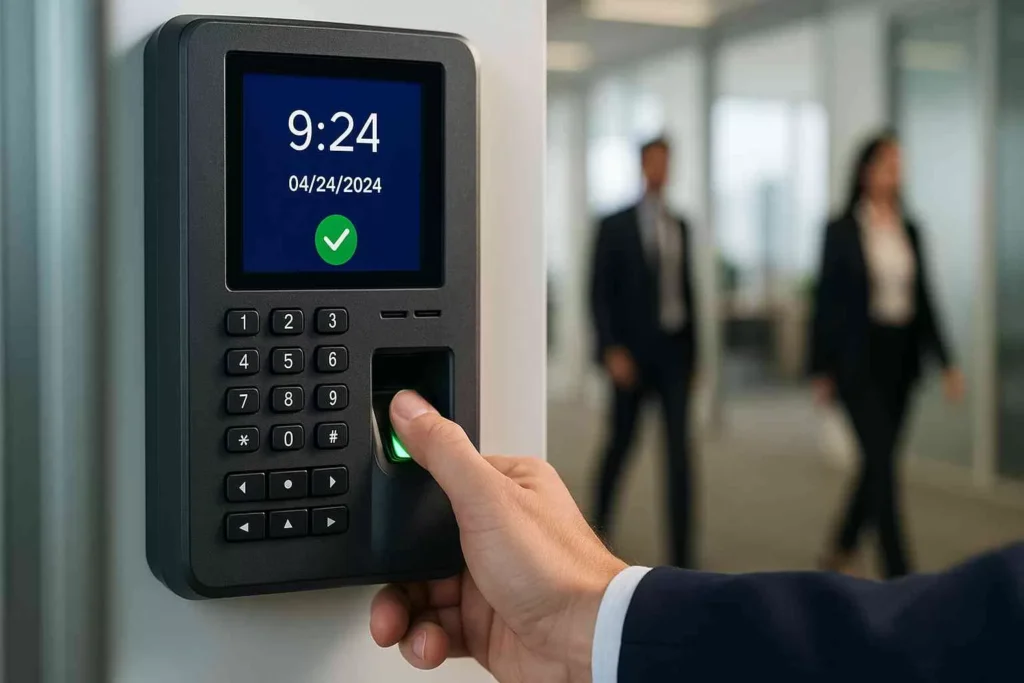
At every factory gate — whether it is the main worker entry, the goods vehicle gate, or the contractor entry — a biometric terminal is installed. When a worker arrives, they authenticate using one of three methods: fingerprint scan, face recognition, or RFID card. The system verifies their identity against the enrolled database in under one second and records a time-stamped entry log.
At shift end, the same process happens at exit. The system automatically calculates hours worked, flags workers who exited early or arrived late, and updates the attendance record in real time.
Centralised Data Management
All devices across all gates — even across multiple factory locations within the same APIIC industrial zone — connect to a central server or cloud platform. This means the HR manager can view live attendance data from all gates simultaneously from a single dashboard on their desktop or phone.
There are no registers to collect, no data to manually enter, and no reconciliation to perform at month end. The data is already there, accurate, and ready.
Automatic Payroll Integration
The attendance software exports daily attendance data directly to the payroll system — whether that is a dedicated payroll platform or the factory’s ERP software. Wages, overtime, late deductions, and leave balances are all calculated automatically based on the actual attendance records. Payroll processing time drops from days to hours.
Statutory Report Generation
Quality biometric attendance software generates the statutory registers required under Indian labour law automatically — including Form 25 (muster roll), the overtime register, the leave register, and wage records — in formats that are directly usable during labour inspections. Platforms with biometric attendance integration not only log punches but also flag anomalies, saving time and reducing compliance risk significantly. SalaryBox
Key APIIC Industrial Zones Across Andhra Pradesh and Their Workforce Challenges
Different industrial zones across AP have distinct workforce profiles — and therefore distinct biometric requirements.
Vijayawada and Krishna District Industrial Areas
The industrial areas around Vijayawada — including Poranki, Auto Nagar, and the surrounding Krishna district — are home to a diverse mix of manufacturing units in food processing, engineering, textiles, and chemicals. Workforce sizes typically range from 100 to 800 workers, with multiple shifts and high worker turnover. The primary challenge here is managing attendance across shift changes at busy gates where queues form quickly. High-speed face recognition barriers and multi-point networked biometric terminals are the recommended solution.
Guntur District Industrial Areas
Guntur’s industrial zones are dominated by agriculture-linked processing industries — cotton ginning, chilli processing, food packaging, and textile weaving. These facilities often employ seasonal workers alongside permanent staff, creating a workforce management complexity that standard attendance systems struggle to handle. Biometric systems with flexible worker enrolment — allowing seasonal workers to be added and deactivated quickly — are essential here.
Tirupati and Sri City SEZ
APIIC develops clusters for sectors like electronics, food processing, pharmaceuticals, automobiles, and textiles in Tirupati district, providing ready-built factory spaces, internal roads, water supply, and power to attract fast-moving industries and startups. Sri City — one of India’s largest integrated business cities near Tirupati — houses multinational manufacturers including PepsiCo, Kellogg’s, and Isuzu Motors, among others. These facilities require enterprise-grade biometric systems with multi-location management, cloud dashboards, and integration with global HR platforms. Government of Andhra Pradesh
Visakhapatnam Industrial Zone and APSEZ
The Andhra Pradesh Special Economic Zone near Visakhapatnam covers approximately 3,213 acres and accommodates a range of sectors including manufacturing, pharmaceuticals, engineering, logistics, and petrochemicals. These are large, complex facilities with stringent security requirements. Face recognition with mask detection, outdoor-rated biometric terminals, and integration with access control and CCTV systems are non-negotiable for SEZ-level deployments. Wikipedia
Nellore, Kakinada, and Coastal Industrial Clusters
Coastal AP’s industrial zones focus heavily on petrochemicals, aquaculture processing, and port-linked logistics. The environmental conditions — high humidity, salt air, and heat — demand biometric terminals with high IP ratings and robust housing. Additionally, these facilities often employ contract labour from multiple agencies, requiring a system that can track contractor attendance separately from permanent workforce records.
Choosing the Right Biometric System for Your APIIC Factory
Not every biometric system suits every factory. Here is how to match the right system to your specific APIIC industrial zone deployment.
For Factories with 50 to 200 Workers
At this scale, a single high-quality fingerprint and RFID terminal at the main gate — connected to attendance management software — is sufficient. The ESSL MB160 or a comparable mid-range device delivers reliable performance, handles dirty and worn fingerprints with its advanced optical sensor, and integrates with Indian payroll software.
Recommended: ESSL MB160 or ZKTeco K40 Pro
Approximate investment: ₹18,000 – ₹45,000 per terminal plus software
For Factories with 200 to 1,000 Workers
At this scale, multiple networked terminals at different gates are required. Face recognition becomes the preferred primary verification method — eliminating fingerprint issues caused by heavy manual work. The ZKTeco uFace 800 with its 8,000-face capacity and TCP/IP networking handles this scale comfortably.
Recommended: ZKTeco uFace 800 or Hikvision DS-K1T604MF
Approximate investment: ₹35,000 – ₹75,000 per terminal plus server and software
For Large Facilities with 1,000+ Workers or Multiple Gates
Enterprise-scale deployments require a centralised server, multiple high-speed face recognition terminals, real-time dashboard access, and full payroll and ERP integration. The Matrix COSEC APTA FMX with its unlimited shift configuration and built-in statutory report generation is the strongest choice for this tier.
Recommended: Matrix COSEC APTA FMX or ZKTeco enterprise series
Approximate investment: ₹60,000 – ₹1,20,000 per terminal plus server, networking, and software
For Outdoor Gate Installations
Factory gates at APIIC industrial zone boundaries are often partially or fully exposed to weather. In these cases, the biometric terminal must carry a minimum IP65 rating — dust-tight and water-resistant. The Suprema BioStation 2 with its IP65 certification and -20°C to 50°C operating range is built precisely for this requirement.
Recommended: Suprema BioStation 2 or Hikvision DS-K1T604MF
Operating temperature range: -20°C to 60°C depending on model
For Facilities with Mandatory PPE Compliance
In pharmaceutical manufacturing, food processing, chemical plants, and any facility where workers wear face masks, safety helmets, or protective eyewear, standard face recognition systems fail. The Hikvision DS-K1T604MF with its deep learning algorithm and mask detection capability is designed to authenticate workers accurately even when PPE obscures significant portions of the face.
Recommended: Hikvision DS-K1T604MF
Key feature: Mask-compliant face recognition, AI-powered deep learning
Key Features Your APIIC Factory Biometric System Must Have
When evaluating biometric attendance systems for an industrial zone deployment, Raise Solutions recommends insisting on the following features as non-negotiable:
Multi-modal verification — at minimum fingerprint and face recognition, with RFID card as a fallback. No single verification method works reliably for 100% of workers in an industrial environment.
Offline operation with local data storage — power fluctuations and network outages are realities in many AP industrial zones. Your attendance system must continue recording locally even when the server connection is interrupted, then sync automatically when connectivity is restored.
Unlimited shift configuration — factories run morning, general, afternoon, and night shifts, often with rotating schedules. The software must handle all of these without manual reconfiguration every week.
Contractor and contract labour tracking — many APIIC zone factories use contract workers from multiple agencies alongside permanent employees. The system must track both categories separately and generate distinct reports for each.
Form 25 and statutory register auto-generation — the system should produce AP Factories Act-compliant muster rolls, overtime registers, and leave records automatically, without manual data entry by the HR team.
PF and ESI report exports — attendance data must be exportable in formats compatible with EPFO and ESIC filing requirements to simplify monthly statutory contributions.
Multi-location centralised dashboard — if your organisation operates more than one factory within APIIC zones, a single dashboard showing attendance across all locations is essential for management visibility and consolidated reporting.
Role-based access control — gate operators, shift supervisors, HR managers, and senior management should each see only the data relevant to their role. Unrestricted access to payroll and attendance data creates both security and compliance risks.
APTRANSCO and Government PSU Attendance: A Special Case
Alongside private APIIC zone factories, government public sector undertakings in Andhra Pradesh — including APTRANSCO (Andhra Pradesh Transmission Corporation) and its distribution companies — have their own biometric attendance requirements that differ in important ways from private sector deployments.
Government PSU facilities typically involve unionised workforces, complex grade-based pay structures, and stricter audit requirements from the Comptroller and Auditor General (CAG) and state vigilance departments. Additionally, biometric data from government facilities may be subject to state data governance policies that restrict cloud storage of employee records.
For APTRANSCO and similar government entities in AP, Raise Solutions recommends on-premise server deployments — where all data resides within the organisation’s own network — combined with biometric terminals that meet government procurement specifications (GFR-compliant procurement, GeM portal compatibility, and EMD/security deposit requirements where applicable).
The key difference from private sector deployment is the approval and procurement process. Government PSU biometric projects typically go through tender-based procurement, requiring vendors to demonstrate their authorisation certificates, product specifications, and after-sales service capability at the time of bidding.
Raise Solutions has experience supporting government procurement processes and can assist APTRANSCO divisions, AP GENCO facilities, and APIIC itself in preparing the technical documentation required for biometric attendance tenders.
Implementation: How Raise Solutions Deploys Biometric Systems in APIIC Zones
A biometric attendance deployment for a factory is not a plug-and-play exercise. Done properly, it follows a structured process that Raise Solutions has refined through multiple industrial zone deployments across Andhra Pradesh.
Phase 1: Site Assessment
First, our team visits your factory to assess the number of entry and exit points, gate dimensions, network infrastructure, power availability, worker shift structure, and existing payroll systems. This assessment typically takes half a day for a standard facility and forms the basis of the system design.
Phase 2: System Design
Based on the site assessment, we design a complete biometric ecosystem — specifying the number and placement of terminals, server configuration, network topology, software modules, and payroll integration approach. We present this as a detailed system design document before any hardware is procured.
Phase 3: Hardware Procurement and Configuration
Once the design is approved, we procure hardware from authorised brand channels — ZKTeco, ESSL, Hikvision, Suprema, or Matrix depending on the requirement. All devices are pre-configured and tested in our facility before delivery to site.
Phase 4: Installation and Networking
Our installation team handles complete on-site deployment — terminal mounting, cable routing and management, server installation, network configuration, and software setup. For outdoor gate terminals, we manage weatherproofing, conduit installation, and UPS integration.
Phase 5: Worker Enrolment
Worker enrolment — capturing fingerprint templates or face data for every employee — is one of the most time-sensitive phases of deployment. For a factory of 300 workers, this typically takes one full working day with two enrolment stations running in parallel. We manage this process entirely, ensuring enrolment quality is high enough to minimise verification failures in daily operation.
Phase 6: Payroll Integration and Testing
We configure the attendance software to integrate with your existing payroll system — whether that is a standalone payroll platform, an ERP module, or a cloud-based HRMS. We then run parallel testing for a minimum of one week, comparing biometric output against your existing attendance records to validate accuracy.
Phase 7: Training and Handover
We train your HR team, shift supervisors, and gate operators on the complete system — including daily operations, report generation, troubleshooting, and emergency procedures. Training is hands-on, conducted at your facility, and repeated until every user is confident.
Phase 8: Annual Maintenance Contract (AMC)
Following successful handover, we offer AMC plans covering preventive maintenance visits, remote technical support, firmware updates, and on-site emergency response within 24 to 48 hours for all clients across Andhra Pradesh.
Common Problems During Biometric Deployment in Industrial Zones
Raise Solutions has seen the same challenges come up repeatedly in factory biometric projects. Being aware of these upfront saves significant time and money.
Fingerprint rejection for heavy-industry workers. Workers in granite processing, cement manufacturing, chemical plants, and heavy fabrication frequently have fingerprints that are too worn or damaged for standard optical sensors. Always deploy face recognition as the primary verification method in these industries, with RFID cards as a secondary fallback.
Network reliability at gate locations. Factory gates are often far from the main office building, and running a reliable network cable to outdoor gate terminals is frequently underestimated in planning. Budget for proper outdoor-rated cabling, junction boxes, and Wi-Fi access points where wired connectivity is impractical.
Worker resistance during enrolment. Some workers — particularly older employees or those unfamiliar with biometric technology — are reluctant to enrol. Supervisory communication, union engagement where applicable, and a clear explanation of why the system is being deployed significantly reduce resistance.
Integration complexity with legacy payroll systems. Older payroll software used by many AP factories does not have standard APIs for attendance data import. Budget for custom integration development or a middleware solution when dealing with legacy systems.
Power backup planning. Gate terminals must continue operating during power cuts, which are a daily reality in many AP industrial zones. Ensure every terminal is connected to a UPS with at least four hours of battery backup.
Biometric Attendance ROI for APIIC Zone Factories: Real Numbers
The financial case for biometric attendance in an APIIC zone factory is straightforward to calculate.
Consider a factory with 400 workers at an average daily wage of ₹600. If 5% of attendance entries on any given day are fraudulent — a conservative estimate in a manual system — that represents 20 worker-days of payroll paid for workers who were absent. At ₹600 per day, that is ₹12,000 per day in phantom wages. Over 26 working days, that is ₹3,12,000 per month — or ₹37,44,000 per year.
A complete biometric attendance system for a 400-worker factory — including hardware, software, installation, and first-year AMC — typically costs ₹3,00,000 to ₹5,00,000 depending on the number of gates and software complexity.
The return on investment in the first year alone is therefore substantial — even before accounting for the savings in payroll processing time, the reduction in compliance penalties, and the elimination of overtime calculation disputes.
Frequently Asked Questions
While no single notification mandates biometric attendance specifically for APIIC zone factories, the combination of the new Labour Codes’ digital record requirements, EPFO and ESIC enforcement digitisation, and AP Labour Department’s shift toward digital-first inspections makes biometric attendance effectively necessary for any factory that wants to maintain clean compliance records. Paper-only attendance is increasingly a liability rather than an acceptable practice.
Q: Can a biometric system handle contract workers separately from permanent employees?
Yes. Quality biometric attendance systems support multiple employee categories — permanent, contract, daily wage, and trainee — with separate attendance tracking, distinct report generation, and different pay rule application for each category.
Q: What happens to attendance data if the server goes down?
All biometric terminals store attendance data locally on their internal memory — typically 50,000 to 5,00,000 records depending on the device — and sync to the server automatically when connectivity is restored. No attendance data is lost during server downtime.
Q: Can one biometric system cover multiple factory locations across different APIIC zones?
Yes. Cloud-based or multi-site networked systems allow centralised management of biometric attendance across multiple factory locations — whether they are in the same industrial zone or in different cities across Andhra Pradesh. Management gets a single dashboard showing real-time attendance at all sites simultaneously.
Q: How is biometric data protected under India’s data protection framework?
Biometric data collected for attendance purposes must be handled in accordance with the Digital Personal Data Protection Act, 2023. Raise Solutions implements data encryption at rest and in transit, role-based access controls, and data retention policies aligned with legal requirements. Employee consent for biometric enrolment is obtained and documented as part of the onboarding process.
Q: How long does a complete biometric deployment take for a 500-worker factory?
From site assessment to live operation, a standard deployment for a 500-worker single-location factory typically takes 10 to 15 working days — including hardware procurement, installation, worker enrolment, payroll integration testing, and staff training.
Q: Does Raise Solutions support tender-based procurement for government PSU projects?
Yes. We support government and PSU clients through the complete procurement process — including technical specification documentation, GeM portal empanelment support, demonstration and trial arrangements, and post-award project execution.
Why APIIC Zone Factories Choose Raise Solutions
Raise Solutions is Vijayawada’s most trusted biometric attendance deployment partner for industrial and manufacturing clients across Andhra Pradesh. We are not a product reseller — we are a complete workforce management technology partner.
Here is what sets our industrial deployments apart:
Deep industrial environment experience — we understand factory floors, outdoor gate installations, dirty fingerprint challenges, and shift management complexity in a way that generic IT vendors do not.
Authorised dealer for top brands — ZKTeco, ESSL, Hikvision, and Suprema. Every device we supply is genuine, warranty-backed, and supported through authorised service channels.
End-to-end deployment — from site survey and system design to installation, enrolment, payroll integration, and staff training. One partner for the entire project.
Local presence across Andhra Pradesh — our team is based in Vijayawada and provides on-site support across the state. When something needs attention, we are there — not calling from another city.
AMC plans with guaranteed response times — 24 to 48 hour on-site response for AMC clients across AP.
Statutory compliance expertise — we configure every system to generate AP Factories Act-compliant registers, Form 25 muster rolls, and PF/ESI-ready exports automatically.
MSME-registered and ISO-certified — a company that factory owners across APIIC zones trust with their workforce data and compliance records.
Andhra Pradesh’s APIIC industrial zones are growing fast. With APIIC developing industrial zones around Vijayawada, Guntur, Tirupati, and Visakhapatnam, the number of factories needing professional workforce management solutions is growing rapidly. At the same time, labour inspectors can now request digital records on short notice, and paper-only records will not satisfy the new OSH Code requirements. Raise SolutionsAccountX
For factory owners and plant managers operating in APIIC zones, the window for relying on manual attendance is closing. The compliance risk is real, the financial cost of attendance fraud is significant, and the technology to fix both problems is affordable, proven, and available right now.
Raise Solutions is ready to assess your facility, recommend the right system, and deploy it completely — from gate terminal to payroll output — so your APIIC zone factory is compliant, efficient, and protected.
Book your free factory site assessment today.
📞 +91 85229 59096
📧 info@raisesolutions.in
🌐 raisesolutions.in
📍 Poranki, Vijayawada, Andhra Pradesh
Serving factories and industrial units across Vijayawada | Guntur | Visakhapatnam | Tirupati | Nellore | Kakinada | All APIIC Industrial Zones in Andhra Pradesh
Raise Solutions — Your trusted partner for Biometric Attendance, Access Control, Security, and Business Automation for APIIC industrial zones across Andhra Pradesh.