
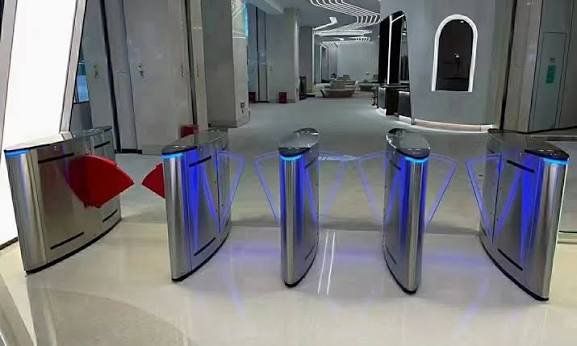
Walk into any major IT park in Hyderabad, Bengaluru, Chennai, or Pune today and you will notice something immediately. The lobby does not have a row of security guards checking ID cards and manually lifting barrier arms. Instead, there is a sleek row of stainless steel flap barriers, a face recognition terminal, and perhaps one guard sitting at a monitoring desk — watching a screen rather than standing at a gate.
This shift is not accidental. It is the result of a very deliberate business decision that thousands of Indian IT companies have made over the last five years. Flap barriers pay for themselves. And in most cases, they pay for themselves faster than the finance team expects.
This blog explains exactly how that happens — with real numbers, real use cases, and a clear breakdown of what you can expect if you are considering making the switch at your IT park or corporate campus.
The Real Cost of a Security Guard at Your Entry Gate
Before talking about flap barriers, it is worth being honest about what a security guard at your entry gate actually costs.
Most facility managers think of security guard cost as the monthly salary figure on their payroll. That number is usually somewhere between ₹12,000 and ₹18,000 per month for a trained security guard in Andhra Pradesh and Telangana. It feels manageable.
However, the true cost is significantly higher once you account for every component:
Basic monthly salary: ₹12,000 – ₹18,000
Provident Fund contribution (employer): ₹1,440 – ₹2,160
ESI contribution: ₹450 – ₹675
Uniform, equipment, training: ₹500 – ₹1,000 per month amortised
Relief guard cost (for leaves, sick days, weekly offs): ₹2,500 – ₹4,000
Overtime during extended hours: ₹1,500 – ₹3,000
Security agency margin (if outsourced): 15–25% on top
When you add everything together, the real cost of a single security guard at a vehicle or pedestrian entry point in Vijayawada or Hyderabad is typically ₹20,000 – ₹28,000 per month — not ₹15,000.
Now multiply that by two, because most entry points require at least two shifts per day. For a 24-hour operation with three shifts, you are looking at three guards per gate — costing ₹60,000 – ₹84,000 per month per entry point.
A medium-size IT park with four entry points — two vehicle gates and two pedestrian entry lanes — is spending ₹2,40,000 – ₹3,36,000 every single month on security guard deployment at entry points alone. That is ₹28,80,000 – ₹40,32,000 per year.
These are the numbers that make IT park facility managers suddenly very interested in flap barriers.
What a Flap Barrier System Actually Costs
A complete flap barrier installation for a medium-size IT park entry — covering two pedestrian lanes with RFID integration, face recognition, and access control software — typically costs the following in 2026:
Equipment cost:
- 2 flap barrier lanes (ZKTeco FBL series): ₹1,20,000 – ₹2,40,000
- 2 face recognition terminals: ₹40,000 – ₹90,000
- Access control software (lifetime licence): ₹15,000 – ₹30,000
- Online UPS (power protection): ₹10,000 – ₹18,000
Installation cost: ₹18,000 – ₹35,000
Annual Maintenance Contract (AMC): ₹15,000 – ₹25,000 per year
Total first-year investment: ₹2,18,000 – ₹4,38,000 (including GST at 18%)
From year two onwards: Only the AMC cost — ₹15,000 – ₹25,000 per year.
Compare that to the ₹28,80,000 – ₹40,32,000 per year you are spending on guards at those same entry points.
The flap barrier system pays for itself in 3 to 6 months. Everything after that is pure savings.
The ROI Calculation — Made Simple
Here is a straightforward calculation based on a real scenario from a 200-employee IT company in Vijayawada:
Before flap barriers:
- 2 pedestrian entry guards per shift × 3 shifts = 6 guards at pedestrian entry
- Average guard cost including all components: ₹22,000 per month
- Total monthly spend on pedestrian entry guards: ₹1,32,000
- Annual spend: ₹15,84,000
After flap barriers:
- 2-lane flap barrier with face recognition: ₹3,20,000 total installed cost
- Guards retained: 1 (monitoring desk only, not actively managing entry)
- Monthly guard cost after: ₹22,000
- Annual guard cost after: ₹2,64,000
- Annual AMC for flap barrier: ₹18,000
- Total annual cost after: ₹2,82,000
Annual saving: ₹13,02,000
Payback period: 2.9 months
This calculation is conservative. It assumes retaining one guard for monitoring. Many IT parks reduce this further by connecting the flap barrier system to a centralised security operations centre where one guard monitors multiple entry points across the entire campus simultaneously.
Why IT Parks Specifically Benefit More Than Other Sectors
Flap barriers deliver measurable cost savings across many industries. However, IT parks and corporate campuses benefit disproportionately for five specific reasons.
Reason 1 — High, predictable footfall volumes
IT parks typically have 500 to 5,000 employees reporting for work within a two to three hour window every morning, and leaving within a similar window every evening. This creates a massive peak-hour pressure on entry points that human guards physically cannot manage efficiently.
A security guard can process approximately 15 to 20 employees per minute during a rush — and only if every employee has their ID card ready, the guard is fully alert, and no one asks any questions. In reality, peak-hour queues at manually managed IT park entries regularly stretch to 10 to 20 minutes.
A single flap barrier lane processes 40 employees per minute. Two lanes handle 80 per minute. The queue problem disappears entirely, and with it the daily frustration that affects employee morale and punctuality records.
Reason 2 — Multiple entry points create compounding savings
A large IT park might have 6 to 10 pedestrian entry points — main lobby, parking structure entry, cafeteria access, server room corridor, and so on. Each point previously required guard deployment. Flap barriers at every point are managed centrally from one access control dashboard, with one or two staff monitoring the entire campus.
The savings compound with every additional entry point that gets automated.
Reason 3 — Compliance and audit requirements
IT companies — particularly those serving international clients — face strict audit requirements around physical security. ISO 27001, SOC 2, and client-mandated security audits all require documented evidence of who accessed which area of the building and when.
A security guard manually checking badges produces no reliable audit trail. A flap barrier system produces a complete, timestamped, tamper-proof log of every entry and exit — by individual, by door, by time — that is searchable, exportable, and indisputable.
When an IT company’s security audit previously required weeks of manual log compilation, the flap barrier system reduces that to a five-minute report export. Compliance teams across Hyderabad and Bengaluru IT parks report this alone as justification for the investment.
Reason 4 — Contractor and visitor volumes are high
IT parks deal with a constant flow of contractors, delivery personnel, maintenance staff, and visitors from client companies. Managing these credentials through a human guard requires physical registers, manual ID verification, and significant guard attention — often creating a second queue alongside the employee queue.
A flap barrier system with visitor management software handles all of this digitally. Visitors pre-register online or at a reception kiosk, receive a temporary QR code valid only for their approved time window, and pass through the barrier without any guard involvement. The temporary credential expires automatically.
Reason 5 — Night shift and weekend security
IT parks operate around the clock — night shifts, weekend support teams, and on-call engineers all need building access outside standard hours. Deploying guards specifically for low-footfall night and weekend access is expensive relative to the number of people being managed.
A flap barrier system handles after-hours access automatically. The same RFID card or face recognition that works during the day works at 3 AM on a Sunday — with the same security, the same logging, and zero additional guard cost.
What Changes for the Security Team
One of the most common concerns facility managers raise when considering flap barriers is the impact on their existing security team. The answer is nuanced and worth addressing directly.
Flap barriers do not eliminate the need for security personnel. They change what security personnel do.
Guards who previously spent eight hours standing at a gate — manually checking ID cards, lifting barriers, and managing queues — are redeployed to higher-value roles. These include CCTV monitoring, patrolling common areas, managing visitor reception, responding to incidents, and overseeing loading docks and service entrances.
Most IT park security managers report that this redeployment improves the overall security posture of the campus. A guard actively patrolling a 10-floor building is a significantly better security resource than a guard standing at one gate all day.
In practice, a campus that previously deployed 12 guards for entry point management often retains 4 guards in upgraded roles — delivering better overall security at one-third of the previous entry-point staffing cost.
The Productivity Benefit Nobody Talks About
There is a productivity benefit to flap barriers that rarely appears in the formal ROI calculation but is very real.
When employees spend 10 to 15 minutes queuing at a manually managed entry gate every morning, that time is not recovered during the workday. A 200-person IT office where every employee loses 12 minutes per day to entry queue time loses the equivalent of 40 employee-hours every single day — or 200 employee-days per month.
At an average billing rate of ₹500 per employee-hour for a mid-tier IT company, that queue is costing the business ₹20,000 per day in lost productive time.
Flap barriers process the same 200 employees in under 5 minutes. The 10 minutes recovered per employee per day translates to a productivity gain that dwarfs the installation cost within the first month.
While this benefit is harder to quantify precisely, it is consistently mentioned by IT park facility managers as the most immediately visible change after installation — because employees notice and appreciate it within the first week.
How Integration Multiplies the Value
A standalone flap barrier that simply opens and closes delivers the cost savings described above. However, when integrated with other systems, the value multiplies significantly.
Integration with HR and payroll software eliminates manual attendance registers entirely. Every flap barrier entry and exit is automatically logged against the employee’s ID and fed into the attendance system. Overtime, shift hours, late arrivals, and early departures are all captured automatically — saving HR teams 20 to 40 hours per month in manual data entry and significantly reducing payroll disputes.
Integration with CCTV means every barrier event is time-stamped and linked to the corresponding camera footage. If a security incident occurs near an entry point, the access control log immediately narrows the investigation to the specific individuals who were present — no manual footage review required.
Integration with visitor management software creates a fully digital visitor workflow. Pre-approved visitors receive digital passes, check in at a self-service kiosk, and pass through the barrier without guard interaction. The system automatically notifies the host employee when their visitor arrives, and the visitor’s pass expires the moment their approved time window ends.
Integration with fire alarm systems ensures the flap barriers fail open during emergencies — all lanes retract immediately, creating maximum evacuation width. This is both a safety requirement and a compliance necessity for most Indian commercial building codes.
Common Objections — Addressed Honestly
“What if the system breaks down during peak hours?”
Quality flap barriers from brands like ZKTeco and Essl are rated for 3 to 5 million open/close cycles — equivalent to 8 to 12 years of continuous operation at a busy IT park. Mechanical failure during operation is rare. However, the more relevant answer is that every quality flap barrier includes a fail-safe mode that opens all lanes automatically on system failure — so a breakdown means free passage for everyone, not a blocked entry. The right AMC with a local provider like Raise Solutions means any issue is typically resolved within 24 hours.
“Our employees are not tech-savvy enough for RFID or face recognition.”
RFID tap cards are simpler to use than a building access badge — which most IT employees already carry. Face recognition requires literally nothing from the employee except to walk toward the camera. In practice, adoption at IT parks is nearly universal within the first week, and employee complaints about the new system are almost always about how long it takes to get their credentials set up — not about using the system itself.
“The upfront cost is too high.”
The upfront cost of a complete 2-lane flap barrier installation — ₹2,50,000 to ₹4,00,000 — is recovered within 3 to 6 months at most IT parks through guard cost reduction alone. The business case is straightforward. If your finance team needs a formal cost-benefit analysis prepared for approval, Raise Solutions can prepare one based on your specific headcount, shift pattern, and current security spend — at no charge, as part of our free site survey process.
“We have a long-term contract with our security agency.”
Flap barriers do not require immediate guard reduction. Many IT parks begin by redeploying guards to other roles while the system runs in parallel — building confidence in the technology before making any staffing changes. The cost savings begin from day one of installation regardless of what happens to the guard headcount.
What to Look for When Choosing a Flap Barrier for Your IT Park
Not all flap barriers deliver the same performance in high-footfall IT park environments. Here is what matters most for this specific application.
Throughput rating — look for barriers rated at 35 to 45 persons per minute per lane. This ensures smooth flow during peak hours without queuing.
MCBF (Mean Cycles Between Failures) — for IT park use, a minimum of 3 million cycles is recommended. ZKTeco’s FBL6000 Pro is rated at 5 million cycles — the right choice for high-use environments.
Motor type — brushless DC motors are quieter, more efficient, and significantly more durable than standard DC motors. For a corporate lobby where noise matters, brushless is the only acceptable choice.
Anti-tailgating detection — this is non-negotiable for IT parks. Multi-beam infrared detection that distinguishes between one person and two people walking close together is essential. Basic single-beam systems are insufficient for IT park security requirements.
Integration API — confirm the barrier’s access control software provides an open API for integration with your HR, payroll, and visitor management systems. Closed systems that do not integrate create manual workarounds that defeat much of the efficiency benefit.
IP rating — for ground-floor lobbies, IP54 is adequate. For semi-outdoor installations near building entrances or covered walkways, IP65 is required.
Frequently Asked Questions
A standard 2 to 4 lane installation — including cabling, face recognition terminals, access control software setup, and employee credential loading — typically takes 2 to 4 days for an IT park of 200 to 500 employees. Larger campuses with multiple entry points take 5 to 10 working days. Raise Solutions schedules installations to minimise disruption — typically completing the majority of cabling and mounting work outside business hours.
In most cases, yes. If your existing cards use a standard RFID frequency — HF 13.56 MHz Mifare or LF 125kHz EM4100 — they are compatible with most quality flap barrier systems. Raise Solutions will verify compatibility during the free site survey and confirm before any purchase commitment is made.
A single flap barrier lane operating at 40 persons per minute for 8 hours of active use can theoretically handle 19,200 person-passages. In practice, IT park peak-hour usage is concentrated in a 2-hour window, and 2 lanes comfortably handle 500 to 800 employees during peak hours without queuing.
Why Raise Solutions Is the Right Partner for Your IT Park
Raise Solutions has delivered flap barrier installations across IT offices, campuses, and commercial facilities throughout Vijayawada, Guntur, and Andhra Pradesh. As an authorised dealer for ZKTeco and Essl — two of the most trusted names in access control — we supply genuine products with valid warranties, not grey-market alternatives.
More importantly, we understand that an IT park installation is not just a hardware purchase. It is a security infrastructure project with implications for HR, payroll, compliance, visitor management, and employee experience. Our approach covers all of it — from the initial site survey and system design through to installation, integration, staff training, and long-term AMC support.
When you call Raise Solutions, you speak to a local engineer who can visit your site the same day or the next. When your system needs maintenance, the response comes from a team based in Vijayawada — not from a national call centre routing a ticket to the nearest available technician three cities away.
Ready to Calculate Your Savings?
If you manage an IT park, corporate office, or commercial campus in Vijayawada or anywhere in Andhra Pradesh — we will prepare a free, detailed cost-benefit analysis based on your specific situation.
No obligation. No sales pressure. Just a clear set of numbers that tells you exactly how long it will take for a flap barrier system to pay for itself at your premises.
📞 Call: +91 85229 59096
📧 Email: info@raisesolutions.in
🌐 Website: www.raisesolutions.in
📍 Location: Poranki, Vijayawada, Andhra Pradesh
Smart security. Lower costs. Better results.