
You have seen them at every airport, mall entrance, court, hotel lobby, and government office in India. You place your bag on the conveyor belt, it disappears behind a curtain of rubber strips, and seconds later it comes out the other side — scanned, cleared, and ready for you to collect.
But what actually happens inside that machine? How does a baggage scanner see through a closed bag without opening it? How does it tell a laptop from a weapon? And why does it show everything in orange, blue, and green instead of black and white?
This guide answers all of it — in plain language, without the engineering jargon.
💡 Raise Solutions supplies and installs baggage scanners (X-ray security systems) for hotels, malls, corporate offices, courts, hospitals and events across Vijayawada and Andhra Pradesh. Call +91 8522959096 for specifications and pricing.
What is a Baggage Scanner?
A baggage scanner — also called an X-ray baggage screening system or luggage scanner — is a security device that uses X-ray radiation to create a detailed image of the contents of a bag, suitcase, or parcel without physically opening it.
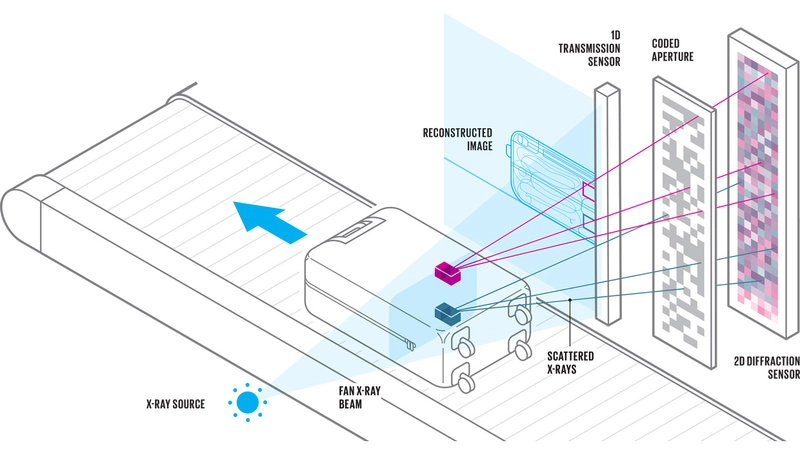
The image is displayed on a monitor, where a trained security operator analyses the contents of the bag. If something suspicious is detected — a weapon, prohibited item, or unusual density object — the operator flags the bag for manual inspection.
Baggage scanners are the first line of defence at any controlled entry point. They allow security personnel to screen hundreds of bags per hour without the chaos and delay of manually opening every single piece of luggage.
A Brief History — From Airports to Everywhere
X-ray baggage scanning technology was first developed for airport security in the 1970s following a wave of aircraft hijackings. Early systems produced basic black-and-white silhouette images — useful but limited.
By the 1990s, colour-coded dual-energy X-ray systems became standard at airports worldwide. After the September 11 attacks in 2001, the technology spread rapidly beyond airports into government buildings, courts, railway stations, hotels, and corporate campuses globally.
In India, the deployment of baggage scanners accelerated significantly after the 2008 Mumbai attacks. Today, CISF, state police, courts, Rajya Sabha and Lok Sabha premises, five-star hotels, metro stations, and major corporate campuses across India operate baggage X-ray systems as a mandatory security layer.
How Does a Baggage Scanner Work — Step by Step
Step 1 — The Bag is Placed on the Conveyor
The passenger or visitor places their bag, purse, laptop bag, or parcel onto the conveyor belt at the entry point of the scanner. Metal trays may be used for loose items like phones, wallets, and keys.
Step 2 — The Conveyor Moves the Bag into the Tunnel
The motorised conveyor belt carries the bag into the scanner’s tunnel — typically a 600mm x 400mm or 800mm x 600mm rectangular opening (dimensions vary by model). Lead-lined rubber curtains at both ends of the tunnel contain the X-ray radiation inside the machine.
Step 3 — X-Ray Beams Are Generated
Inside the tunnel, an X-ray generator (the X-ray tube) emits a fan-shaped beam of X-ray radiation. The beam is aimed diagonally across the conveyor belt at the moving bag.
X-rays are a form of electromagnetic radiation — the same family as visible light but at a much higher energy level and much shorter wavelength. This high energy allows X-rays to penetrate through most materials that block ordinary light — fabric, leather, plastic, paper, thin metal — while being absorbed or attenuated to different degrees depending on the density and atomic number of the material.
Step 4 — X-Rays Pass Through the Bag and Its Contents
As the X-ray beam passes through the moving bag, different materials inside absorb different amounts of radiation:
- Dense materials (metals, heavy objects) absorb more X-rays — less radiation reaches the detector on the other side
- Less dense materials (clothing, paper, plastic) absorb less — more radiation passes through
- Organic materials (food, drugs, explosives) have a characteristic absorption pattern based on their atomic composition
Step 5 — Detectors Capture the Transmitted X-Rays
On the opposite side of the bag from the X-ray source, an array of X-ray detectors — typically scintillation detectors or photodiodes — captures the radiation that passed through the bag. Different detectors in the array are sensitive to different energy levels of X-rays.
Modern dual-energy scanners use two sets of detectors:
- High-energy detectors — capture X-rays that pass through denser materials
- Low-energy detectors — capture X-rays that are absorbed by lower-density materials
The difference between the high-energy and low-energy readings for each point in the image tells the system the effective atomic number of the material at that point.
Step 6 — A Computer Processes the Data in Real Time
The detector readings are fed to an onboard computer that processes thousands of data points per second as the bag moves through the tunnel. The computer uses this data to:
- Calculate the density of each object at each position
- Determine the effective atomic number (Z) of each material
- Assign a colour code to each material based on its properties
- Construct a real-time image of the bag’s contents on the operator’s screen
This entire process happens in under 1 second as the bag moves through the tunnel.
Step 7 — The Operator Analyses the Colour-Coded Image
The processed image appears on the operator’s monitor in real time — a full cross-sectional view of everything inside the bag, colour-coded by material category. The operator analyses the image for suspicious shapes, densities, or overlapping objects.
Step 8 — Bag Cleared or Flagged for Manual Inspection
If nothing suspicious is detected, the conveyor carries the bag out of the tunnel on the other side. If the operator spots something suspicious — or if automatic threat detection software flags an anomaly — the bag is stopped and directed for manual inspection.
What Do the Colours Mean?
This is the most commonly misunderstood aspect of baggage scanning. The colours on the screen are not photographs — they are computer-generated representations of material properties, specifically the effective atomic number of each material.
Orange / Brown — Organic Materials
Organic compounds — food, drugs, explosives, wood, leather, most plastics. Organic materials have low atomic numbers (carbon, hydrogen, oxygen, nitrogen) and appear in shades of orange to brown. This is why explosives and narcotics show up in orange — their organic composition matches this colour band.
Blue — Heavy Metals / Dense Inorganic Materials
High-density metals — steel, iron, lead, copper, and other heavy metals. Hard metals that absorb the most X-ray energy appear in deep blue. Guns, metal components, dense tools, and heavy electronics show up blue.
Green — Lighter Metals and Mixed Materials
Lighter metals and mixed-composition materials — aluminium, some alloys, thin metal sheets. Green sits between orange and blue on the atomic number scale.
Black — Extremely Dense or Overlapping Objects
Areas where X-rays cannot penetrate at all — very thick or dense metal objects, or areas where multiple dense objects overlap. If you see a black mass in an X-ray image, the operator cannot determine what is inside — this typically triggers a manual inspection.
✅ A simplified rule: Orange = Organic, Blue = Metal, Green = Mixed. But experienced operators understand far more nuance — the shade, shape, outline sharpness, and context of every object in the image.
Dual-Energy X-Ray — Why Two Energies?
Standard (single-energy) X-ray scanners produce a greyscale image based only on how much radiation is absorbed — essentially a density map. These systems are cheaper but less informative.
Dual-energy X-ray systems fire two different energy levels of X-rays simultaneously or in rapid alternation. By comparing how each material absorbs high-energy versus low-energy X-rays, the system can calculate the effective atomic number of each material — which is what determines the colour coding.
This is critical because density alone cannot distinguish between, for example, a block of C4 explosive and a block of hard cheese. Both have similar density. But their atomic compositions are different — dual-energy X-ray distinguishes them by their Z-number, showing the explosive as orange-organic and assigning a different shade to the food item.
Most modern security-grade baggage scanners used in hotels, malls, and airports in India are dual-energy systems.
Types of Baggage Scanners Used in India
Single-View X-Ray Baggage Scanner
The most common type — produces one cross-sectional image of the bag from a single angle. The operator sees a 2D slice of the bag’s contents. Entry-level and mid-range security deployments.
Best for: Hotels, corporate offices, malls, coaching institutes, small courts
Typical tunnel size: 600mm x 400mm
Dual-View X-Ray Baggage Scanner
Two X-ray sources at different angles produce two simultaneous images — a side view and a top view. This allows the operator to see overlapping items from multiple perspectives, significantly reducing the chance of a hidden item being missed.
Best for: Airports, major government buildings, high-security checkpoints
CT (Computed Tomography) Baggage Scanner
Uses rotating X-ray sources to produce full 3D volumetric images of bag contents. Dramatically more accurate than conventional X-ray — can detect explosives by density profile and chemical composition. Used in premium international airports. Very high cost.
Best for: International airports, defence installations, embassies
ETD (Explosive Trace Detection) Scanner
Not an X-ray system — instead uses swabbing and mass spectrometry or ion mobility spectrometry to detect microscopic traces of explosive chemicals on surfaces. Often used alongside X-ray systems for secondary screening.
Best for: High-security checkpoints as a secondary layer alongside X-ray
What Can and Cannot a Baggage Scanner Detect?
What It CAN Detect
- Firearms — guns, pistols, revolvers (show as blue/dark metal masses)
- Edged weapons — knives, blades, scissors (show as thin blue outlines)
- Explosive devices — IEDs, detonators, wiring (organic + metal combination pattern)
- Narcotics and drugs — by density and organic colour signature
- Contraband electronics — hidden devices, modified phones, jammers
- Prohibited items — aerosols, lighters, sharp tools
- Suspicious organic masses — large quantities of unknown organic material
What It Has Difficulty Detecting
- Very thin flat metal objects concealed within other flat metal items (e.g., a blade inside a book)
- Liquid explosives in small quantities (unless a dedicated liquid scanner is also used)
- Items hidden in extremely dense overlapping objects (black mass areas)
- Objects specifically designed and shaped to mimic benign items
This is why trained operators, manual inspection, and additional screening layers (HHMD, ETD) are always used alongside baggage scanners at high-security checkpoints — no single technology is sufficient alone.
Is X-Ray Baggage Scanning Radiation Safe?
This is one of the most frequently asked questions — and the answer is yes, completely safe for the bags and items inside them.
X-ray baggage scanners are not body scanners. They scan bags and luggage — not people. The radiation dose delivered to items inside the scanner is extremely low and has no effect on food, medicine, film (modern digital equipment), or electronic devices.
The lead-lined curtains and shielded housing of the scanner contain all radiation inside the tunnel. The X-ray beam is focused exclusively on the conveyor belt area and does not emit radiation outside the machine during normal operation.
Operators are positioned at a monitor several feet from the scanner tunnel — well outside any radiation zone. In continuous high-volume operation environments, operators are periodically rotated as a precautionary measure per safety guidelines.
The radiation dose from a baggage scanner is orders of magnitude lower than a medical X-ray — essentially negligible.
Key Technical Specifications to Compare When Buying
Tunnel Size
The internal opening that bags must fit through. Standard sizes: 600mm x 400mm (carry-on bags), 800mm x 600mm (larger luggage), 1000mm x 800mm (large cargo). Always confirm your largest expected bag or parcel fits through the tunnel before purchasing.
Conveyor Speed
Measured in metres per minute. Faster conveyors increase throughput but require sharper operator attention. Typical range: 0.2 to 0.5 metres per second.
Image Resolution
Measured in wire diameter (AWG) — the smallest wire the scanner can resolve in the image. The finer the wire it can detect, the higher the resolution. Quality scanners resolve 36–40 AWG wires.
Penetration
The maximum material thickness the X-ray can penetrate. Typically measured in steel penetration (mm) — standard being 30–34mm of steel. Higher penetration means denser objects can be imaged clearly.
Dual-Energy
Confirms whether the scanner produces the full colour-coded organic/metal/mixed differentiation or only greyscale density imaging.
Automatic Threat Detection (ATD)
Software that automatically flags suspicious shapes, densities, or material profiles and highlights them on the operator screen. Reduces operator fatigue and catches items that might be visually missed.
IP Rating
For outdoor or semi-outdoor installation (covered entry points, checkpoints exposed to dust). IP54 minimum for such environments.
Where Are Baggage Scanners Used in India?
Airports — all commercial airports in India operate BCAS-approved baggage screening at check-in and at security checkpoints.
Metro Stations — Hyderabad Metro, Delhi Metro, Bangalore Metro, Chennai Metro all operate X-ray baggage screening at station entry points.
Courts and Tribunals — High courts, district courts, and tribunals across India use baggage scanners at entry gates as per Supreme Court security directives.
Hotels — 5-Star and Business — Five-star hotels and large business hotels in metros and tier-2 cities including Vijayawada operate baggage scanners at guest entrances.
Shopping Malls — Large malls operate baggage scanners at main entry points, particularly in cities with elevated security requirements.
Corporate Offices and IT Parks — Large corporate campuses, especially those with government contracts or data sensitivity requirements, use baggage scanners at entry gates.
Government Buildings — Secretariats, legislative assembly buildings, collectorate offices, and PSU headquarters.
Hospitals — Large hospital campuses use scanners at main entry to restrict contraband and enhance general security.
Events and Exhibitions — High-footfall events, political rallies, religious gatherings, and trade exhibitions use portable or temporary baggage scanner setups.
Educational Institutions — Premium schools and universities are increasingly deploying scanners at main gates as part of comprehensive campus security.
Baggage Scanner Price in India — 2026 Guide
| Category | Price Range | Best For |
|---|---|---|
| Entry-Level Single Energy | ₹3,50,000 – ₹5,50,000 | Small offices, clinics, private schools |
| Mid-Range Dual Energy | ₹5,50,000 – ₹9,00,000 | Hotels, malls, courts, corporate offices |
| Premium Dual Energy | ₹9,00,000 – ₹16,00,000 | Airports, government buildings, large campuses |
| Heavy Duty / Large Tunnel | ₹14,00,000 – ₹25,00,000+ | Cargo screening, defence, major checkpoints |
⚠️ These prices are for the scanner unit. Installation, operator training, power supply setup, and AMC are additional. Always request an all-inclusive quote.
Factors that affect price:
- Tunnel size — larger tunnels cost more
- Dual-energy vs single-energy — dual costs more but gives far better threat detection
- Image resolution — higher AWG resolution costs more
- Automatic threat detection software — adds cost but reduces operator dependency
- Brand — imported European brands (Smiths, Rapiscan, L3) cost more than Asian brands
- Warranty terms — 1-year vs 3-year on parts and labour
Baggage Scanner vs DFMD vs HHMD — Which Do You Need?
Most high-security entry points use all three together — each catches what the others might miss.
| Device | Detects | Used For |
|---|---|---|
| Baggage Scanner (X-ray) | Contents inside bags and parcels | Screening all carried items |
| DFMD (Door Frame Metal Detector) | Metal on the person’s body | Screening the person walking through |
| HHMD (Handheld Metal Detector) | Metal on specific body areas | Secondary person screening or spot checks |
A complete entry security system uses all three: the bag goes through the X-ray scanner while the person walks through the DFMD, with HHMD available for secondary checks.
Frequently Asked Questions
No. The X-ray dose delivered to items inside a baggage scanner is extremely low — far lower than a medical X-ray. Food, medicine, baby formula, and electronic devices are completely safe passing through a baggage scanner
Why Choose Raise Solutions for Your Baggage Scanner?
We are not just a product supplier — we are a security systems company that has been deploying integrated access control and surveillance systems across Andhra Pradesh since 2012. When you buy a baggage scanner from Raise Solutions, you get:
- ✅ Genuine products — full manufacturer warranty, proper GST invoice
- ✅ Free site assessment — right tunnel size and model for your entry point
- ✅ End-to-end service — supply, delivery, installation, and operator training
- ✅ Integration with DFMD, HHMD, and CCTV for a complete entry security system
- ✅ AMC available — scheduled maintenance and priority breakdown response
- ✅ ISO Certified | MSME Registered | NSIC Recognised
- ✅ Local presence in Vijayawada — fast on-site response across AP
📞 Get Specifications & Pricing Today
Call: +91 8522959096
Email: info@raisesolutions.in
Website: raisesolutions.in
Visit: Nidamanuru Road, Poranki, Vijayawada, Andhra Pradesh – 521137
Tell us your premises type, expected daily footfall, and tunnel size requirement — we will recommend the right baggage scanner with full pricing within 24 hours.