
Walk into any modern corporate office, IT park, or hospital in Vijayawada today and you will notice something that was barely seen here five years ago — a sleek, gold-lit barrier at the entrance that opens the moment you tap your card or scan your face, and closes silently behind you.
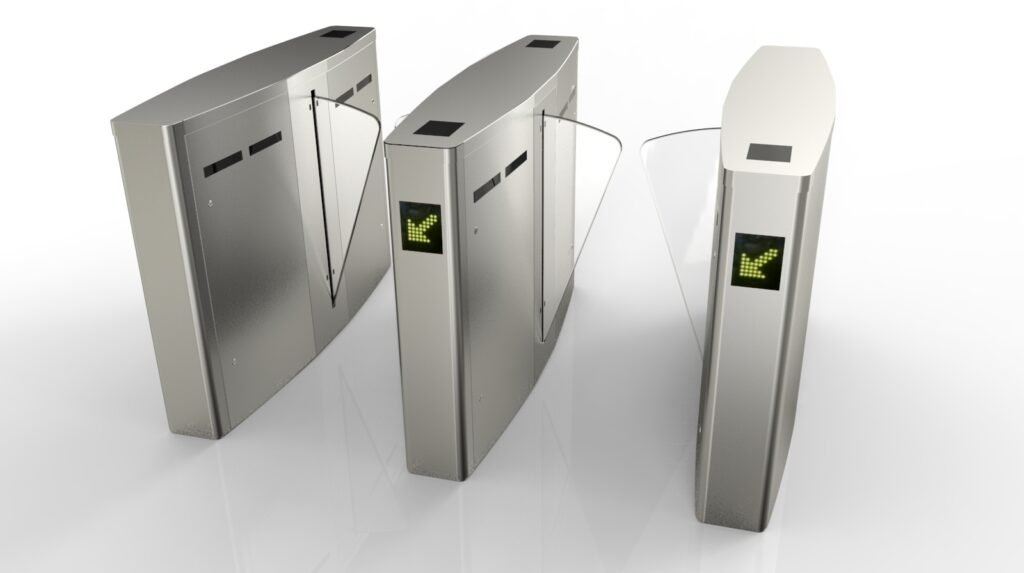
That is a flap barrier. And in 2026, it is becoming the standard entry system for serious businesses across Vijayawada, Guntur, Amaravati and the wider Andhra Pradesh region.
So what is driving this shift? Why are businesses that managed perfectly well with a security guard and a register suddenly investing in automated pedestrian access control?
The answer is not one reason. It is five — and each one has a direct impact on your security, your costs, your compliance, and your reputation as a modern business.
Let us break them down.
Reason 1: Proxy Attendance Is Costing Vijayawada Businesses Lakhs Every Year
Let us start with the most expensive problem that most business owners quietly ignore.
Proxy attendance — where one employee marks present on behalf of another — is rampant across offices, factories and institutions in Andhra Pradesh. It is not always malicious. Sometimes it is a favour between colleagues. Sometimes it is organised fraud. Either way, your business pays the price.
Here is what the numbers look like in a typical 100-person Vijayawada office:
If just 5 employees mark proxy attendance for colleagues who are late or absent twice a week, you are paying for approximately 520 false working days per year. At an average daily wage of ₹700, that is ₹3,64,000 per year flowing out of your business for work that was never done.
A flap barrier with face recognition or biometric integration eliminates this. The gate only opens for the person who is physically standing in front of it. Their face or fingerprint is their credential. No one can mark attendance on their behalf — not a colleague, not a friend, not even a manager.
The attendance record generated is 100% accurate, timestamped, and photo-verified. It syncs directly to your payroll software, so salary is calculated only for hours actually worked.
For most Vijayawada businesses, the flap barrier pays for itself in under 12 months purely from attendance fraud savings. Everything after that is profit.
Reason 2: A Security Guard Alone Is No Longer Enough
This is a conversation that many business owners in Vijayawada need to have openly.
A security guard at the entrance costs your business ₹12,000–₹18,000 per month in salary, or ₹1.44 lakh–₹2.16 lakh per year. That is before you factor in provident fund, ESI contributions, leave, overtime, and replacement costs when the guard is sick or quits.
And what does that guard actually give you?
A human being who can be distracted, bribed, deceived, or simply unable to remember the faces of 200 employees. A guard cannot verify identity with certainty. A guard cannot log every entry and exit with a timestamp. A guard cannot send an alert when someone enters a restricted zone. A guard cannot generate a report showing who was in the building at 11 PM last Thursday.
A flap barrier can do all of this — automatically, accurately, and without a salary.
This is not about replacing human beings entirely. Most offices in Vijayawada keep one guard for general assistance and visitor reception. But the primary access control function — verifying who enters, logging every movement, and preventing unauthorised access — is now handled by the system.
The result is better security at lower long-term cost. A two-lane flap barrier system fully installed costs ₹1.5 lakh–₹2.8 lakh once. The annual maintenance cost after that is ₹16,000–₹24,000. Compare that to ₹2.88 lakh–₹4.32 lakh you would spend on two guards over the same two years — and the flap barrier is clearly the smarter investment.
Reason 3: Vijayawada’s Business Growth Has Made Visitor and Contractor Management a Real Problem
Vijayawada is no longer a tier-2 city quietly going about its business. The growth of the Amaravati capital region, the expansion of industrial corridors in Krishna district, and the rise of IT and logistics companies in areas like Poranki and Auto Nagar have brought a new challenge to local businesses — managing a constant flow of visitors, contractors, vendors, and temporary workers.
In a small 20-person office, the owner probably knows everyone by face. In a 150-person office with daily vendor visits, contractor teams, client delegations, and delivery personnel, it is physically impossible to track who is on your premises at any given moment using manual methods.
This creates serious security vulnerabilities. Confidential documents can be accessed. Equipment can be removed. Sensitive areas like server rooms, accounts departments, and MD cabins are exposed to people who have no business being there.
A flap barrier with visitor management integration solves this precisely. Here is how a typical flow works in a modern Vijayawada office:
A vendor arrives at the reception. The receptionist registers them in the visitor management system — name, company, phone number, photo, and the person they are visiting. A temporary access pass is issued — either a printed card or a QR code on their phone. The flap barrier opens only for that specific pass, only for the approved time window. When the vendor leaves, their exit is logged. If they try to access any other floor or zone, the system denies entry and raises an alert.
You now have a complete, tamper-proof record of every visitor who entered your building — when they came, where they went, and when they left. This is the level of security that corporate clients, auditors, and insurance providers expect from a serious business in 2026.
Reason 4: Andhra Pradesh Businesses Are Facing Stricter Compliance and Audit Requirements
This is a reason that has grown significantly in importance over the last two years and will only increase in 2026.
ISO-certified companies, government contractors, MSME-registered businesses, and organisations handling sensitive data are now regularly audited for physical security standards. Whether it is an ISO 9001 renewal, a government tender requirement, a corporate client audit, or a cyber insurance assessment, one of the first things auditors check is your physical access control.
The question they ask is simple: can you prove who was in your building on a specific date and time?
If your answer is a paper register, a spreadsheet, or a security guard’s memory — you have a compliance problem. If your answer is a digital access control system with timestamped logs, photo verification, and exportable reports — you pass the audit.
Flap barrier systems with proper access control software generate audit-ready reports at the click of a button. Every entry, every exit, every access attempt — including failed attempts — is recorded with a timestamp, the person’s name, their photo, and the specific door they used. This data is stored for months or years depending on your configuration.
Several Vijayawada companies have lost government tenders and corporate contracts specifically because they could not demonstrate adequate physical security controls. In 2026, a flap barrier is not just a security investment — it is a compliance investment that protects your business relationships and revenue.
Reason 5: It Signals That Your Business Is Serious — To Employees, Clients and Partners
The fifth reason is one that business owners rarely say out loud but everyone understands instinctively.
The way your office entrance looks and works tells every person who walks through it exactly what kind of organisation you are.
A paper attendance register and a disinterested guard at the door communicates one thing. A sleek, intelligent flap barrier system with face recognition, a digital visitor log, and a clean lobby communicates something completely different.
When a client walks into your Vijayawada office for the first time and is greeted by a professional access control system, they immediately understand that you take security seriously, that you run a disciplined organisation, and that their data and interests are safe with you.
When a new employee joins your company and sees that attendance is handled by technology rather than manual registers, they understand that this is a company that runs on systems — not on favouritism or manipulation.
When a government auditor or corporate procurement team visits your premises and sees an access control system with proper logs and reports, they check a major box in their assessment before the meeting even begins.
In 2026, your office entrance is a statement. Vijayawada businesses that understand this are investing in flap barriers not just for security, but for the professional signal it sends to everyone who interacts with their organisation.
What Type of Flap Barrier Should You Install?
Now that you understand why Vijayawada offices are installing flap barriers, the next question is which type is right for your specific situation.
Here is a quick guide:
For a small office with 10–50 employees — a standard single-lane RFID or fingerprint flap barrier costing ₹38,000–₹70,000 is sufficient. It handles access control, generates attendance logs, and integrates with basic payroll software.
For a mid-size corporate office with 50–200 employees — a two-lane or three-lane setup with face recognition is the recommended choice. Budget ₹1.5 lakh–₹3 lakh for the full installation including hardware, cabling, and software setup. The ZKTeco SpeedFace V5L is the most popular choice in this category across Vijayawada.
For a large office, IT park, hospital, or institution with 200+ employees, a multi-lane setup with face recognition, visitor management integration, and a central access control server is required. Budget ₹3 lakh–₹8 lakh, depending on the number of entry points and integration complexity.
For factories and outdoor installations — choose an IP67-rated weatherproof face recognition terminal designed for Andhra Pradesh’s humid climate.
For high-security zones like server rooms, vaults, or data centres, a multi-factor terminal combining face recognition with RFID and PIN provides the highest level of protection.
The Installation Process — What to Expect
Many business owners delay installing a flap barrier because they worry about disruption to their operations. Here is the reality of what a professional installation looks like.
Day 1 is the site survey. Our engineers visit your premises, measure entry widths, assess floor material, check network connectivity, and plan the cable routing. You receive a detailed quote the same day or within 24 hours.
Once you confirm the order, hardware is procured from our authorised ZKTeco and eSSL dealer stock — usually available for delivery within 2–3 working days in Vijayawada.
The installation itself takes one to two days for a standard two-lane setup. This includes mounting the barrier units, running power and network cables, installing electric locks or door releases, setting up the access control software on your server or cloud, and configuring all access rules and time schedules.
Employee face or fingerprint enrolment is done on the same day or within the following day. Our technician handles the enrolment — your staff simply stand in front of the device for a few seconds each.
Your system is live and fully operational within 48 hours of installation starting. Staff training for the admin user takes approximately one hour.
Prices start from ₹38,000 per lane for a standard RFID model and go up to ₹1,40,000 per lane for a ZKTeco face recognition system. Full office installations typically cost ₹80,000–₹3,00,000 depending on the number of lanes and integration requirements.
The five reasons Vijayawada offices are installing flap barriers in 2026 are not abstract. They are practical, financial, operational, and reputational.
Proxy attendance is draining money from your business every single month. A single security guard cannot provide the access control a growing organisation needs. Visitor and contractor management has become a genuine security challenge. Compliance requirements are tightening across every sector. And your office entrance is a statement about what kind of business you are.
A flap barrier with face recognition and payroll integration addresses all five of these problems at once — with a system that pays for itself, runs without ongoing staff costs, and makes your business more secure, more compliant, and more professional from the day it is installed.
If you are a business owner in Vijayawada considering a flap barrier, the best first step is a free site survey. Our engineers will visit your premises, understand your specific requirements, and give you a transparent, all-inclusive quote — no pressure, no hidden charges.
About Raise Solutions
Raise Solutions is an ISO-certified, MSME-registered, NSIC-listed security solutions company based in Poranki, Vijayawada, Andhra Pradesh. Authorised dealer for ZKTeco and eSSL. Over 500 installations across Andhra Pradesh including corporate offices, hospitals, schools, factories and government institutions.
Call us: +91 85229 59096 Email: info@raisesolutions.in Visit: raisesolutions.in