
A boom barrier looks simple from the outside — a horizontal arm that goes up and comes down. But inside that housing is a carefully engineered system of mechanical, electrical, and electronic components working together to deliver thousands of reliable open-close cycles every single day.
When your boom barrier stops working, a technician does not just look at it and guess. They diagnose the specific component that has failed — the motor, the control board, the loop detector, the limit switch — and replace or repair that part. Understanding boom barrier parts names and their functions helps you communicate effectively with your service technician, understand your AMC scope, and make informed decisions when buying or upgrading a system.
This guide covers every major boom barrier part — its name, what it does, and what happens when it fails.
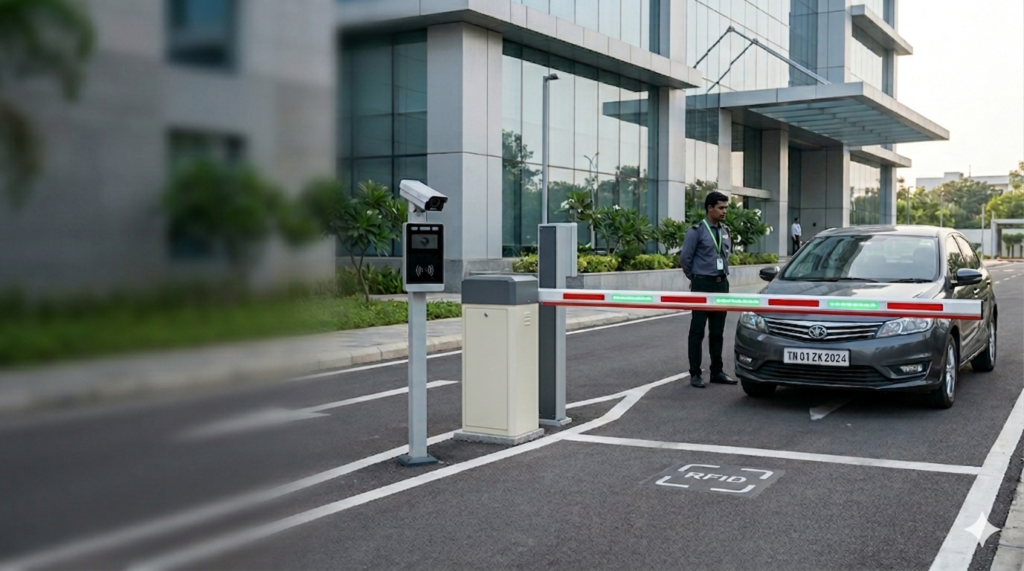
Boom Barrier — Complete Parts List
A standard automatic boom barrier consists of these main parts:
- Boom Arm
- Housing / Cabinet
- Motor
- Gearbox / Reduction Gear
- Control Board / Control Card
- Limit Switches
- Counterbalance Spring / Counterweight
- Clutch / Safety Clutch
- Power Supply Unit
- Vehicle Loop Detector
- Loop Detector Wire (Inductive Loop)
- RFID Reader
- Remote Control Receiver
- LED Warning Light / Signal Light
- Rubber Skirt / Arm Buffer
- Photocell / IR Safety Sensor
- UPS / Battery Backup
- Manual Release Key
- Mounting Bracket / Base Plate
- Cable Entry / Conduit Fittings
Let us go through each one in detail.
1. Boom Arm
Also called: Barrier arm, gate arm, horizontal bar, boom rod, boom pole
The boom arm is the most visible part of the barrier — the horizontal bar that rises to allow vehicles and lowers to block them. It is the defining component that gives the boom barrier its name.
Materials used in India:
- Aluminium alloy — lightweight, resistant to corrosion, most common for standard boom arms up to 5 metres
- Fibreglass reinforced plastic (FRP) — lighter than aluminium, used in longer arm lengths (6 metres and above) to reduce motor strain
- PVC-coated steel — heavier, more robust, used in high-security and industrial applications
Standard lengths: 3 metres, 4 metres, 5 metres, 6 metres, up to 9 metres for heavy-duty hydraulic systems
Markings: Most boom arms are painted in alternating red and white stripes — the standard safety colour coding for vehicle access barriers in India. Some installations use yellow and black striping. Reflective tape is added on arms that operate in low-light environments.
What happens when the arm fails: Boom arms bend or break on vehicle impact. A cracked or bent arm is a safety hazard and must be replaced immediately. Always keep a spare arm of the correct length at your facility — arm replacement is a same-day repair if the spare is on hand.
Folding arm variant: Some models use a folding arm that bends in the middle when rising — used in locations with low overhead clearance such as basement parking entrances. The folding mechanism has its own hinge and spring that can wear and require servicing.
2. Housing / Cabinet
Also called: Barrier body, casing, enclosure, chassis
The housing is the metal box that contains all the mechanical and electronic components of the boom barrier. It is mounted on a concrete foundation pad and typically made from powder-coated mild steel or stainless steel.
Key specifications:
- IP rating — the housing’s protection against dust and water ingress. Indoor barriers typically carry IP44 or IP54. Outdoor barriers need minimum IP55. Coastal or high-humidity locations need IP65 or higher.
- Material thickness — heavier gauge steel (2–3mm) for industrial applications, lighter gauge (1–1.5mm) for commercial barriers
- Ventilation — the housing needs ventilation slots or a fan to dissipate heat from the motor during sustained operation
What happens when the housing fails: Rusted or damaged housing allows moisture and dust ingress that damages internal electronics. A corroded housing also compromises structural integrity — the boom arm mounting point weakens. Regular painting and sealing of the housing extends service life significantly in coastal Andhra Pradesh locations.
3. Motor
Also called: Drive motor, barrier motor, electric motor, actuator motor
The motor is the heart of the boom barrier — it converts electrical energy into mechanical rotation that drives the boom arm up and down. Motor quality determines the barrier’s duty cycle, reliability, and lifespan.
Types of motors used in boom barriers:
AC Motor (Alternating Current): Runs directly on the mains power supply. Simple, robust, less expensive. Used in economy and mid-range barriers. Higher power consumption and generates more heat during sustained operation. Suitable for 40–60% duty cycle applications.
DC Brushless Motor: Uses direct current from an internal rectifier. More energy-efficient than AC motors, generates less heat, quieter operation, and longer service life. Used in premium barriers. Supports 80–90% duty cycle. The preferred motor type for corporate and commercial deployments.
Hydraulic Motor: Uses pressurised hydraulic fluid rather than electrical rotation. Extremely high torque, handles long arm lengths (up to 9 metres), rated for 100% continuous duty cycle. Used in toll plazas and industrial applications. More expensive and requires hydraulic fluid maintenance.
High-Speed Motor: A specialised DC motor with optimised torque-to-speed ratio designed to open and close the barrier in under 1.5 seconds. Used in high-throughput applications.
Motor specifications to know:
- Power rating — typically 24V DC or 230V AC
- Torque — measured in Nm (Newton-metres); higher torque handles longer arms and adverse weather
- Duty cycle — percentage of time the motor can run continuously
- Operating temperature range — important for Vijayawada’s climate (30–44°C ambient)
What happens when the motor fails: The barrier stops moving or moves erratically. Common motor failure causes: overheating from exceeding duty cycle, moisture ingress, worn brushes in brushed DC motors, capacitor failure in AC motors. A failed motor typically requires replacement rather than repair. This is the most common reason for emergency service calls in Indian boom barrier installations.
4. Gearbox / Reduction Gear
Also called: Gear reducer, worm gear, transmission, reduction drive
The gearbox sits between the motor and the boom arm mechanism. The motor rotates at high speed (typically 1,000–3,000 RPM) — far too fast to directly drive the boom arm. The gearbox reduces this rotation speed while multiplying torque, converting high-speed low-torque motor output into the low-speed high-torque motion needed to smoothly raise and lower a 3–6 metre boom arm.
Types used in boom barriers:
- Worm gear — most common type. High reduction ratio, self-locking (the arm stays in position even without power), compact and quiet. The worm gear is also what enables the manual release function.
- Helical gear — used in premium barriers. More efficient than worm gears (less energy lost to heat), quieter operation, longer lifespan.
- Planetary gear — used in high-performance high-speed barriers. Extremely compact and efficient.
What happens when the gearbox fails: Grinding or squealing noise during operation, arm movement becomes jerky or uneven, barrier moves much slower than rated speed. Gearbox wear is a normal consequence of high-cycle operation — it is a wear part that needs periodic lubrication (typically every 6 months under AMC) and eventual replacement after 3–5 years in high-cycle deployments.
5. Control Board / Control Card
Also called: Main control board, PCB, controller, logic board, main card
The control board is the brain of the boom barrier. It is an electronic circuit board that receives input signals from all the barrier’s sensors and command devices and sends output signals to the motor, lights, and other actuators.
What the control board manages:
- Receives open/close commands from RFID reader, remote control, loop detector, push button
- Controls motor direction (up vs down), speed, and stopping position
- Monitors limit switches to stop the motor at correct open and close positions
- Manages the LED signal light output
- Implements safety logic — prevents closing when a vehicle is under the arm
- Handles error conditions — motor overload, limit switch failure, power fault
- Controls the relay outputs for integration with third-party systems
What happens when the control board fails: The barrier becomes unresponsive — does not respond to remote, RFID card, or push button. Or it behaves erratically — arm stops midway, lights behave incorrectly, barrier opens but does not close. Control board failure can be caused by power surges (very common in Andhra Pradesh), moisture ingress, or component aging. This is why a voltage stabiliser and UPS backup are essential in every Raise Solutions installation.
Brand-specific boards: ZKTeco and eSSL barriers use proprietary control boards — always ensure your AMC provider stocks the correct board for your brand and model.
6. Limit Switches
Also called: End stop switches, position switches, micro switches, travel limit switches
Limit switches are small mechanical or magnetic switches that tell the control board when the boom arm has reached its fully open position (90°) or fully closed position (0°). When the motor drives the arm to the correct position, the limit switch triggers and the control board cuts power to the motor — stopping the arm precisely at the right point.
Types used:
- Mechanical micro switch — physical contact switch. Reliable, inexpensive, the most common type in standard boom barriers.
- Magnetic reed switch — uses a magnet on the arm mechanism to trigger a sealed switch. More weather-resistant than mechanical switches, used in outdoor and high-humidity applications.
- Proximity sensor — electronic sensor that detects the arm position without physical contact. Used in premium and high-speed barriers.
What happens when limit switches fail: The arm overshoots — goes past the fully open or fully closed position, putting stress on the motor and gearbox. Or the arm stops before reaching the correct position, leaving a partial opening. Incorrectly set limit switches also cause the barrier to not fully close, which is a security gap. Limit switch adjustment and replacement is a routine part of AMC maintenance.
7. Counterbalance Spring / Counterweight
Also called: Return spring, balance spring, counterweight assembly, torsion spring
The boom arm, even in aluminium, has significant weight for a motor to lift hundreds of times per day. The counterbalance spring or counterweight offsets most of this weight — making the motor’s job much easier, reducing power consumption, and dramatically extending motor life.
How it works: The spring (or counterweight) is pre-loaded to exert an upward force on the arm mechanism equal to roughly 70–80% of the arm’s weight. The motor only has to overcome the remaining 20–30% to raise the arm — and the spring naturally assists closing too, meaning the motor works much less hard in both directions.
Counterbalance adjustment: When a new arm length is installed (replacing a 4m arm with a 6m arm, for example), the counterbalance spring must be re-adjusted or replaced to match the new arm weight. An incorrectly balanced barrier puts excessive load on the motor.
What happens when the spring fails: Spring fracture causes the arm to feel extremely heavy to the motor — the motor overloads, thermal protection trips, and the barrier stops. The arm may also fall suddenly and with force if the spring breaks during operation, creating a safety hazard. Spring inspection is a critical part of quarterly AMC maintenance.
8. Safety Clutch
Also called: Slip clutch, torque limiter, overload clutch, anti-crash clutch
The safety clutch is a mechanical device that allows the boom arm to be pushed up manually when a force is applied from below — such as when a vehicle accidentally drives into the lowered arm.
Without a safety clutch, a vehicle impact on the closed boom arm would damage the gearbox and motor (since the arm cannot move). The safety clutch allows the arm to rotate upward under impact force, protecting the mechanism, and then the barrier auto-resets to the correct position.
What happens when the clutch fails or is incorrectly set: If set too tight, vehicle impacts damage the gearbox instead of slipping. If set too loose, the arm moves upward from wind load or vibration even without a vehicle impact — defeating the security purpose. Clutch adjustment is a specialist task performed during installation and AMC.
9. Power Supply Unit
Also called: Power supply, transformer, rectifier, SMPS
The power supply unit converts mains AC power (230V AC in India) to the correct voltage for the barrier’s control board and motor (typically 24V DC for the electronics, with AC for the motor in AC motor variants).
Key specifications:
- Input: 230V AC, 50Hz (Indian standard)
- Output: 24V DC at appropriate amperage for the control board
- Protection: Overload protection, short-circuit protection, transient voltage suppression (critical in India where power quality varies)
What happens when the power supply fails: The barrier is completely dead — no lights, no response to any command. Often confused with control board failure. A simple multimeter test determines whether the power supply output voltage is correct before assuming the board is faulty.
10. Vehicle Loop Detector
Also called: Loop detector, inductive loop sensor, vehicle detector, loop controller
The vehicle loop detector is an electronic unit that works with the inductive loop buried in the road surface (see Part 11). It continuously monitors the loop’s inductance. When a vehicle drives over the loop, the metal in the vehicle changes the loop’s inductance — the detector senses this change and sends a signal to the control board.
Functions of the loop detector in a boom barrier system:
- Safety loop (under arm): Detects vehicle presence directly under the barrier arm. If a vehicle is detected under the arm, the control board is prevented from lowering the arm — preventing the barrier from coming down on a vehicle that has not fully cleared.
- Trigger loop (approach): Detects a vehicle approaching the barrier. In automatic/ticketless parking systems, this loop triggers the barrier to prepare for vehicle processing.
- Exit loop: Detects a vehicle clearing the exit barrier — signals the barrier to close after the vehicle passes.
What happens when the loop detector fails: The barrier cannot detect vehicles — either the arm comes down on vehicles that have not fully cleared (dangerous), or the barrier fails to open automatically for approaching vehicles. Loop detector sensitivity can drift over time and requires recalibration — a standard AMC service task.
11. Inductive Loop Wire
Also called: Detection loop, buried loop, road loop, ground loop
The inductive loop is a coil of wire (typically 1–4 turns of 1.5mm² cross-linked polyethylene insulated wire) buried in a slot cut into the road surface, approximately 50–100mm deep. The loop connects back to the loop detector unit inside the barrier housing.
Installation: The road slot is cut using a disc cutter, the loop wire is laid in a figure-8 or rectangular pattern, and the slot is sealed with bitumen or epoxy sealant. Incorrect installation — sharp bends in the wire, poor sealant, too-shallow burial — leads to loop failure from traffic vibration and temperature cycling.
What happens when the loop wire fails: The loop detector shows a fault, the safety function is lost, and the barrier may become unsafe. Loop wire failure is common in high-traffic areas where road surface flexing eventually breaks the wire. Periodic loop resistance testing is part of proper AMC maintenance.
12. RFID Reader
Also called: Card reader, proximity reader, contactless reader, tag reader
The RFID reader is mounted on a separate post adjacent to the boom barrier. It reads authorised RFID cards or fobs presented by vehicle occupants and sends an open command to the control board when a valid credential is detected.
RFID frequency types used in India:
- 125 kHz (LF): The most common in older and budget installations. Cards simply need to be held within 5–10cm. Slower data exchange, basic security.
- 13.56 MHz (HF): Faster, more secure, supports encrypted cards (MIFARE, DESFire). Required for higher-security applications.
Integration: The RFID reader connects to the control board via a Wiegand interface (the standard connection protocol between readers and access control systems). The control board checks the card data against its authorised card list and triggers the motor if the card is valid.
What happens when the RFID reader fails: Cards stop working — the barrier does not respond to valid cards. Causes include water damage (ensure the reader has IP65 rating for outdoor mounting), cable damage, or reader head failure. The manual release key becomes necessary as a backup when the reader fails.
13. Remote Control Receiver
Also called: RF receiver, wireless receiver, remote receiver module
The remote control receiver is a small electronic module mounted inside the barrier housing (or sometimes integrated into the control board) that receives radio frequency signals from handheld remote controls carried by authorised users.
Frequency: Most Indian boom barrier remotes operate at 433 MHz or 315 MHz.
Learning mode: Remote receivers use a learning mode to register new remote controls. A button inside the housing is pressed to enter learning mode, then the new remote button is pressed to store its unique code. Most systems can store 50–500 remote codes.
What happens when the receiver fails: Remote controls stop working — the barrier does not respond to any remote. This is often confused with a dead battery in the remote. Simple test: try multiple remotes including one that was recently working. If none work, the receiver module is the suspect.
14. LED Warning Light / Signal Light
Also called: Signal lamp, traffic light, indicator light, arm light, warning beacon
Most boom barriers include an LED strip along the boom arm and/or a separate signal light on the housing. These serve two purposes: safety warning (alerting approaching drivers that the barrier is operating) and access indication (red for closed, green for open).
LED arm strip: An LED strip runs the length of the boom arm, lit red during normal closed position and switching to green or flashing during the open-close cycle. The LED strip requires a flexible power cable connection into the arm — this connection is a common wear point that can fail after thousands of cycles.
What happens when the signal light fails: Safety is compromised — drivers cannot clearly see whether the barrier is open or closed, particularly in low-light conditions. LED replacement is a simple maintenance task but the LED arm cable connection requires careful inspection.
15. Rubber Skirt / Arm Buffer
Also called: Arm pad, bumper strip, rubber buffer, protective skirt
A rubber or foam profile attached to the underside of the boom arm. When the arm lowers onto a vehicle that did not clear in time, the rubber skirt reduces the impact force and protects the vehicle’s roof or bodywork from being scratched or dented by the bare metal arm.
What happens when the rubber skirt fails: Deteriorated rubber skirts can tear and fall, creating debris. More critically, a missing rubber skirt means metal-to-vehicle contact on any impact — risking paint damage and potential legal liability. Rubber skirt replacement is inexpensive and should be checked at every AMC visit.
16. Photocell / IR Safety Sensor
Also called: Infrared sensor, beam sensor, safety photocell, optical sensor, light curtain
Some boom barrier installations include an infrared beam sensor pair — a transmitter and receiver mounted on opposite sides of the lane at arm height. If the IR beam between transmitter and receiver is broken (by a vehicle, a pedestrian, or any obstruction under the arm), the control board is prevented from lowering the arm.
Difference from loop detector: The loop detector detects metal vehicles. The IR photocell detects any obstruction — including pedestrians and cyclists. In mixed pedestrian-vehicle environments, both loop detector and photocell are recommended.
What happens when the photocell fails: If the receiver fails and the system interprets this as a permanent beam-break, the barrier will not close — stuck in open position. If the transmitter fails, the safety function is lost — the barrier may close on a pedestrian. Photocell alignment is a critical AMC check — vibration and physical impact can misalign the beam.
17. UPS / Battery Backup
Also called: Uninterruptible power supply, battery backup, backup power unit
A UPS stores electrical charge in a battery and automatically switches to battery power when mains power fails. For a boom barrier, the UPS ensures the barrier continues to operate during power cuts — opening and closing normally for a specified backup duration (typically 4–8 hours depending on battery capacity).
Fail-safe mode: Most barriers are configured to open the arm (fail-safe open) during power failure — ensuring vehicles are not trapped. The UPS allows controlled operation rather than the default fail-safe, maintaining security during power interruptions.
Battery maintenance: UPS batteries have a lifespan of 2–3 years. A battery that no longer holds charge will appear to work until the first power cut — then fail. Battery testing is part of AMC maintenance. Replace before failure rather than after.
18. Manual Release Key
Also called: Emergency release key, hand crank, manual override, emergency handle
Every boom barrier must have a manual release mechanism — a way to operate the arm without electricity. This is a safety and regulatory requirement.
Types:
- Clutch release key: A specific key inserted into a keyhole on the housing disengages the motor/gearbox from the arm mechanism, allowing the arm to be raised by hand.
- Hand crank: A removable handle that fits onto the manual drive shaft, allowing the arm to be cranked up manually.
When used: Power failure with UPS battery depleted, motor failure, control board failure, emergency vehicle access, maintenance. Security staff must be trained on manual release procedure — it should never be the first time they use it during an actual emergency.
19. Mounting Bracket / Base Plate
Also called: Foundation plate, anchor plate, housing base, floor mount
The base plate is welded to the bottom of the housing and bolted to the concrete foundation pad using anchor bolts. The quality and correct installation of the mounting is critical — an improperly anchored barrier will shift over time, misaligning the arm and stressing the mechanism.
Foundation requirements: Typically a reinforced concrete pad of 600mm × 600mm × 600mm depth. The concrete must fully cure (minimum 7 days, ideally 28 days) before the barrier is mounted. In Indian conditions — soft soil, high water table in coastal areas — foundation design sometimes requires deeper or wider pads.
20. Cable Entry / Conduit Fittings
Also called: Cable gland, conduit entry, cable inlet, waterproof entry
All external cables entering the barrier housing — power supply, loop detector cables, RFID reader cable, remote receiver aerial — enter through cable glands or conduit fittings in the housing wall. These must be properly sealed to maintain the IP rating of the housing.
Common installation error: Untreated cable entry points allow moisture and insects to enter the housing, leading to corrosion of the control board and electrical faults. Every AMC inspection should check that all cable entry points are properly sealed.
Boom Barrier Parts — Quick Reference Table
| Part Name | Also Called | Function | Common Failure Symptom |
|---|---|---|---|
| Boom Arm | Barrier arm | Blocks / allows vehicle passage | Bent or broken on impact |
| Housing | Cabinet | Contains all components | Rust, moisture ingress |
| Motor | Drive motor | Powers arm movement | Barrier stops moving |
| Gearbox | Reduction gear | Slows motor, multiplies torque | Grinding noise, jerky movement |
| Control Board | PCB, main card | Brain — controls all functions | Barrier unresponsive |
| Limit Switch | End stop switch | Stops arm at correct position | Arm overshoots |
| Counterbalance Spring | Return spring | Offsets arm weight | Motor overloads |
| Safety Clutch | Slip clutch | Protects on vehicle impact | Arm moves from wind |
| Power Supply | SMPS, transformer | Converts mains to working voltage | Barrier completely dead |
| Loop Detector | Vehicle detector | Detects vehicle presence | Safety failure |
| Inductive Loop | Buried loop | Generates detection field | Loop fault alarm |
| RFID Reader | Card reader | Reads access cards | Cards stop working |
| Remote Receiver | RF receiver | Receives remote commands | Remotes stop working |
| LED Signal Light | Warning light | Safety indication | Poor visibility |
| Rubber Skirt | Arm buffer | Protects vehicles on impact | Arm tears vehicle |
| Photocell | IR sensor | Detects non-metal obstructions | Barrier stuck open |
| UPS | Battery backup | Power during outages | Fails during power cut |
| Manual Release | Emergency key | Manual operation | Trapped vehicles |
| Mounting Bracket | Base plate | Anchors barrier to ground | Barrier misalignment |
| Cable Gland | Conduit entry | Seals cable entries | Moisture damage |
How to Maintain Boom Barrier Parts — AMC Checklist
A comprehensive AMC (Annual Maintenance Contract) for a boom barrier should cover these checks at every quarterly visit:
Mechanical:
- Boom arm integrity check — cracks, bends, rubber skirt condition
- Gearbox lubrication — apply correct grease to worm gear
- Counterbalance spring tension check and adjustment
- Safety clutch slip force calibration
- All mounting bolts — check for loosening
- Housing seal inspection — all cable entries, ventilation covers
Electrical:
- Motor current draw measurement — elevated current indicates mechanical problem
- Control board visual inspection — burn marks, corrosion, loose connectors
- Limit switch operation — verify correct arm stopping positions
- UPS battery load test — confirm backup duration
- LED signal light function check
- Power supply output voltage measurement
Electronic:
- RFID reader test — all registered cards, check read range
- Loop detector sensitivity check — correct vehicle detection, no false triggers
- Photocell alignment and beam strength check
- Remote control test — all registered remotes
- Integration test with parking software or access control system
AMC rates for boom barriers in Vijayawada from Raise Solutions start from ₹6,000 per year per barrier — covering all the above checks quarterly plus priority response for breakdowns.
Where to Get Boom Barrier Parts in Vijayawada
Raise Solutions stocks genuine spare parts for ZKTeco and eSSL boom barriers — including control boards, motors, boom arms, limit switches, loop detectors, RFID readers, and rubber skirts. We carry local inventory so your barrier is back online quickly, without waiting weeks for parts from another city.
What Raise Solutions provides:
✅ Genuine spare parts for ZKTeco and eSSL barriers
✅ Same-day parts availability for common failure components
✅ AMC from ₹6,000/year — quarterly maintenance, priority breakdown response
✅ Emergency call-out service across Vijayawada and Andhra Pradesh
✅ Trained technicians — correct diagnosis, correct part, first visit fix
✅ Free site survey for new boom barrier installation
✅ ISO 9001 Certified | MSME Registered | NSIC Recognised
Raise Solutions Experience Center
1st Floor, Pradham Building, beside Indian Oil Petrol Pump
Nidamanuru Road, Poranki-521137, Vijayawada, Andhra Pradesh
📞 94926 67817 | 85229 59096
🌐 www.raisesolutions.in
Frequently Asked Questions
Q: What are the main parts of a boom barrier?
The main parts of a boom barrier are: boom arm, housing/cabinet, motor, gearbox, control board, limit switches, counterbalance spring, safety clutch, power supply, vehicle loop detector, inductive loop wire, RFID reader, remote control receiver, LED signal light, rubber skirt, photocell sensor, UPS battery backup, manual release key, mounting bracket, and cable entry glands.
Q: What is the boom arm made of?
Boom barrier arms are typically made from aluminium alloy (for arms up to 5 metres), fibreglass reinforced plastic/FRP (for longer arms above 5 metres where weight reduction is critical), or PVC-coated steel (for heavy-duty industrial applications). Aluminium is the most common material in Indian commercial boom barriers.
Q: What causes a boom barrier to stop working?
The most common causes of boom barrier failure in India are motor burnout from exceeding duty cycle, control board failure from power surges or moisture ingress, limit switch failure causing the arm to overshoot, counterbalance spring breakage causing motor overload, loop detector failure, and RFID reader failure from water damage. Regular AMC maintenance prevents most of these failures.
Q: What is a loop detector in a boom barrier?
A loop detector is an electronic unit that monitors an inductive loop wire buried in the road surface under the barrier. When a vehicle (metal) drives over the loop, it changes the loop’s electrical inductance. The detector senses this change and sends a signal to the barrier’s control board — either to trigger opening or to prevent the arm from closing while a vehicle is still underneath it.
Q: What is the manual release on a boom barrier?
The manual release is a mechanism that allows the boom arm to be raised by hand without any electrical power. It typically involves inserting a specific key into a keyhole on the barrier housing to disengage the motor and gearbox from the arm mechanism. All security staff operating a boom barrier should know how to use the manual release.
Q: Where can I get boom barrier spare parts in Vijayawada?
Raise Solutions stocks genuine ZKTeco and eSSL boom barrier spare parts in Vijayawada — including control boards, motors, boom arms, loop detectors, RFID readers, and limit switches. Call 94926 67817 for parts availability and same-day delivery across Vijayawada.
Conclusion
A boom barrier is not just an arm that goes up and down — it is a precisely engineered system of 20 or more components working in coordination. Understanding each component’s name, function, and failure mode helps you maintain your barrier properly, diagnose problems faster, and make informed decisions when servicing or replacing your system.
The most important takeaway: most boom barrier failures are preventable with regular AMC maintenance. A quarterly check of the motor, gearbox, springs, limit switches, loop detector, and UPS battery catches the vast majority of failures before they cause downtime.
If your boom barrier in Vijayawada or anywhere in Andhra Pradesh needs service, spare parts, or a new installation — contact Raise Solutions on 94926 67817. Our technicians carry the right parts and the right tools to get your barrier back online the same day.
Published by Raise Solutions | ZKTeco & eSSL Authorised Dealer — Vijayawada, Andhra Pradesh
94926 67817 | raisesolutions.in | Poranki-521137, Vijayawada