
When most people think of vehicle access control, they picture a boom barrier — the horizontal arm that swings up to let vehicles through. But at certain locations, a horizontal arm simply isn’t enough.
High-security government compounds, bank vaults, data centres, military installations, and premium commercial buildings need a barrier that doesn’t just slow vehicles down — one that physically stops them. A vertical lift barrier does exactly that.
This guide explains what a vertical lift barrier is, how it works, where it’s used, how it compares to other barrier types, and what it costs to install in India
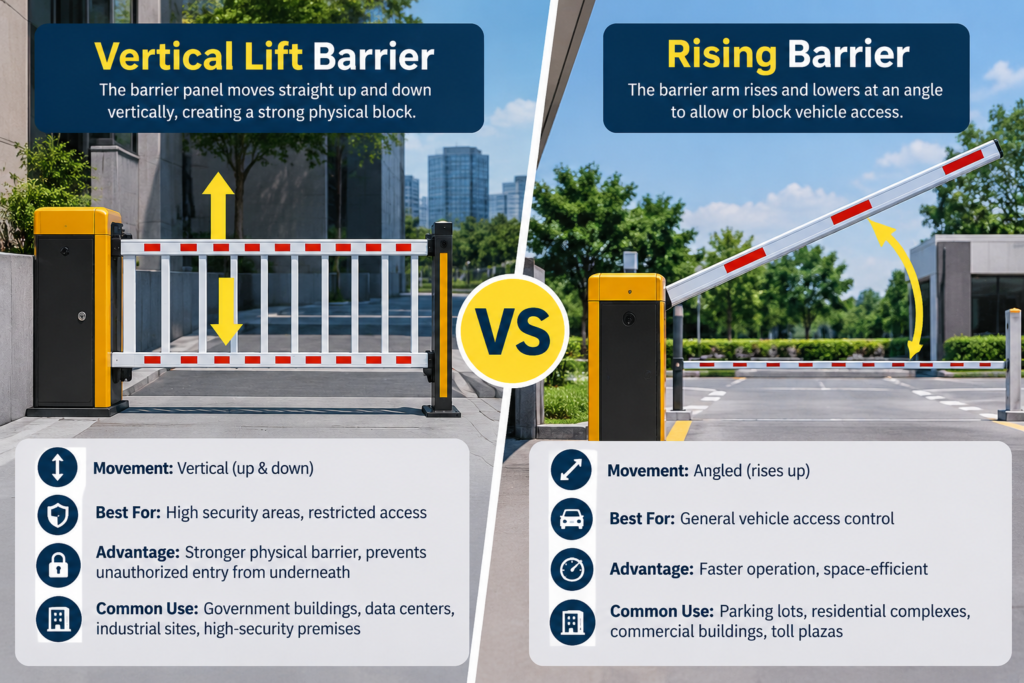
What Is a Vertical Lift Barrier?
A vertical lift barrier — also called a rising barrier, vertical rising barrier, or rising arm barrier — is a vehicle access control system where a solid metal arm or panel rises vertically from a base housing to block vehicle entry, then lowers back into the ground or base when access is granted.
Unlike a boom barrier where the arm swings upward at an angle (horizontal to 90°), a vertical lift barrier’s arm or panel moves straight up and down. This mechanical difference has significant consequences for security, installation, and use cases.
The key distinction from a boom barrier:
| Feature | Boom Barrier | Vertical Lift Barrier |
|---|---|---|
| Arm movement | Swings up (rotates) | Rises straight up |
| Vehicle clearance | Arm swings overhead | Gate recedes below or rises above lane |
| Space required | Requires clear overhead arc | Compact — fits in tight spaces |
| Security level | Moderate (arm can be snapped) | High (solid stainless/steel construction) |
| Anti-ram rating | None (standard) | Available (crash-rated versions) |
| Traffic speed | 0.6–2 seconds | 2–6 seconds |
| Typical use | Offices, malls, societies | High-security, premium commercial |
How Does a Vertical Lift Barrier Work?
A vertical lift barrier consists of four main mechanical and electronic systems working together:
1. The Barrier Arm or Panel
The visible element that blocks vehicle passage. In vertical lift barriers, this is typically:
- A solid stainless steel arm (40mm–80mm diameter, powder-coated or brushed finish) — slimmer profile, faster movement
- A flat panel (200mm–400mm height) — wider blocking surface, stronger visual deterrent
- A hollow square section with optional LED illumination — premium installations
Unlike a boom barrier arm (usually aluminium or fibreglass), vertical lift barrier arms are built from thicker, heavier materials because they must withstand vertical mechanical stress from the lift mechanism and, in security-rated versions, deliberate vehicle impact.
2. The Drive Mechanism
The motor and drive system that moves the arm vertically. Two technologies dominate:
Electro-hydraulic drive:
- Uses a hydraulic piston to push the arm upward
- Extremely strong — can move heavy arms (15kg–50kg) smoothly
- Preferred for crash-rated and heavy-duty versions
- Operates even in power fluctuations due to hydraulic pressure reservoir
- Higher cost, requires hydraulic fluid maintenance
Electro-mechanical drive:
- Uses a motor-driven screw mechanism or linear actuator
- Lighter, more compact, less maintenance
- Suitable for standard security applications
- Lower cost, 12V DC or 24V DC operation possible
3. The Housing Unit
The metal cabinet at road level that contains the drive mechanism and stores the arm when the gate is open. This is typically:
- Cast iron or heavy-gauge steel (3mm–6mm thickness)
- Surface-mounted on a concrete foundation plinth (above-ground housing)
- Or flush-mounted in a recessed in-ground pit (pit-mounted version — arm recedes underground when open)
Above-ground housing is more common for retrofits and simpler installations.
In-ground (pit-mounted) housing gives a completely unobstructed road surface when the gate is open — the arm drops below road level. Premium version used in airports, government compounds, and luxury commercial properties.
4. Control Electronics
The brain of the system:
- Control card/PCB: Receives signals from access readers, processes logic, drives the motor
- Limit switches: Tell the system when the arm is fully raised or fully lowered (prevents over-travel)
- Safety sensors: Obstacle detection — if a vehicle is under the arm, it doesn’t lower
- Fail-safe/fail-secure mode selection: Critical for safety (explained below)
- Input interfaces: RFID, keypad, intercom, biometric, remote control, boom control integration
The entire rise-and-fall cycle — from trigger signal to fully open to fully closed — takes 2–6 seconds depending on arm weight and motor power
Types of Vertical Lift Barriers
Not all vertical lift barriers are the same. They vary significantly by application, security level, and installation method.
1. Standard Rising Barrier (Surface Mount)
- Housing sits on surface at road level
- Arm rises 800mm–1,200mm above road surface
- Speed: 3–5 seconds
- Security: Medium — deters casual intrusion, not crash-rated
- Cost: ₹85,000 – ₹2,50,000 installed
- Use: Commercial buildings, parking lots, hospitals, universities
2. In-Ground (Pit-Mounted) Rising Barrier
- Housing recessed in concrete pit below road surface
- Arm rises from road level upward
- When open: road surface is completely clear, no obstruction
- Speed: 3–6 seconds
- Security: Medium to high
- Cost: ₹1,50,000 – ₹4,00,000 installed (includes excavation and pit construction)
- Use: Premium commercial, airport entry roads, government premises
3. Anti-Ram / Crash-Rated Rising Barrier
- Built to resist deliberate vehicle impact at speed
- Crash ratings: K4 (stopping a 6,800 kg truck at 48 km/h), K8 (80 km/h), K12 (100+ km/h)
- Construction: Heavy steel, reinforced hydraulic drive, anchored deep foundation
- Speed: 4–8 seconds (heavier mechanism)
- Cost: ₹5,00,000 – ₹25,00,000+ per unit installed
- Use: Embassy compounds, military gates, nuclear facilities, data centres, central bank vaults
4. Bi-Fold Rising Barrier
- The arm folds in the middle as it rises, reducing the height clearance needed above the gate
- Useful where overhead space is restricted (covered parking, basement entry)
- Speed: 3–5 seconds
- Cost: ₹1,20,000 – ₹3,00,000 installed
5. Vertical Pivot Barrier
- A variation where the panel rotates around a horizontal axis near its middle point
- One end rises, other end dips into a recess in the road
- Faster than standard vertical lift, compact mechanism
- Use: High-traffic locations needing speed + security
Where Are Vertical Lift Barriers Used?
The use case determines which type is appropriate. Below are the most common applications in India:
Government & Defence
- Ministry buildings, secretariat complexes
- Police headquarters, court complexes
- Military base entry points
- DRDO and defence research facilities
Why: Crash-rated versions are often mandatory under government security standards. Surface-mounted boom barriers are not permitted at red-category government premises.
Banking & Financial Institutions
- Bank headquarters, RBI compounds
- Currency chest facilities
- Stock exchange buildings
- ATM cash loading bays (rising bollards or vertical barriers for the loading dock)
Why: Physical security at financial institutions must meet RBI and home ministry guidelines. Standard barriers can be rammed through; crash-rated rising barriers cannot.
Data Centres & Server Farms
- Tier III and Tier IV data centres
- Telecom exchanges
- Disaster recovery sites
Why: Access control must match the physical security level of the facility. A ₹500 crore data centre protected by a ₹40,000 boom barrier is a security mismatch.
Premium Commercial Real Estate
- Grade A office buildings in business districts
- IT parks and SEZs
- Corporate headquarters
- Luxury hotels and resorts
Why: Aesthetic — in-ground rising barriers give a clean, premium look with no above-ground obstruction when open. Combined with ANPR, the entry experience is seamless for registered vehicles.
Airports & Railway Premises
- Airside/landside boundary control
- VIP and cargo gate access
- Restricted zone entry roads
Why: Airport Security Act mandates physical vehicle barriers at all controlled access points. Rising barriers at airside gates must meet BCAS (Bureau of Civil Aviation Security) specifications.
Educational Institutions (Premium)
- IITs, IIMs, central universities
- Private universities with large campuses
- International schools
Why: Rising barriers at main entry gates make a visual security statement while handling high vehicle volume at peak hours.
Vertical Lift Barrier vs Boom Barrier: Full Comparison
| Parameter | Boom Barrier | Vertical Lift Barrier |
|---|---|---|
| Movement direction | Horizontal → vertical (swing) | Vertical (straight rise/fall) |
| Overhead space needed | Yes — arm swings up | No (above-ground) / Road pit (in-ground) |
| Lane width coverage | Arm spans lane | Panel/arm spans lane at road level |
| Anti-ram capability | No (standard) | Yes (crash-rated versions) |
| Speed | 0.6–2 sec | 2–6 sec |
| Maintenance | Low | Medium |
| Aesthetics | Industrial/functional | Premium/architectural |
| Typical cost (installed) | ₹40,000 – ₹1,50,000 | ₹85,000 – ₹25,00,000+ |
| Best for | Offices, societies, parking | High-security, premium, government |
| Fail-safe behavior | Arm raises (open) | Arm raises or lowers (configurable) |
The bottom line: Boom barriers manage traffic flow. Vertical lift barriers control access under security requirements a boom barrier cannot meet
Vertical Lift Barrier vs Road Blocker / Tyre Killer
Both are high-security options but work differently:
| Parameter | Vertical Lift Barrier | Road Blocker | Tyre Killer |
|---|---|---|---|
| Mechanism | Arm rises vertically | Flat steel plate rises from road | Spikes rise from road surface |
| Blocks vehicle by | Physical barrier above road | Ram-proof plate at road level | Puncturing tyres of unauthorized vehicles |
| Directionality | Both entry and exit | Both | Typically exit-only or entry-only |
| Speed | 2–6 sec | 3–8 sec | 1–3 sec |
| Crash rating | Yes (specific models) | Yes (standard feature) | Tyre damage only — not anti-ram |
| Reversibility for authorized vehicles | Barrier lowers | Plate lowers | Spikes retract |
| Cost | ₹85,000 – ₹25,00,000 | ₹3,00,000 – ₹20,00,000 | ₹80,000 – ₹3,00,000 |
When to use which:
- Rising barrier: When you need a visible deterrent + fast vehicle recognition (RFID/ANPR) + premium look
- Road blocker: When crash resistance is the primary requirement and aesthetics are secondary
- Tyre killer: Exit control only — stops vehicles from reversing out of an exit lane or unauthorized exit
Technical Specifications to Ask For
When evaluating vertical lift barriers, these are the specifications that matter:
Mechanical
- Arm/panel material: Stainless steel 304 (standard) vs 316 (corrosion-resistant, better for coastal areas)
- Arm diameter or panel height: 40mm–80mm round / 200mm–400mm flat panel
- Lifting height: 800mm (standard) to 1,200mm (higher security)
- Maximum lane width coverage: 2.5m, 3.5m, 4.5m, 6m options
- Cycle speed: Rise time + dwell time + fall time
Motor & Drive
- Drive type: Electro-mechanical (standard) or electro-hydraulic (heavy duty/crash)
- Motor power: 100W–750W depending on arm weight
- Duty cycle: Cycles per hour the motor can sustain
- Operating voltage: 230V AC (standard Indian supply) + battery backup option
Safety
- Obstacle detection: IR sensor or ground loop that prevents lowering on a vehicle
- Fail-safe mode: Open (barrier rises on power failure — vehicles can pass) or Secure (barrier stays lowered on power failure — vehicles blocked)
- Manual override: Key-operated manual release for emergency operation
- IP rating: IP54 minimum for outdoor use, IP65+ for monsoon-heavy regions
Control Interface
- Input compatibility: Dry contact (for RFID, biometric, intercom output), RS485, Wiegand 26/34
- Remote control: RF remote, 433MHz standard
- Integration: Boom control terminals, VMS software, PSIM (Physical Security Information Management)
Certifications (crash-rated versions)
Installation Requirements
Site Preparation
A vertical lift barrier requires more site work than a boom barrier:
Foundation: Concrete foundation minimum 600mm × 600mm × 600mm (varies by housing size). For in-ground versions, the pit is typically 300mm–400mm deep, 500mm × 500mm footprint with waterproofing.
Electrical: 230V, 15A dedicated line per barrier. Earthing mandatory. UPS/battery backup recommended (adds 4–8 hours backup for 24V DC systems).
Lane width: The barrier arm or panel spans the full lane width. Standard lane: 3m–4m. Wide lane (for trucks): up to 6m (requires a heavier arm or dual-arm configuration).
Overhead clearance: Above-ground housing rising barriers need 1.2m–1.5m of clear vertical height above the arm in its highest position (for maintenance access). In-ground versions need zero overhead clearance.
Timeline
- Standard surface-mount: 2–3 days (Day 1: civil, Day 2: equipment, Day 3: wiring + programming)
- In-ground pit-mount: 4–7 days (2 extra days for pit excavation and waterproofing cure time)
- Crash-rated installation: 7–14 days (deep anchoring, structural assessment, commissioning test)
Fail-Safe vs Fail-Secure: Critical Configuration Decision
This is the most important configuration decision for a vertical lift barrier — and getting it wrong has serious safety or security consequences.
Fail-Safe Open: On power failure, the barrier arm rises and stays up. Vehicles can pass freely.
- Use when: Human safety takes priority over security (hospitals, emergency exits, public roads)
- Risk: If power is deliberately cut, barrier is neutralized
Fail-Secure (Fail-Locked): On power failure, the barrier stays in its current position. If it was down, it stays down.
- Use when: Security is paramount and unauthorized vehicle entry cannot be risked (data centres, vaults, military)
- Risk: Authorized vehicles can’t enter during power failure (needs manual override protocol)
Best practice for most installations: Fail-safe open mode + UPS battery backup. The UPS gives you 4–8 hours of normal operation. In a genuine extended power failure, fail-safe open prevents gridlock. The combination of UPS + fail-safe open handles 99% of real-world scenarios safely
Pricing Guide: Vertical Lift Barriers in India (2026)
| Configuration | Estimated Installed Price |
|---|---|
| Standard rising barrier, 3m lane, surface mount | ₹85,000 – ₹1,50,000 |
| Standard rising barrier, 4.5m lane, surface mount | ₹1,20,000 – ₹2,00,000 |
| In-ground (pit-mount), 3m lane, standard security | ₹1,50,000 – ₹2,80,000 |
| In-ground, 4.5m lane, with ANPR integration | ₹3,00,000 – ₹5,50,000 |
| Crash-rated K4, surface mount, 3m lane | ₹5,00,000 – ₹10,00,000 |
| Crash-rated K8, hydraulic, 4.5m lane | ₹12,00,000 – ₹20,00,000 |
| Full integrated system (barrier + RFID + VMS software + ANPR) | ₹4,50,000 – ₹15,00,000 |
Prices include equipment, civil work, wiring, and commissioning. Excludes RFID card supply, software licensing, and annual AMC.
Annual Maintenance Cos
Choosing Between a Boom Barrier and a Vertical Lift Barrier
Use this decision checklist before specifying:
Choose a boom barrier if:
- Location is an office, mall, apartment, hospital, or parking lot
- Primary need is traffic flow management, not physical security
- Budget is under ₹1,50,000 per gate
- Speed is critical (0.6–2 second cycle)
- Standard vehicle classification (cars and light trucks only)
Choose a vertical lift barrier if:
- Location requires a higher security visual deterrent
- Overhead space is restricted (basement, covered entry)
- Aesthetic requirement: premium look with no overhead arm arc
- Government or compliance mandate specifies anti-ram capability
- Integration with ANPR or biometric access is required
- Heavy vehicle access required (trucks, buses — needs wider lane coverage)
Choose a crash-rated rising barrier if:
- Location is government category A or B premises
- Defence, banking, data centre, or critical infrastructure
- Security assessment identified vehicle-borne threat risk
- International certification (PAS 68, ASTM F2656) is specified in tender
Frequently Asked Questions
A vertical lift barrier is a vehicle access control gate where a solid metal arm or panel rises straight upward to block vehicle entry and lowers to allow passage — unlike a boom barrier where the arm swings in an arc. It offers higher security, a more premium appearance, and in crash-rated versions, resistance to deliberate vehicle ramming.
The arm movement is the core difference — boom barriers rotate (swing up), rising barriers translate (move straight up or down). Rising barriers are heavier, more secure, better-looking, and significantly more expensive. Boom barriers are faster, cheaper, and sufficient for 80% of commercial applications.
Standard vertical rising barriers are a deterrent but not crash-rated. Crash-rated versions (K4, K8, K12 rated) can physically stop a vehicle weighing 6,800 kg at 80–100 km/h. These require heavy construction, deep foundations, and certified installation.
What happens to a vertical lift barrier during a power failure?
Depends on how it’s configured. Fail-safe open mode: barrier rises, vehicles can pass freely. Fail-secure mode: barrier stays in current position. Most commercial installations use fail-safe open with a UPS battery backup for 4–8 hours of normal operation.
How long does a vertical lift barrier last?
With regular maintenance, the housing and mechanical components last 10–15 years. Hydraulic seals need replacement every 3–5 years. Motors in electro-mechanical versions last 7–10 years. In-ground versions require more attention to waterproofing and corrosion, especially in high-rainfall areas.
Are vertical lift barriers available for wide gates (6 metres)?
Yes — for lanes wider than 4.5m, manufacturers supply a heavier arm (typically hollow square section rather than round tube) with a reinforced drive mechanism. Alternatively, two barriers in a dual-drive configuration can cover a 6m+ lane with a central support or cantilever design.
What is the installation time for a vertical lift barrier?
Surface-mount standard barrier: 2–3 days. In-ground pit-mount: 4–7 days. Crash-rated installation: 7–14 days. Time depends on civil preparation, concrete cure time, and access control integration complexity.