
If you have ever searched for a boom barrier price in India, you already know how confusing the market can be.
One vendor quotes ₹18,000. Another quotes ₹1,80,000. A third sends you a PDF with twenty model numbers and no explanation of what separates them. You are left wondering whether you are being overcharged, underserved, or about to buy the wrong product entirely.
This guide cuts through all of that.
By the time you finish reading, you will know exactly what an automatic boom barrier costs in India in 2026 — broken down by type, brand, duty cycle, arm length, and integration level. You will understand what drives price differences, which price ranges correspond to which use cases, and what hidden costs most vendors never mention upfront.
This is the most complete and honest boom barrier price guide published in India in 2026.
What Is an Automatic Boom Barrier?
An automatic boom barrier — also called a boom gate, parking barrier, vehicle access barrier, or boom arm gate — is a motor-driven horizontal arm that rises and falls to control vehicle entry and exit at a controlled point.
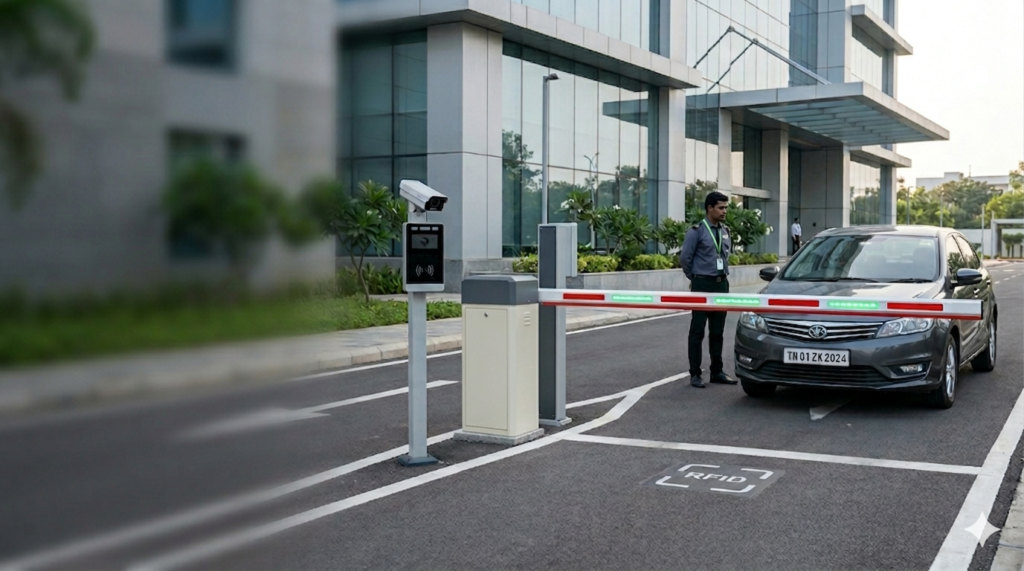
The word automatic distinguishes it from manual boom barriers that require a security guard to physically lift the arm. An automatic boom barrier opens and closes in response to an electronic signal — from an RFID card reader, remote control, vehicle loop detector, ANPR camera, intercom, or parking management software — without any manual intervention.
When you tap your RFID card at a corporate office gate, the barrier opens automatically. When you take a ticket at a mall parking entry, the barrier rises automatically. When an ambulance approaches a hospital gate with a pre-registered plate, the barrier opens automatically before the vehicle reaches it. All of these are automatic boom barriers in action.
The price of an automatic boom barrier in India in 2026 ranges from ₹15,000 for a basic economy unit to ₹5,00,000 or more for a heavy-duty industrial or high-security system — a range so wide that understanding what drives the difference is essential before you spend a rupee.
What Drives the Price of an Automatic Boom Barrier?
Before the price tables, it is important to understand the six factors that drive boom barrier pricing in India. Every price difference you will encounter in the market comes down to one or more of these:
1. Motor Type and Duty Cycle
The motor is the heart of a boom barrier. It powers every single open-close cycle the barrier performs. Motor quality and its rated duty cycle — the percentage of time it can operate in a given hour — is the single biggest determinant of price and long-term reliability.
Duty cycle explained:
- 40% duty cycle — the motor can run for 24 minutes in every hour. Suitable for 50–150 operations per day. Low-volume residential and small office use.
- 60% duty cycle — 36 minutes per hour. Suitable for 150–400 operations per day. Medium corporate offices, schools, hospitals.
- 90% duty cycle — 54 minutes per hour. Suitable for 400–800 operations per day. Large IT parks, busy corporate campuses.
- 100% duty cycle — continuous operation. Suitable for toll plazas, industrial gates, high-frequency parking. Hydraulic motors typically.
A cheap barrier with a 40% duty cycle motor installed at a site with 500 daily operations will burn out within 6 months. This is the most common and most expensive mistake buyers make. Always match duty cycle to real traffic volume before comparing prices.
2. Arm Length
The horizontal arm of a boom barrier comes in standard lengths: 3 metres, 4 metres, 5 metres, 6 metres, and up to 9 metres for wide-lane hydraulic units. Longer arms require more motor torque, larger counterbalance weights, and heavier-duty housing — all of which increase price.
Standard single-lane vehicle widths in India are 3 to 4 metres for cars and SUVs. Two-lane or truck entry points may need 5 to 6 metres or paired barriers on both sides.
3. Opening Speed
How quickly the arm rises from horizontal to vertical (90°) directly affects site throughput and directly affects price.
- Standard speed: 4–6 seconds. Economy and mid-range barriers.
- Fast speed: 2–3 seconds. Premium corporate and commercial barriers.
- High speed: Under 1.5 seconds. Dedicated high-speed motors, significantly higher cost.
- Crash-rated / road blocker speed: Varies. Maximum security applications.
For a site doing 5 vehicles per minute at peak, a 4-second barrier creates a 20-second queue. A 1.5-second barrier handles the same flow with almost no queue. Speed has a direct operational value that justifies higher price.
4. Brand and Country of Origin
This is where Indian buyers often get confused. The market has four tiers:
European brands — FAAC (Italy), BFT (Italy), Nice (Italy), Magnetic Autocontrol (Germany), CAME (Italy). These are the global gold standards for boom barriers — extremely reliable, excellent software integration, long service life. Also the most expensive, and spare parts availability in tier-2 Indian cities can be slower.
International Asian brands — ZKTeco (China), Dahua, HikVision access barriers. Significantly more affordable than European brands, with genuinely competitive quality at the mid-to-upper range. Strong local support network in India. The dominant choice for serious Indian corporate deployments in 2026.
Indian brands — eSSL, CP Plus, Panamax, Newtech. Made or assembled in India. Competitive pricing, good local support, varying quality levels. Best for budget-conscious deployments where European or premium Asian brand budgets are not available.
Economy / unbranded — Generic models sold through distributors without a clear manufacturer brand. Very low price points. High failure rates. No reliable spare parts chain. These are the barriers that prompt “why is my barrier broken after 8 months” calls. Avoid for any serious commercial use.
5. Integration Features
A basic boom barrier opens with a push-button remote. A sophisticated one integrates with RFID readers, ANPR cameras, vehicle loop detectors, parking management software, visitor management systems, UPS backup, and cloud monitoring platforms. Each integration layer adds cost — both in hardware and in software licensing.
The more you need your barrier to do automatically, the more it will cost. But this cost also delivers measurable operational value — reduced manpower, complete audit trails, and frictionless access for authorised vehicles.
6. Warranty and After-Sales Support
A barrier with a 3-year onsite warranty from a brand with local engineers in your city costs more than a barrier with a 6-month carry-in warranty from a distant distributor. That price difference is real and it reflects real support availability. For a barrier used 300 times per day at a critical access point, a 3-day repair turnaround versus a 3-week spare-parts-from-overseas situation has direct operational and financial consequences.
Automatic Boom Barrier Price in India 2026 — Complete Breakdown
Category 1 — Economy / Basic Boom Barrier
Price range: ₹15,000 – ₹30,000 per unit
| Specification | Details |
|---|---|
| Motor type | AC motor, electromechanical |
| Duty cycle | 30–40% |
| Arm length | 3–4 metres |
| Opening speed | 5–7 seconds |
| Daily operations | Up to 100–150 |
| Typical brands | Generic / unbranded, some local assemblers |
| Warranty | 6–12 months, carry-in |
| Integration | Remote control only |
Best for: Small residential complexes, small private parking areas, temporary deployments, extremely budget-constrained applications where security is minimal.
Honest assessment: Economy barriers at this price point are viable for low-frequency, low-criticality applications. For anything used more than 100 times per day or at a commercial premises where reliability matters, the long-term total cost of ownership — frequent repairs, early motor replacement, downtime — makes these a false economy.
Category 2 — Mid-Range Boom Barrier
Price range: ₹30,000 – ₹65,000 per unit
| Specification | Details |
|---|---|
| Motor type | DC brushless or AC motor |
| Duty cycle | 60–80% |
| Arm length | 3–6 metres |
| Opening speed | 3–5 seconds |
| Daily operations | Up to 300–500 |
| Typical brands | eSSL, CP Plus, Panamax, ZKTeco entry-level |
| Warranty | 1 year, carry-in to onsite |
| Integration | Remote, RFID, loop detector ready |
Best for: Gated residential communities, medium-sized corporate offices, schools, hospitals, small commercial parking areas, retail complexes.
Honest assessment: This is the sweet spot for most Indian commercial deployments. Indian and entry-level international brands at this price point offer genuine reliability for typical business use cases. RFID integration is standard, and most models in this range support loop detectors for automatic closing after vehicle passage.
Category 3 — Corporate / Professional Boom Barrier
Price range: ₹65,000 – ₹1,50,000 per unit
| Specification | Details |
|---|---|
| Motor type | DC brushless, high-torque |
| Duty cycle | 90% |
| Arm length | 3–6 metres |
| Opening speed | 1.5–3 seconds |
| Daily operations | Up to 800–1,000 |
| Typical brands | ZKTeco Pro series, Dahua, BFT, FAAC mid-range |
| Warranty | 1–2 years onsite |
| Integration | RFID, ANPR, loop detector, parking software, UPS |
Best for: Large corporate campuses, IT parks, multi-tenant commercial buildings, hotels, large hospitals, universities, busy commercial parking complexes.
Honest assessment: If your site has consistent high vehicle traffic — more than 300 movements per day — this is the category to buy in. The higher duty cycle motors genuinely outlast cheaper alternatives over a 5-year horizon. ANPR integration at this level enables truly automatic operation — no cards, no remotes, number plates are recognised and barriers open automatically.
Category 4 — High-Speed Boom Barrier
Price range: ₹1,20,000 – ₹2,50,000 per unit
| Specification | Details |
|---|---|
| Motor type | High-speed DC brushless or servo motor |
| Duty cycle | 90–100% |
| Arm length | 3–6 metres |
| Opening speed | 0.9–1.5 seconds |
| Daily operations | 1,000–3,000+ |
| Typical brands | FAAC, BFT, Magnetic Autocontrol, ZKTeco high-speed |
| Warranty | 2–3 years onsite |
| Integration | Full — ANPR, multi-lane software, UPS, cloud |
Best for: Major corporate campuses with high vehicle throughput, large shopping mall parking, stadium entry, airport access roads, high-footfall commercial districts.
Honest assessment: At under 1 second open-close speed, these barriers are genuinely impressive in operation. The ROI calculation is different from standard barriers — the value is in throughput (fewer queues, faster entry) rather than just security. Worth every rupee at sites with 500+ vehicle movements per day.
Category 5 — Heavy-Duty Hydraulic Boom Barrier
Price range: ₹1,50,000 – ₹5,00,000+ per unit
| Specification | Details |
|---|---|
| Motor type | Hydraulic |
| Duty cycle | 100% (continuous) |
| Arm length | 4–9 metres |
| Opening speed | 2–4 seconds |
| Daily operations | Unlimited — designed for 24/7 continuous use |
| Typical brands | FAAC, Came, Magnetic Autocontrol, specialist manufacturers |
| Warranty | 2–3 years onsite |
| Integration | Full industrial integration, PLC compatible |
Best for: Toll plazas, industrial factory gates, logistics parks, ports, mining facilities, large warehouse complexes, any site requiring continuous 24/7 barrier operation.
Honest assessment: Hydraulic barriers are not for standard commercial use — they are industrial workhorses. The mechanism withstands vehicle impact better than electromechanical barriers, handles wide arms up to 9 metres, and simply does not wear out at normal operating frequencies. If your barrier never stops moving, this is the right category.
Category 6 — Solar-Powered Boom Barrier
Price range: ₹75,000 – ₹1,50,000 per system
| Specification | Details |
|---|---|
| Power source | Solar panel + battery backup |
| Duty cycle | 40–60% (battery dependent) |
| Arm length | 3–5 metres |
| Opening speed | 3–5 seconds |
| Daily operations | Up to 300 (varies with solar charging) |
| Typical brands | ZKTeco solar series, specialist solar security brands |
| Warranty | 1 year unit, 5 years solar panel |
| Integration | Remote, RFID, solar controller |
Best for: Remote agricultural land gates, construction site entries, factory perimeter gates, rural facility access points, any location without reliable grid power.
Honest assessment: Solar barriers have become genuinely reliable in 2026. The lithium battery backup handles 3–5 days of cloudy weather without grid power. For remote sites where running electrical cabling is more expensive than the barrier itself, this is the most practical and cost-effective solution.
Complete Brand-wise Price Comparison — India 2026
| Brand | Origin | Entry Price | Mid Price | Premium Price | Best For |
|---|---|---|---|---|---|
| ZKTeco | China | ₹35,000 | ₹80,000 | ₹1,80,000 | Corporate, IT parks |
| eSSL | India | ₹25,000 | ₹55,000 | ₹1,00,000 | SMEs, offices |
| CP Plus | India | ₹28,000 | ₹58,000 | ₹1,10,000 | Residential, offices |
| FAAC | Italy | ₹85,000 | ₹1,50,000 | ₹3,00,000+ | Premium, industrial |
| BFT | Italy | ₹75,000 | ₹1,30,000 | ₹2,50,000+ | Corporate, premium |
| Nice | Italy | ₹65,000 | ₹1,10,000 | ₹2,00,000+ | Commercial |
| Magnetic Autocontrol | Germany | ₹1,20,000 | ₹2,00,000 | ₹4,00,000+ | Industrial, toll |
| Panamax | India | ₹20,000 | ₹45,000 | ₹85,000 | Budget, residential |
| Dahua | China | ₹40,000 | ₹85,000 | ₹1,60,000 | Corporate, security |
All prices are approximate ex-GST market rates for Andhra Pradesh as of August 2026. Final prices vary by dealer, quantity, and configuration.
Installation Cost — What to Budget Beyond the Barrier Price
This is where most buyers get surprised. The barrier unit is only part of your total investment. Here is a realistic all-inclusive budget breakdown:
Civil and Foundation Work
₹3,000 – ₹15,000 per barrier
A boom barrier requires a concrete foundation pad — typically 600mm × 600mm × 600mm deep — to anchor the housing. Without proper foundation, the barrier shifts and misaligns over time. Cost depends on existing ground conditions.
Electrical Wiring and Power Supply
₹2,000 – ₹10,000 per barrier
Dedicated power supply, proper earthing, and wiring from the nearest distribution board to the barrier location. UPS backup wiring if specified. Cost varies with distance and cable specification.
RFID Reader and Cards
₹3,000 – ₹15,000 per lane
The RFID reader mounted on a post reads cards or fobs for authorised vehicle access. Cards for all authorised vehicles — typically 125kHz or 13.56MHz format. Cost scales with number of users.
Vehicle Loop Detectors
₹3,000 – ₹8,000 per loop
Inductive loops buried in the road surface detect vehicle presence and trigger automatic barrier closing after a vehicle clears, and prevent the barrier from closing on a vehicle that has not fully passed. Most professional installations use two loops per lane — one for triggering and one for safety.
ANPR Camera (Optional)
₹15,000 – ₹60,000
Automatic Number Plate Recognition camera reads vehicle registration plates and opens the barrier automatically for pre-registered vehicles. Eliminates the need for RFID cards. Higher end of price range for 4K ANPR cameras with night-vision capability.
Parking Management Software (Optional)
₹10,000 – ₹50,000 (one-time) + annual subscription
Cloud-based or local server software that manages the complete vehicle access system — entry/exit logs, ticket generation, payment integration, occupancy monitoring, and reports. Essential for paid parking and large campus management.
UPS Backup
₹5,000 – ₹20,000
Ensures the barrier continues operating during power cuts. Battery backup capacity determines how long it operates without power — typically 4 to 8 hours for standard UPS units paired with boom barriers.
Complete All-Inclusive Budget Guide
| Site Type | Barrier Unit | Installation & Accessories | Total Budget |
|---|---|---|---|
| Small office (1 lane, basic) | ₹30,000 | ₹15,000 | ₹45,000 – ₹55,000 |
| Residential complex (2 lanes) | ₹70,000 | ₹40,000 | ₹1,10,000 – ₹1,30,000 |
| Corporate office (2 lanes, RFID) | ₹1,60,000 | ₹60,000 | ₹2,20,000 – ₹2,50,000 |
| IT park (4 lanes, ANPR) | ₹5,00,000 | ₹2,00,000 | ₹7,00,000 – ₹8,00,000 |
| Mall parking (6 lanes, full system) | ₹8,00,000 | ₹4,00,000 | ₹12,00,000+ |
Annual Maintenance Contract (AMC) — What It Costs and Why It Matters
Every automatic boom barrier needs regular maintenance. A barrier doing 300 operations per day completes over 1,00,000 open-close cycles per year. Mechanical components wear, sensors need calibration, software needs updates.
Typical AMC Rates in India 2026
| Coverage Level | What’s Included | Annual Cost (per barrier) |
|---|---|---|
| Basic | 2 visits/year, labour only | ₹4,000 – ₹6,000 |
| Standard | 4 visits/year, labour + minor parts | ₹6,000 – ₹10,000 |
| Comprehensive | Quarterly visits, all parts, priority response | ₹10,000 – ₹18,000 |
What Good AMC Covers
- Quarterly preventive maintenance visits
- Motor lubrication and mechanical inspection
- Sensor calibration and cleaning
- Software and firmware updates
- Priority breakdown response — typically 4–8 hours for local suppliers
- Discounted spare parts pricing
- Annual safety and performance certification
Why AMC matters more than most buyers realise: A barrier without AMC that fails at 7 PM on a Friday at a corporate campus — with 200 vehicles needing to exit — is not just an inconvenience. It is a security incident and a management crisis. The cost of one emergency call-out without an AMC contract typically exceeds an entire year of AMC fees.
Automatic Boom Barrier Price in Vijayawada — Local Market Guide
In Vijayawada and across Andhra Pradesh, boom barrier prices broadly follow the national market with some variation for logistics, local dealer margins, and installation complexity.
Vijayawada market price ranges (installed, all-inclusive):
| Category | Vijayawada All-Inclusive Price |
|---|---|
| Basic barrier (3m, economy) | ₹40,000 – ₹55,000 |
| Standard barrier (4m, RFID) | ₹65,000 – ₹95,000 |
| Corporate barrier (90% duty cycle) | ₹1,00,000 – ₹1,50,000 |
| High-speed barrier with ANPR | ₹1,50,000 – ₹2,50,000 |
| Hydraulic / industrial | ₹2,00,000 – ₹5,00,000+ |
| Solar-powered system | ₹90,000 – ₹1,50,000 |
Important: These are all-inclusive installed prices — barrier unit, civil work, wiring, loop detectors, RFID reader and cards, and commissioning. Always compare suppliers on an all-inclusive basis. A barrier quoted at ₹25,000 with ₹40,000 of add-on charges is more expensive than one quoted at ₹55,000 all-inclusive.
5 Mistakes That Make Your Boom Barrier More Expensive in the Long Run
1. Buying by Unit Price Alone
The barrier that costs ₹20,000 less today may cost you ₹60,000 more over 3 years in repairs, motor replacements, and emergency call-outs. Always calculate total cost of ownership over 3–5 years, not just purchase price.
2. Under-Specifying Duty Cycle
Installing a 40% duty cycle barrier at a site with 400 daily operations guarantees motor failure within months. Match duty cycle to real measured traffic volume — not an estimate.
3. Ignoring Installation Quality
A premium barrier poorly installed — inadequate foundation, incorrect loop detector placement, improper wiring — will perform like a cheap barrier. Installation quality matters as much as product quality.
4. Skipping the UPS
Power cuts are common across Andhra Pradesh. A barrier with no UPS backup fails open (safety mode) or fails closed (blocking mode) during every power interruption. UPS is not optional for serious deployments.
5. Choosing a Supplier Without Local Service
A barrier supplier based 400km away with no local engineer is not a real option when your barrier fails on a busy Monday morning. Always verify that your supplier has a local presence and a committed response time in their AMC agreement.
How to Get the Right Quote — What to Tell Your Supplier
To get an accurate, comparable quote from any boom barrier supplier in India, provide these details upfront:
- Site type — corporate office, residential, hospital, mall, industrial
- Number of lanes — entry lanes + exit lanes separately
- Lane width — measure in metres
- Daily vehicle count — realistic peak-day estimate
- Operating hours — 8 hours/day, 16 hours, 24 hours
- Required integration — remote only, RFID, ANPR, software
- Power availability — grid power available, UPS needed, or solar required
- Timeline — when do you need installation complete
With these details, any serious supplier can give you an accurate all-inclusive quote within 24 hours.
Why Raise Solutions for Boom Barrier Supply and Installation in Vijayawada
Raise Solutions is Vijayawada’s authorised dealer for ZKTeco and eSSL boom barriers — with 12+ years of installation experience across Andhra Pradesh.
What you get when you buy from Raise Solutions:
✅ Free site survey — correct duty cycle, arm length, and integration specified before you commit
✅ Genuine products — ZKTeco and eSSL, 100% authentic with manufacturer warranty
✅ All-inclusive pricing — civil work, wiring, loop detectors, RFID, commissioning — no hidden charges
✅ Same-day installation for standard single-lane systems
✅ ANPR and parking software integration expertise
✅ AMC from ₹6,000/year with local Vijayawada response
✅ EMI options available
✅ ISO 9001 Certified | MSME Registered | NSIC Recognised
Raise Solutions Experience Center
1st Floor, Pradham Building, beside Indian Oil Petrol Pump
Nidamanuru Road, Poranki-521137, Vijayawada, Andhra Pradesh
📞 94926 67817 | 85229 59096
🌐 www.raisesolutions.in
Frequently Asked Questions
Q: What is the minimum price of a boom barrier in India?
Basic economy boom barriers start from ₹15,000–₹20,000 for the unit only. All-inclusive installed cost starts from ₹40,000–₹45,000 for a single-lane basic system. For a serious commercial deployment, budget from ₹65,000 per lane all-inclusive.
Q: Which boom barrier brand is best in India?
For corporate offices and IT parks — ZKTeco offers the best balance of quality, features, and price. For premium and high-security deployments — FAAC and BFT are the global benchmarks. For budget-conscious deployments — eSSL and CP Plus offer reliable performance. Raise Solutions stocks and recommends ZKTeco and eSSL for Andhra Pradesh deployments.
Q: How long does a boom barrier last?
A quality boom barrier from a reputable brand, correctly specified for its duty cycle, with regular AMC maintenance typically lasts 8 to 12 years. Economy barriers at high-traffic sites may need motor replacement within 1 to 2 years.
Q: What is the GST rate on boom barriers in India?
Boom barriers attract 18% GST in India. All prices in this guide are ex-GST. Factor in GST for your total budget calculation.
Q: Can a boom barrier work without electricity?
Standard electromechanical barriers need continuous power. With a UPS backup, they continue operating for 4–8 hours during power cuts. Solar-powered barriers are fully independent of the electricity grid and are the right choice for remote sites.
Q: How long does boom barrier installation take?
A standard single-lane installation — including civil work, wiring, commissioning, and testing — typically takes one working day. Multi-lane systems with significant civil work may take 2–3 days.
The price of an automatic boom barrier in India in 2026 ranges from ₹15,000 for a basic unit to over ₹5,00,000 for a heavy-duty industrial system — but the right price for your site is determined by duty cycle, daily traffic volume, arm length, integration requirements, and the total cost of ownership over 3 to 5 years.
Do not buy a boom barrier by unit price alone. Buy the right specification for your real usage, from a supplier with a genuine local presence and a clear AMC commitment, at an all-inclusive price that covers everything from civil work to commissioning.
If you are in Vijayawada or anywhere in Andhra Pradesh, Raise Solutions will survey your site for free, specify the right system, and give you a transparent all-inclusive price — so you know exactly what you are getting before you spend a rupee.
Published by Raise Solutions | Authorised ZKTeco & eSSL Dealer | Vijayawada, Andhra Pradesh
94926 67817 | raisesolutions.in | Poranki-521137, Vijayawada