
If you manage or live in a gated apartment complex in Andhra Pradesh, you already know the problem. Unauthorised vehicles entering the premises. Delivery bikes parking inside without permission. Outsiders using your resident parking. Security guards who can’t manage the rush hour entry at 9 AM and 6 PM simultaneously.
The solution most apartment associations across Vijayawada, Guntur, Amaravati, Tirupati and Visakhapatnam are adopting in 2026 is a boom barrier system — an automated vehicle access control gate that replaces or assists the manual security guard at entry and exit points.
But with so many models, brands and price points available, choosing the right boom barrier for your apartment complex is confusing. This guide breaks it all down — what to look for, which models work best for Indian apartment conditions, and how to calculate your actual budget before calling a vendor.
Why Apartment Complexes in Andhra Pradesh Need a Boom Barrier
Before jumping to products, let us understand why the demand for boom barriers in residential complexes has surged across AP in the last three years.
1. Rising vehicle count per flat The average apartment in Vijayawada or Guntur now has 1.4 vehicles per household. A 100-unit complex has 140+ vehicles moving in and out daily. Manual management by one guard is not just inefficient — it is impossible during peak hours.
2. Guard collusion and unauthorised parking When entry is controlled by a human, outsiders can talk their way in, tip the guard, or simply follow another vehicle inside. Boom barriers remove human discretion from the equation — either your RFID tag or number plate is registered, or you do not enter.
3. Insurance and liability Several apartment complexes in AP have faced theft and vandalism incidents. Insurance companies increasingly ask for documented access control systems as part of property insurance policies.
4. Resident convenience A properly set up RFID or FASTag-integrated boom barrier means residents never need to stop, roll down the window, or interact with a guard. The gate opens as they approach. This is the standard that most residents now expect.
5. Reduced guard headcount cost A boom barrier with RFID and CCTV integration can reduce required guard count from 2 to 1 at each entry point. At ₹15,000 per guard per month, that is ₹1,80,000 saved per year — at a single gate.
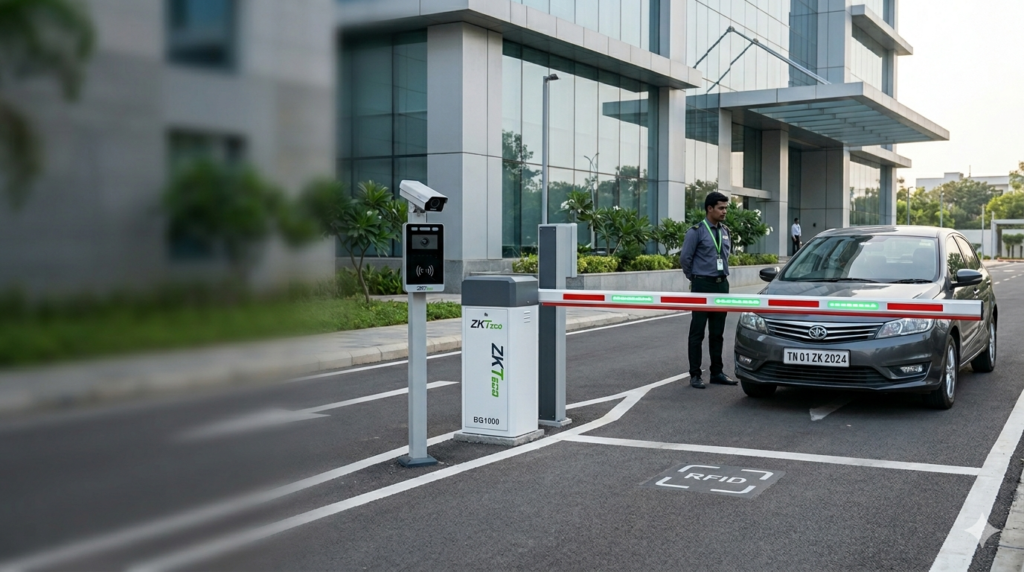
What to Look for in a Boom Barrier for an Apartment Complex
Not all boom barriers are suitable for residential use. Here are the specific factors that matter for apartments in Andhra Pradesh.
1. Duty Cycle
Duty cycle tells you how many operations per hour the motor is designed to handle before it needs to rest.
- 40% duty cycle = 24 operations per hour maximum
- 80% duty cycle = 48 operations per hour maximum
For a 100-unit apartment complex, peak entry time (7:30 AM to 9:30 AM) can see 60–80 vehicle movements per hour across entry and exit. A 40% duty cycle barrier will overheat and fail within months if subjected to this volume.
Recommendation for apartments: Minimum 60% duty cycle. 80% is ideal for complexes with more than 80 units.
2. Arm Length
Measure your lane width before ordering anything. This is the single most common mistake apartment associations make.
Standard residential lane widths in AP:
- Older complexes: 3.0m to 4.0m
- New constructions post-2015: 4.0m to 5.0m
- Wide entry lanes for premium complexes: 5.5m to 6.0m
Always measure gate-to-gate and add 15cm clearance on each side. An arm that is too short lets two-wheelers squeeze past. An arm that is too long puts mechanical stress on the motor.
3. Access Control Method
This is where most apartment associations get confused. Your choices are:
RFID card / sticker — Each registered vehicle gets an RFID card or windshield sticker. As the vehicle approaches, the reader detects the tag and opens the barrier. Cost-effective and reliable. Visitors need a different process (intercom, guard override, or visitor card).
Remote control — Simple handheld remote given to each resident. Works without any reader installation. The disadvantage: remotes can be given to outsiders, lost, or duplicated.
FASTag integration — Your existing vehicle FASTag (the NHAI toll payment tag on your windscreen) is used as the access credential. No new sticker or card needed. The barrier reads your FASTag and opens if your vehicle is registered. This is the most convenient option for residents and is increasingly popular in AP apartments.
Number plate recognition (ANPR) — A camera reads your number plate and opens the gate automatically. No card, no tag, no remote needed. The most premium and frictionless experience. Suitable for larger complexes with higher budgets.
Recommendation for most AP apartments: RFID sticker + FASTag integration combo, with remote control as backup for older vehicles.
4. Power Backup
Andhra Pradesh still experiences power cuts, particularly in smaller towns and outskirts. Your boom barrier must have a UPS backup that keeps it operational for at least 2–4 hours during an outage. Confirm this with your vendor before purchasing.
Also confirm: what happens during a power failure? The barrier should automatically rise (fail-safe open) so vehicles are not trapped. This is a safety requirement, not a preference.
5. Build Quality for Andhra Pradesh Climate
AP’s climate is harsh on outdoor equipment. Vijayawada, Guntur and coastal AP get high humidity, heavy monsoon rain, and summer temperatures exceeding 45°C. Your barrier must be:
- IP54 rated or higher (dust and water resistant)
- Motor housing in powder-coated steel or aluminium, not plastic
- UV-resistant arm material (fibreglass or aluminium, not PVC)
- Sealed cable entry points to prevent water ingress
6. Safety Sensors
Anti-crash sensors are mandatory, not optional, in a residential setting. Children, cyclists and pedestrians cross barrier lanes. The system must detect obstacles under the arm and immediately stop or reverse if something is detected mid-close. Ask your vendor specifically for loop detector or IR safety sensor inclusion — do not assume it is included in the base price.
Best Boom Barrier Models for Apartments in Andhra Pradesh (2026)
Option 1: Standard RFID Barrier — Best for Small to Medium Apartments (Up to 80 Units)
Best suited for: Apartment complexes with 30–80 units, moderate traffic volume, single entry/exit lane.
Key specs to look for:
- Arm length: 3m to 5m
- Duty cycle: 40–60%
- Open/close speed: 3–4 seconds
- RFID reader compatible
- Built-in loop detector
Installed price range in Vijayawada: ₹35,000 – ₹60,000 per lane
What this gets you: Reliable, low-maintenance barrier that handles normal residential traffic. Pair it with an RFID reader and you have a complete gated entry system. Suitable for most independent apartments and smaller complexes across Vijayawada, Guntur and smaller AP towns.
Option 2: High-Speed Barrier — Best for Large Complexes and High Traffic (80+ Units)
Best suited for: Apartment complexes with 80–300 units, two or more entry/exit points, high peak-hour traffic.
Key specs to look for:
- Arm length: 4m to 6m
- Duty cycle: 80–90%
- Open/close speed: 1.5–2 seconds
- ANPR camera compatible
- Anti-tailgating loop detector
Installed price range in Vijayawada: ₹65,000 – ₹95,000 per lane
What this gets you: A barrier built for continuous, high-volume operation. At 1.5 seconds open/close, it can process one vehicle every 4–5 seconds during peak hours — roughly 700+ vehicles per day without motor stress. The 80–90% duty cycle means it can run all day without overheating. This is the right choice for large gated communities, township complexes and premium apartment projects across AP.
Option 3: FASTag-Integrated Barrier — Most Convenient for Residents
Best suited for: Premium apartments where resident convenience is the top priority. Works especially well in Vijayawada’s newer township developments.
Key specs to look for:
- UHF RFID reader (reads FASTag from 3–5 metres)
- No stopping required — reads the tag at driving speed
- Whitelist management via web/mobile app
- Compatible with standard electromechanical or high-speed barrier motor
Installed price range in Vijayawada: ₹55,000 – ₹90,000 per lane (reader + barrier combined)
What this gets you: Residents drive in without slowing down. The UHF reader picks up the vehicle’s FASTag from 3–5 metres away and triggers the barrier before the vehicle reaches it. For visiting vehicles without a FASTag or unregistered FasTags, a backup intercom or guard override handles the exception. This is the closest experience to a proper smart barrier without going full ANPR.
Option 4: ANPR (Number Plate Recognition) Barrier — Most Advanced Option
Best suited for: Premium gated communities, villa projects, high-end township apartments in Amaravati corridor, Vijayawada west, and Vizag.
Key specs to look for:
- High-resolution ANPR camera (min. 2MP, IR night vision)
- Cloud-based number plate database management
- Mobile app for resident number plate registration
- Visitor QR pass generation from mobile
- Integration with CCTV recording
Installed price range in Vijayawada: ₹1,10,000 – ₹1,80,000 per lane (full ANPR system)
What this gets you: The most frictionless experience possible. Registered vehicles enter without any card, tag, remote or interaction. The camera reads the plate, matches it to the database and opens the barrier — all in under 2 seconds. Visitors receive a QR code via WhatsApp that the guard scans for one-time entry. Every entry and exit is photographed and logged with timestamp. This system essentially eliminates gate duty for the security guard — they shift from managing traffic to reviewing flagged incidents on a monitor.
How Much Does a Boom Barrier Cost for an Apartment in Andhra Pradesh?
Here is a clear, realistic cost breakdown for a typical apartment complex installation in 2026:
Single lane, RFID system (basic):
- Barrier + RFID reader + loop detector + UPS: ₹45,000 – ₹70,000
- Civil work (concrete foundation, conduit): ₹5,000 – ₹10,000
- Installation and configuration: Included by Raise Solutions
- Total: ₹50,000 – ₹80,000 per lane
Single lane, FASTag-integrated system:
- High-speed barrier + UHF reader + loop detector + UPS: ₹70,000 – ₹1,00,000
- Civil work: ₹8,000 – ₹12,000
- Total: ₹78,000 – ₹1,12,000 per lane
Single lane, full ANPR system:
- Barrier + ANPR camera + controller + software + UPS: ₹1,20,000 – ₹1,80,000
- Civil work: ₹10,000 – ₹15,000
- Total: ₹1,30,000 – ₹1,95,000 per lane
Typical apartment complex (2 lanes — 1 entry, 1 exit):
- Basic RFID: ₹1,00,000 – ₹1,60,000
- FASTag integrated: ₹1,56,000 – ₹2,24,000
- Full ANPR: ₹2,60,000 – ₹3,90,000
Annual Maintenance Contract (AMC): ₹6,000 – ₹15,000 per barrier per year, covering preventive maintenance visits, software updates and priority breakdown response.
ROI Calculation for Apartment Associations
Here is how to calculate whether the investment makes sense for your complex.
Current cost of manual gate management (2 guards, 2 shifts):
- 4 guards x ₹15,000/month = ₹60,000/month = ₹7,20,000/year
With a boom barrier system:
- Barrier system cost (RFID, 2 lanes): ₹1,20,000 one-time
- Reduce to 2 guards (1 per shift for monitoring only): ₹30,000/month = ₹3,60,000/year
- AMC: ₹24,000/year
- New annual cost: ₹3,84,000
Annual saving: ₹3,36,000 Payback period: Less than 5 months
After the payback period, the apartment association saves over ₹3 lakh every year — indefinitely — while providing better security and resident convenience.
Common Mistakes Apartment Associations Make When Buying a Boom Barrier
Mistake 1: Buying on price alone The cheapest barrier in the market is cheap because it uses a low-quality motor, undersized duty cycle rating, and no-name electronics. In AP’s heat and humidity, these units typically fail within 12–18 months, costing more in repairs than the original saving. Always buy from authorised dealers of established brands.
Mistake 2: Not measuring lane width accurately Many associations order a 4m arm for a 4.5m lane. The arm does not reach. They then have to order an extension or, worse, a completely new arm. Measure twice before ordering.
Mistake 3: Skipping civil work The barrier foundation must be done properly — correct depth, correct concrete mix, correct anchor bolt placement. A poorly done foundation causes the barrier housing to tilt over months, misaligning the arm and stressing the pivot. Always insist on proper civil work as part of the installation.
Mistake 4: Not planning for visitors RFID and FASTag systems work perfectly for registered residents. But what is the process for delivery personnel, guests and service providers? Plan this before installation — visitor card system, guard intercom override, or QR-based visitor pass. Raise Solutions sets up all of this during the installation.
Mistake 5: Ignoring AMC A boom barrier operates 200+ times per day. Moving parts wear. Electronics drift. A barrier without annual maintenance will fail at the worst possible time — usually at peak hour on a Monday morning. Always sign an AMC with a local vendor who can respond on-site within hours, not days.
Why Choose Raise Solutions for Your Apartment Barrier in AP
Raise Solutions is Vijayawada’s ISO 9001:2015 certified, MSME-registered, NSIC-listed security automation company. We are an authorised dealer for leading access control brands, with 500+ installations across Andhra Pradesh — including residential complexes in Vijayawada, Guntur, Amaravati, Krishna district, Tirupati and Visakhapatnam.
What we offer apartment associations:
- Free site survey — our engineer visits, measures your lanes and assesses traffic volume before quoting
- Genuine branded products with manufacturer warranty
- Complete installation including civil foundation work
- RFID/FASTag enrollment for all resident vehicles
- Visitor management system setup
- Integration with existing CCTV
- AMC plans from ₹6,000/year with 24-hour on-site response
- We are based in Poranki, Vijayawada — not a call centre in another state
A standard 2-lane barrier installation (foundation, barrier, readers, wiring, testing) takes 1–2 working days. Resident RFID enrollment can be done in batches over 2–3 days.
The right boom barrier for your apartment complex in Andhra Pradesh depends on three things: the number of units, your peak traffic volume, and your budget. For most complexes in the 50–150 unit range, a high-speed barrier with FASTag integration at ₹70,000–₹1,00,000 per lane hits the sweet spot of convenience, reliability and cost.
Whatever your requirement, the most important decision is not the brand or model — it is choosing an installer with a proven local track record, genuine products, and a team that will actually show up when something needs attention.
Raise Solutions has been that team for 500+ installations across Andhra Pradesh. We would be glad to be that team for your apartment complex too.
📞 Call or WhatsApp: +91 85229 59096 📧 Email: info@raisesolutions.in 🌐 Website: raisesolutions.in 📍 Address: Poranki, Vijayawada, Andhra Pradesh — 521137
Free site survey available across entire Andhra Pradesh. Call today to book your slot.