
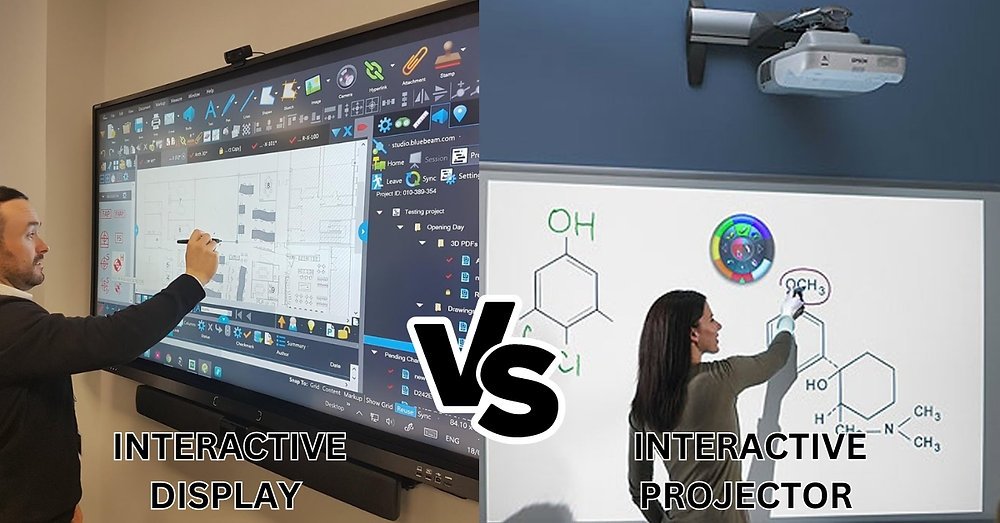
Walk into any school in Andhra Pradesh today and you will find one of two things mounted at the front of the classroom — either a large flat screen glowing with crisp colour, or a projector throwing an image onto a whiteboard or wall.
Both claim to be the future of classroom technology. Both have been sold to thousands of schools across India over the last decade. And both have passionate advocates who will tell you the other option is a waste of money.
So which one is actually right for your school?
That is exactly what this guide answers — with no brand bias, no sales pitch, and no jargon. Just a straight, honest comparison based on how these technologies actually perform in real Indian classrooms, in 2026.
Whether you are a school principal, a correspondent, a government education officer, or a parent on a committee making a purchasing decision — this is the only guide you need to read before spending a single rupee.
What Changed in 2026 — Why This Comparison Matters More Than Ever
Before we dive into the comparison, it is worth understanding why this question is more relevant now than it was even two or three years ago.
Google’s Helpful Content updates (2022–2025) have repeatedly rewarded in-depth, experience-based educational content and pushed generic, thin articles out of search results. Schools searching for technology guidance are finding better answers. And they deserve better answers — because this is a decision that will cost anywhere from ₹60,000 to ₹3,00,000 per classroom and last for a decade.
The Indian education technology market has exploded. Under initiatives like PM eVIDYA, NIPUN Bharat, and state-level smart classroom programmes in Andhra Pradesh, Telangana, Karnataka and Tamil Nadu, thousands of crores are being allocated to classroom technology. The wrong choice wastes public and private money and fails students.
Interactive Flat Panels (IFPs) have crossed a price threshold. In 2020, a 75-inch IFP cost ₹2,50,000 or more. In 2026, quality 75-inch IFPs are available at ₹1,00,000 to ₹1,40,000. This has fundamentally changed the comparison — and most guides written before 2024 are already outdated.
With that context, let us get into the comparison.
First — What Exactly Are We Comparing?
What Is an Interactive Flat Panel (IFP)?
An Interactive Flat Panel is essentially a very large touchscreen display — like an oversized Android tablet — designed for classroom use. Sizes typically range from 65 inches to 110 inches. The panel has built-in Android (or Windows) operating system, speakers, front-facing cameras, HDMI and USB inputs, and a multi-touch screen that responds to finger touch or a stylus.
Teachers can write on the screen, drag and drop content, open YouTube videos, run quiz software, annotate over PDFs and presentations — all directly on the display without any separate computer or projector.
Leading brands available in India: Philips, LG CreateBoard, Samsung Flip, Optoma, ViewSonic, BenQ, SMART Technologies, Reach (Indian brand), Triumph Board.
What Is a Projector (Including Interactive Projector)?
A traditional projector throws light from a lamp or laser source onto a wall or screen. A standard projector just displays content. An interactive projector adds an infrared or laser-based system that makes the projected surface touch-responsive — turning a wall or whiteboard into a large interactive display without a dedicated screen.
Types in Indian schools:
- Standard DLP projector + whiteboard (most common, cheapest)
- Short-throw interactive projector (projects from close range, reduces shadow)
- Ultra-short-throw (UST) interactive projector (mounts near the board, no shadow)
- Laser projector (replaces lamp with laser, longer life)
Leading brands in India: Epson, BenQ, Optoma, NEC, Sony, Casio, ViewSonic, Hitachi.
The 12-Point Comparison — Classroom by Classroom
1. Image Quality & Visibility
Interactive Flat Panel: Delivers consistent, bright, high-contrast Full HD or 4K display regardless of ambient light conditions. Whether the classroom windows are open at noon or the room is dim in the evening — the picture is equally sharp and vivid. No shadows. No colour washout.
Projector: Image quality is highly dependent on ambient light. In a brightly lit Indian classroom — particularly in the afternoon with windows open — projected images become washed out and difficult to see, even with curtains. Students in the back rows frequently struggle to read text on a projected screen in daylight.
Winner: Interactive Flat Panel — especially for Indian classrooms where controlling ambient light is difficult and often impractical.
2. Interactivity & Touch Experience
Interactive Flat Panel: Multi-touch capability (10 to 20 simultaneous touch points) is built into the screen itself. The touch response is fast, precise, and natural — similar to using a large smartphone. Students can walk up and interact directly. Writing with a finger or stylus feels exactly like writing on paper. No calibration needed.
Projector: Standard projectors have zero interactivity. Interactive projectors use infrared pens or cameras to track touch on the projected surface, but the experience is noticeably inferior — latency is higher, precision is lower, and the system requires frequent recalibration. The interactive zone is also limited by the projected area and can be disrupted by surface imperfections.
Winner: Interactive Flat Panel — the touch experience is simply in a different class. No pun intended.
3. Upfront Purchase Cost
Interactive Flat Panel: A quality 75-inch IFP from a reputed brand (Philips, ViewSonic, BenQ) costs ₹1,00,000 to ₹1,60,000 in 2026. Budget Indian brands like Reach or Triumph Board offer 75-inch panels from ₹70,000 to ₹90,000.
Projector: A standard 3000-lumen DLP projector costs ₹25,000 to ₹50,000. Add a motorised projection screen (₹8,000–₹15,000) and installation, and a basic setup lands at ₹35,000 to ₹65,000. A quality interactive projector system (short-throw + interactive software) costs ₹80,000 to ₹1,50,000 — comparable to an IFP once you add the screen.
Winner: Projector (standard) — for pure upfront cost, a basic projector setup is cheaper. But this gap narrows dramatically when you factor in the total cost of ownership over 5 years.
4. Total Cost of Ownership — The Number Every School Gets Wrong
This is the most important financial consideration — and the one most schools do not calculate before purchasing.
Projector lamp replacement: Traditional DLP projector lamps last 2,000 to 5,000 hours. A school using a projector 6 hours per day, 220 days per year uses 1,320 hours annually — meaning a lamp replacement every 2 to 4 years. Replacement lamps cost ₹4,000 to ₹12,000 each. Over 10 years, a school will spend ₹20,000 to ₹60,000 in lamps alone per classroom — before accounting for servicing, colour degradation, or bulb failure mid-lesson.
Laser projectors eliminate lamp costs but cost ₹80,000 to ₹2,00,000 upfront.
Interactive Flat Panel: No lamp. No consumable parts. LED backlight lasts 50,000+ hours — over 37 years at the same usage rate. Maintenance cost is essentially zero unless the panel is physically damaged. An AMC (Annual Maintenance Contract) costs ₹3,000 to ₹8,000 per year for peace of mind.
| Cost Factor | Projector (10 yrs) | IFP (10 yrs) |
|---|---|---|
| Purchase price | ₹40,000 | ₹1,20,000 |
| Lamp replacements | ₹40,000 | ₹0 |
| Screen replacement | ₹15,000 | ₹0 |
| Servicing / AMC | ₹30,000 | ₹50,000 |
| Total 10-year cost | ₹1,25,000 | ₹1,70,000 |
The gap over 10 years is far smaller than the upfront difference suggests — and this does not account for the productivity, quality, and educational experience advantages of the IFP.
Winner: Projector (marginally, on pure cost) — but the gap is much smaller than most schools assume.
5. Ease of Use for Teachers
Interactive Flat Panel: Teachers interact with the panel exactly as they would with a smartphone or tablet — touch, swipe, pinch, zoom. No remote control needed. No calibration. No dealing with a separate computer. Most IFPs have built-in Android with pre-installed classroom apps. Setup time each morning: zero.
Projector: Requires turning on projector, waiting for warm-up (1–3 minutes), ensuring the laptop or desktop is connected via HDMI, adjusting alignment if the projector has shifted, and managing cabling. Interactive projectors require regular calibration — a process that can take 5 to 10 minutes and must be repeated when the projector moves. Teachers frequently cite projector setup time as a source of daily frustration.
Winner: Interactive Flat Panel — dramatically simpler for teachers, especially those who are not technology-confident.
6. Durability in Indian School Conditions
Interactive Flat Panel: Solid-state display with no moving parts and no fragile lamp. The screen surface is typically toughened glass. Resistant to dust, humidity, and power fluctuations (most have built-in surge protection). Built to last 10 to 15 years with normal use. No part degrades predictably the way a projector lamp does.
Projector: The lamp is the critical weakness. High temperatures — common in Indian classrooms without air conditioning — dramatically shorten lamp life. Dust clogs the projector’s cooling system, causing overheating and failure. Power cuts and fluctuations can blow lamps and damage circuitry. The projection lens and mirror system can be affected by vibration over time.
In the Indian climate — particularly in Andhra Pradesh and Telangana where summer temperatures regularly exceed 40°C — projectors require significantly more maintenance attention than in temperate climates for which most specifications are written.
Winner: Interactive Flat Panel — considerably more durable in real Indian classroom conditions.
7. Screen Size & Classroom Coverage
Interactive Flat Panel: Standard sizes are 65, 75, 86 and 98 inches. A 75-inch panel covers a classroom effectively up to 10 metres depth. Beyond that, students in the back rows begin to struggle — but most Indian classrooms are within this range.
Projector: Can produce very large images — 100 to 200 inches — on a low budget. For very large classrooms, auditoriums, or assembly halls where a 100+ inch display is needed, a projector is often the only practical option.
Winner: Projector — for very large spaces and auditorium applications. For standard classrooms, a 75–86 inch IFP covers the room adequately.
8. Software & Content Ecosystem
Interactive Flat Panel: Built-in Android supports thousands of educational apps — Google Classroom, Khan Academy, DIKSHA, Zoom, Teams, YouTube, and proprietary classroom software. Content sharing from teacher and student devices via screen mirroring (Miracast, AirPlay). Some IFPs have built-in lesson recording and OPS (Open Pluggable Specification) computer slot.
Projector: A projector is simply a display — it shows whatever the connected computer shows. No built-in apps. Software capability depends entirely on the laptop or PC it is connected to. Interactive projectors add basic whiteboard annotation software but it is far more limited than IFP software ecosystems.
Winner: Interactive Flat Panel — the built-in software ecosystem transforms it from a display into a teaching platform.
9. Student Engagement & Learning Outcomes
Multiple independent studies — including research published by the Journal of Educational Technology & Society and implementation reviews under India’s Smart Classroom programme — consistently show that touch-based interactive flat panels produce higher levels of student attention, participation, and retention compared to projected displays.
The key factors: students can physically interact with the content, lessons can be instantly adapted with digital tools, and the bright consistent display holds attention better than a washed-out projected image.
A practical reality: In any classroom, you will notice students in the back rows copying from the board rather than engaging with projected content on bright days. This simply does not happen with a well-placed IFP.
Winner: Interactive Flat Panel
10. Maintenance & Support in India
Interactive Flat Panel: Most reputed brands offer 3-year onsite warranty. After warranty, an AMC from a local vendor covers the full system. Repair typically means a visit from a qualified technician. No consumable parts to stock.
Projector: Lamps must be stocked or ordered when they fail — and they often fail mid-semester. Finding the exact replacement lamp for older projector models can be difficult in tier-2 and tier-3 cities. Service network quality varies widely by brand and region.
Winner: Interactive Flat Panel — more predictable maintenance and better service availability in most Indian cities.
11. Health & Safety
Interactive Flat Panel: Displays at eye level. No bright beam directed toward students. Blue light filtering available on most modern panels. No UV emission. Safe for daily prolonged use.
Projector: The projection beam is intensely bright and directed across the room at screen level. Students and teachers who accidentally look into the beam — which happens — are exposed to intense light. Some projector lamps emit UV radiation. The glare from projected images in a bright room causes eye strain over time.
Winner: Interactive Flat Panel
12. Installation Requirements
Interactive Flat Panel: Requires a sturdy wall-mount bracket (included with most IFPs) and a power socket. Installation takes 2 to 3 hours. A height-adjustable mobile stand is also available for flexibility.
Projector: Ceiling mount, cable management from ceiling to PC, projection screen installation, and alignment all add complexity. Installation takes 4 to 6 hours minimum. Any shift in the projector mount requires recalibration of the image.
Winner: Interactive Flat Panel
Summary Scorecard
| Category | Interactive Flat Panel | Projector |
|---|---|---|
| Image quality & visibility | ⭐⭐⭐⭐⭐ | ⭐⭐⭐ |
| Touch interactivity | ⭐⭐⭐⭐⭐ | ⭐⭐ |
| Upfront cost | ⭐⭐⭐ | ⭐⭐⭐⭐⭐ |
| 10-year total cost | ⭐⭐⭐⭐ | ⭐⭐⭐ |
| Ease of use | ⭐⭐⭐⭐⭐ | ⭐⭐⭐ |
| Durability in India | ⭐⭐⭐⭐⭐ | ⭐⭐⭐ |
| Screen size options | ⭐⭐⭐ | ⭐⭐⭐⭐⭐ |
| Software ecosystem | ⭐⭐⭐⭐⭐ | ⭐⭐ |
| Student engagement | ⭐⭐⭐⭐⭐ | ⭐⭐⭐ |
| Maintenance ease | ⭐⭐⭐⭐⭐ | ⭐⭐⭐ |
| Health & safety | ⭐⭐⭐⭐⭐ | ⭐⭐⭐ |
| Installation simplicity | ⭐⭐⭐⭐⭐ | ⭐⭐⭐ |
| Overall | ⭐⭐⭐⭐⭐ | ⭐⭐⭐ |
When Should a School Still Choose a Projector?
Despite the IFP winning most categories, there are genuine scenarios where a projector remains the right choice:
Very tight budget, large number of classrooms: If a school needs to equip 30 classrooms on a ₹15 lakh budget, basic projectors are the only feasible option. A basic projector setup at ₹40,000–₹50,000 per room covers 30 classrooms for ₹12–₹15 lakhs. Thirty IFPs at ₹1,20,000 each would cost ₹36 lakhs.
Auditoriums and large halls: For spaces where a 120–200 inch display is needed, a projector is the only practical solution. IFPs max out at 110 inches.
Temporary or rented premises: If the school is in a temporary building or rented space, a portable projector is easier to move and reinstall than a wall-mounted IFP.
Outdoor or open-air events: Projectors on portable screens work for school events, annual days, and outdoor programmes in a way that IFPs cannot.
When Should a School Choose an IFP?
New classroom construction or renovation: If you are building new classrooms or renovating existing ones, install IFPs. The 10-year total cost difference is marginal, and the educational and maintenance benefits are enormous.
Schools with existing projectors that are failing: If your projectors are more than 5 years old and lamps are failing frequently, do not replace the lamp — replace the projector with an IFP. You are already spending money on a worse experience.
Schools that rely on digital content: DIKSHA, Khan Academy, Google Classroom, and interactive quiz platforms all work dramatically better on an IFP than on a projected display.
Schools that want to reduce teacher friction: If your teachers are not fully adopting classroom technology because of setup complexity, an IFP will change that within a week.
Schools in government smart classroom programmes: Most state government programmes in Andhra Pradesh, including the Smart Classroom initiative and the Mana Badi Nadu Nedu programme, now specify IFPs as the preferred display technology.
Government Schemes in India That Fund Classroom Technology in 2026
One of the most important developments for Indian schools is the availability of government funding for classroom technology. Many schools are not aware of what they are eligible for.
PM eVIDYA: Central government initiative funding digital classroom infrastructure for government schools including IFPs, tablets, and broadband connectivity.
Samagra Shiksha Abhiyan: Provides per-school grants for smart classroom equipment. Private aided schools in many states are eligible.
NIPUN Bharat: Focused on foundational literacy and numeracy with technology support for Classes 1–3. IFPs with appropriate software qualify.
Andhra Pradesh — Mana Badi Nadu Nedu: Infrastructure improvement programme that has funded display technology upgrades across government schools in AP. Private schools in AP can consult the APSCERT for current eligibility.
CBSE Smart Class Guidelines: CBSE recommends IFPs as the standard for affiliated schools. New CBSE affiliation inspections increasingly look for IFPs or equivalent interactive technology.
TIP: Before purchasing any classroom technology, consult your state’s SSA (Samagra Shiksha Abhiyan) district coordinator to confirm what funding your school may be eligible for. Many schools spend their own money on technology they could have received through a government grant.
The 5 Mistakes Indian Schools Make When Buying Classroom Technology
These are real mistakes that cost schools money and result in equipment that sits unused within two years.
Mistake 1 — Choosing on price alone A ₹25,000 projector that needs ₹10,000 in lamps every 3 years and frustrates teachers into not using it is far more expensive than a ₹1,20,000 IFP that works flawlessly for 10 years.
Mistake 2 — Not training teachers No piece of classroom technology succeeds without teacher training. Schools that install IFPs without a structured 2-day teacher training programme find the panels being used only to display PowerPoint slides — a massive underutilisation of the investment.
Mistake 3 — Buying unbranded or grey-market hardware Indian market is flooded with unbranded IFPs claiming premium specs at budget prices. These panels consistently fail within 2–3 years, have no warranty support, and leave schools with expensive, useless hardware. Always buy from an authorised dealer of a recognised brand with a valid India warranty.
Mistake 4 — Ignoring connectivity An IFP without reliable broadband is like a smartphone without a SIM. Before purchasing classroom technology, ensure the school has fibre or leased line broadband, or at minimum a strong WiFi network, in every classroom. Without this, most IFP features are unavailable.
Mistake 5 — Not planning AMC Schools install the panel and forget about maintenance until something breaks. An AMC from the day of installation ensures your technology investment is protected and regularly serviced — at a predictable annual cost.
What Indian Schools Are Actually Buying in 2026
Based on market trends and installation data from across Andhra Pradesh and southern India:
Government schools are increasingly receiving IFPs through state and central schemes. Schools under Mana Badi Nadu Nedu in AP are receiving 75-inch panels as part of infrastructure upgrades.
Private CBSE and ICSE schools in urban and semi-urban areas are upgrading from projectors to 75-inch or 86-inch IFPs at an accelerating pace, particularly in Vijayawada, Guntur, Hyderabad, and Amaravati.
Budget private schools in rural areas still predominantly rely on standard projectors — primarily due to upfront cost constraints, though this is changing as IFP prices continue to fall.
The trend is clear: the question is no longer if schools will move to IFPs — it is when. The price point crossed the threshold of practical affordability for mid-range private schools in 2024–2025, and the curve is accelerating.
Recommended IFP Brands for Indian Schools in 2026
If you have decided to invest in an Interactive Flat Panel, here are the most reliable brands available in India with good after-sales support:
Premium Segment (₹1,40,000–₹2,00,000 for 75 inch): Philips, Samsung Flip, BenQ, LG CreateBoard, SMART Technologies — global brands with robust warranty and service networks in India.
Mid-Range Segment (₹90,000–₹1,40,000 for 75 inch): ViewSonic, Optoma, Hitachi — solid mid-range options with good India support.
Value Segment (₹65,000–₹90,000 for 75 inch): Reach (Indian brand), Triumph Board, Newline — acceptable for budget-conscious schools. Verify warranty terms carefully before purchase.
Key questions to ask any IFP vendor:
- Is this brand’s warranty valid in India or only internationally?
- What is the onsite warranty period and response time?
- Is there a service centre within 50 km of our school?
- Does the panel support DIKSHA and Google Classroom natively?
- What is the AMC cost after warranty expires?
Raise Solutions — Smart Classroom Solutions in Vijayawada & Andhra Pradesh
At Raise Solutions, we are an authorised supplier and installer of Interactive Flat Panel systems for schools, colleges, and coaching institutes across Vijayawada, Guntur, Amaravati, and the Krishna district.
We supply panels from leading brands including Philips, ViewSonic, and Optoma — all with valid India warranty and full after-sales support through our Vijayawada service centre.
What we offer schools:
Free Classroom Assessment — Our education technology specialist visits your school, assesses classroom dimensions, ambient light conditions, and connectivity, and recommends the right panel size and specification for each room.
Supply & Professional Installation — We supply genuine, warranty-backed panels and install them with proper wall-mount brackets, cable management, and alignment. Every installation includes a post-installation test with the teacher present.
Teacher Training — We provide a structured half-day teacher training session covering the full feature set of the IFP, app installation, content sourcing from DIKSHA and other platforms, and troubleshooting basics.
AMC & Ongoing Support — Our Annual Maintenance Contract covers preventive maintenance visits, priority breakdown response, and firmware updates — keeping your classroom technology running at full performance year after year.
Connectivity Setup — We can also assess and upgrade your school’s WiFi and broadband infrastructure to ensure your IFPs are connected and fully functional from day one.
For a classroom up to 9 metres deep with 30–40 students, a 75-inch panel is the standard recommendation. For larger classrooms up to 12 metres, an 86-inch panel is preferable. Anything beyond 12 metres depth typically requires two displays or a projector for adequate visibility.
Conclusion — The Honest Answer
If you came to this article hoping for a nuanced “it depends” answer that keeps all options open, here it is honestly:
For any school making a fresh investment in classroom display technology in 2026 — an Interactive Flat Panel is the right choice in almost every scenario.
The price gap versus projectors has narrowed dramatically. The total cost of ownership over 10 years is comparable. The educational, usability, and durability advantages of an IFP are significant and well-documented. And the teaching experience is simply in a different league.
The only scenarios where a projector still makes sense are very large display requirements (auditoriums), very tight per-classroom budgets where coverage across many rooms is the priority, or temporary installations.
If your school has an existing projector that is working — there is no emergency to replace it. But when it fails, when the lamp needs replacing again, or when you are constructing a new block — choose an IFP. You will not look back.
Get a Free Smart Classroom Consultation for Your School
📞 +91 8522959096 📧 info@raisesolutions.in 🌐 www.raisesolutions.in 📍 Poranki, Vijayawada, Andhra Pradesh
Serving schools across Vijayawada | Guntur | Amaravati | Krishna District | All of Andhra Pradesh