
You have seen them hundreds of times — those sleek, stainless steel pedestrian gates in office lobbies, metro stations, and airport terminals that open silently when you tap your card and close just as smoothly behind you. Those are flap barriers, and they have quietly become the gold standard for pedestrian access control across India.
But what exactly is a flap barrier? How does it work? What does it cost? And most importantly, does your business actually need one?
This guide answers every question you might have about flap barriers in plain language, so you can make a confident and informed decision for your premises.
What Is a Flap Barrier?
A flap barrier — also called a wing barrier, paddle barrier, or swing barrier — is an automated pedestrian access control gate that uses a pair of retractable flaps or paddles to allow or restrict entry at a controlled point.
When an authorised person presents a valid credential — an RFID card, fingerprint, face scan, QR code, or mobile NFC — the flaps retract instantly and the person walks through the open lane. The flaps then close automatically behind them, ready for the next person.
When an unauthorised person attempts to enter, the flaps stay closed. If someone tries to force through or tailgate behind an authorised user, the barrier detects the intrusion and triggers an alarm.
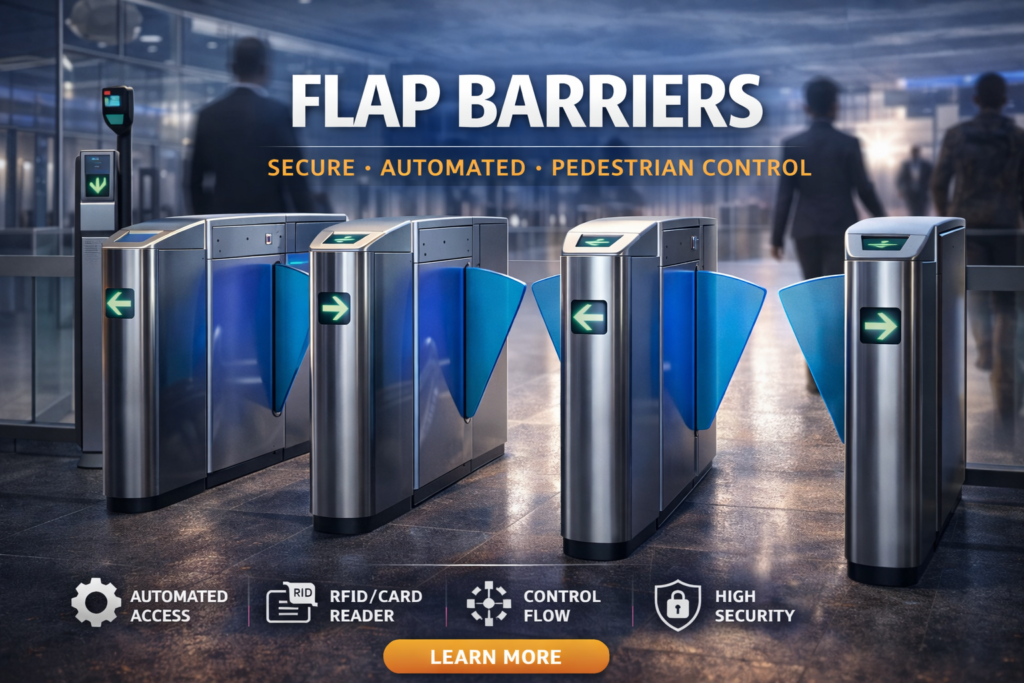
Flap barriers are the most widely used pedestrian access control solution in modern India — deployed in IT parks, corporate offices, metro stations, airports, universities, hospitals, banks, and industrial facilities.
How Does a Flap Barrier Work?
Understanding the working mechanism makes it much easier to appreciate why flap barriers are so effective. Here is the complete step-by-step process:
Step 1 — The person approaches the barrier lane. The individual walks toward the flap barrier. The barrier is in its default closed position — flaps extended across the lane, blocking passage.
Step 2 — The credential is presented. The person taps an RFID card on the reader, scans their fingerprint, looks at the face recognition camera, or presents a QR code on their phone. This happens in less than a second for most credential types.
Step 3 — The system verifies the credential. The access control software checks the presented credential against the database of authorised users in real time. This verification typically takes under 0.5 seconds.
Step 4 — The flaps retract for authorised users. Once the system confirms the credential as valid, it sends a signal to the barrier’s motor. The flaps retract smoothly and quickly — usually within 0.2 to 0.3 seconds — opening the lane for passage.
Step 5 — The person walks through. The individual passes through the open lane. The barrier uses infrared sensors to detect when the person has fully cleared the lane.
Step 6 — The flaps close automatically. As soon as the person clears the detection zone, the flaps close back into position. The barrier is immediately ready for the next user.
Step 7 — The event is logged. Every access event — authorised entry, denied attempt, alarm trigger — is recorded in the system with a timestamp, user identity, and gate location. This creates a complete, searchable audit trail.
What Are the Main Components of a Flap Barrier?
A flap barrier is more than just a pair of moving paddles. Each unit contains several carefully engineered components working together:
The Housing or Cabinet The outer casing that contains all the internal components. Premium flap barriers use 304-grade stainless steel housings for durability, corrosion resistance, and a professional appearance.
The Flaps or Paddles The retractable panels that physically block or open the lane. Quality flaps are made from tempered glass, acrylic, or stainless steel — strong enough to deter casual forced entry but designed to retract smoothly without mechanical stress.
The Drive Motor The electric motor that powers flap movement. A high-quality motor ensures fast, quiet, and consistent flap operation over millions of cycles without significant wear.
The Control Board The electronic brain of the barrier. It processes signals from the access control system, manages flap movement, monitors sensor data, and triggers alarms when needed.
Infrared Sensors Multiple infrared beams across the lane that detect the presence and passage of individuals. These sensors prevent the flap from closing on a person mid-passage and detect tailgating attempts.
The Credential Reader The device mounted on the barrier post that reads the access credential — RFID card, fingerprint, face, QR code, or NFC. Many flap barriers support multiple reader types simultaneously for maximum flexibility.
The Alarm System An integrated buzzer or connection to a central alarm panel that activates when tailgating, forced entry, or prolonged lane obstruction is detected.
The LED Indicator Visual indicators — typically green for access granted and red for access denied — that guide users through the entry process clearly and intuitively.
Types of Flap Barriers
Not all flap barriers are identical. Depending on your environment and requirements, different types serve different purposes:
Standard Flap Barrier
The most common type. Features two retractable flap panels on either side of the lane that retract horizontally when access is granted. Standard lane width is 550–600 mm. Widely used in corporate offices, IT parks, schools, and hospitals.
Wide-Lane Flap Barrier
Essentially the same mechanism as a standard flap barrier but with a wider lane of 900–1000 mm. Designed to accommodate wheelchairs, prams, luggage trolleys, and individuals with mobility aids. Required by law in public buildings under accessibility guidelines. Frequently installed alongside standard lanes in airports, hospitals, and government buildings.
Full-Panel Flap Barrier
Uses larger, full-height panels instead of smaller paddles, providing greater physical deterrence against tailgating. Because the panels cover more of the lane height, they are harder to step over and more visible to security cameras. Popular in high-security environments.
Bi-Directional Flap Barrier
Designed to manage both entry and exit through the same lane. The flap direction reverses depending on the credential presented. Commonly used in facilities with limited space or controlled bidirectional pedestrian flow.
Slim or Compact Flap Barrier
A narrower cabinet design for installations where space is limited or the aesthetic requires a more minimal profile. Slim barriers are popular in boutique offices, retail environments, and modern co-working spaces.
Outdoor Flap Barrier
Built with a higher IP rating (IP65 or above) for resistance to rain, dust, humidity, and temperature extremes. Essential for semi-outdoor installations at building entrances, covered walkways, or open transit hubs.
What Credentials Can a Flap Barrier Accept?
One of the most valuable features of a modern flap barrier is its flexibility in accepting different types of access credentials. Most quality barriers support multiple credential types simultaneously:
RFID Cards and Key Fobs The most widely used credential type in Indian offices and apartments. Fast, reliable, and easy to manage — cards can be issued, deactivated, and replaced through the access control software without touching the barrier hardware.
Fingerprint Biometrics A fingerprint scanner mounted on the barrier post identifies authorised individuals by their unique fingerprint pattern. No card to forget or lose. Widely used in manufacturing, government, and corporate environments.
Face Recognition The most advanced and convenient credential type. A camera mounted on or near the barrier identifies the individual by facial features. Because it requires no physical contact and no credential to carry, face recognition delivers the fastest and most seamless entry experience. Increasingly popular in premium offices and campuses post-2020.
QR Code A QR code displayed on a smartphone or printed pass is scanned at the barrier. Particularly useful for visitor management — temporary QR passes are issued digitally and expire automatically after the visit.
Mobile NFC The individual’s smartphone acts as the credential via NFC technology. The phone is tapped against the reader just like a card. Popular in tech-forward organisations where employees prefer not to carry separate access cards.
PIN Keypad A numeric PIN entered at the barrier grants access. Often used as a backup credential type or in areas where carrying a card or phone is inconvenient.
Multi-Factor Authentication For high-security zones, two or more credential types are required simultaneously — for example, RFID card plus fingerprint, or face recognition plus PIN. This dramatically reduces the risk of credential sharing or misuse.
Where Are Flap Barriers Used in India?
Flap barriers are found across a remarkably wide range of environments in India today:
Corporate Offices and IT Parks are the most common deployment environment. Flap barriers control employee entry, manage visitor access, and integrate with time attendance systems for automatic working hours tracking. Most modern IT parks in Hyderabad, Bengaluru, Chennai, and Vijayawada use flap barriers as the primary pedestrian access control system.
Metro Stations and Railway Terminals Metro systems across India — Hyderabad Metro, Delhi Metro, Chennai Metro, and others — rely on flap barriers to manage millions of daily commuters efficiently and securely. High-speed flap barriers handle peak-hour throughput without creating bottlenecks.
Airports and Bus Terminals Flap barriers manage restricted zone access for airline staff, ground crew, and security personnel. Wide-lane barriers accommodate passengers with luggage and mobility aids.
Banks and Financial Institutions Flap barriers protect customer service areas, back-office operations, and vault access points. Because financial environments demand the highest security standards, anti-tailgating performance is critical.
Universities and Research Campuses Student and staff entry is managed through RFID cards or face recognition. Flap barriers also help universities enforce campus security policies and track attendance automatically.
Hospitals and Healthcare Facilities Flap barriers restrict access to sensitive areas — ICUs, pharmacies, operation theatres, and administrative zones — while allowing seamless movement for authorised staff. Wide-lane barriers accommodate wheelchairs and medical equipment.
Data Centres Among the most security-sensitive environments for flap barrier deployment. Multi-factor authentication combined with full-panel barriers ensures that only authorised personnel enter server rooms and network operation centres.
Manufacturing Plants and Industrial Facilities Shift-based access control using RFID or biometric flap barriers helps manufacturers manage large workforces efficiently, track attendance automatically, and restrict access to hazardous zones.
Government Buildings Increasingly, state and central government offices in India are deploying flap barriers at public counters and staff entry points to improve security and eliminate unauthorised access.
Key Benefits of Installing a Flap Barrier
1. Prevents Unauthorised Entry Completely
Because the flap physically blocks the lane and the system only opens for verified credentials, unauthorised entry becomes extremely difficult. Unlike a security guard who can be distracted, deceived, or overwhelmed at peak hours, the barrier maintains consistent access control around the clock.
2. Eliminates Tailgating
Infrared sensors detect if more than one person attempts to pass on a single credential authorisation. When the system detects tailgating, the alarm triggers immediately — making it one of the most effective anti-tailgating solutions available.
3. Automates Time and Attendance Tracking
Every entry and exit event is logged with the individual’s identity and timestamp. Since this data feeds directly into the HR and payroll system, attendance tracking becomes fully automatic — eliminating buddy punching, manual registers, and administrative errors.
4. Handles High Footfall Efficiently
A single flap barrier lane can process 25 to 40 persons per minute. Adding multiple lanes scales capacity linearly, making flap barriers equally effective for a 50-person office and a 5,000-person campus.
5. Reduces Security Manpower Costs
Because the barrier handles routine access control automatically, organisations typically reduce their security guard requirement significantly. Most flap barrier installations recover their investment within 18 to 24 months through manpower savings alone.
6. Creates a Professional First Impression
A well-specified flap barrier in a corporate lobby immediately communicates professionalism, security-consciousness, and modernity to every visitor and employee who walks through the door. This matters more than most organisations realise — because first impressions shape perceptions of the entire business.
7. Provides a Complete Digital Audit Trail
Every access event is recorded and searchable. During a security investigation, HR dispute, or compliance audit, having a complete and tamper-proof record of who entered and exited — and exactly when — is invaluable.
8. Integrates with Your Existing Systems
Modern flap barriers connect with CCTV, fire alarms, visitor management systems, parking barriers, HR software, and building management platforms through standard open protocols. As a result, your security infrastructure works as one coordinated system rather than a collection of disconnected products.
Flap Barrier Price in India — 2026 Overview
Flap barrier prices in India vary based on brand, build quality, credential type, lane width, and integration requirements. Here is a realistic overview:
| Category | Price Per Lane | Best For |
|---|---|---|
| Entry-Level | ₹35,000 – ₹55,000 | Small offices, basic access control |
| Mid-Range | ₹55,000 – ₹1,20,000 | Corporate offices, schools, hospitals |
| Premium | ₹1,20,000 – ₹2,50,000 | IT parks, banks, large campuses |
| High-Security / Luxury | ₹2,50,000 – ₹5,00,000+ | Airports, data centres, premium lobbies |
Note that these prices cover the barrier unit only. Installation, credential readers, cabling, and software integration typically add ₹10,000 to ₹30,000 per lane depending on site complexity. Always request an all-inclusive quote that covers hardware, installation, and commissioning together.
Flap Barrier vs. Other Pedestrian Access Solutions
| Feature | Flap Barrier | Tripod Turnstile | Full-Height Turnstile | Speed Gate |
|---|---|---|---|---|
| Speed | Fast | Moderate | Slow | Very fast |
| Security level | High | Medium | Very high | High |
| Aesthetics | Excellent | Basic | Industrial | Premium |
| Cost | Moderate | Low | Moderate | High |
| Wheelchair access | Yes (wide lane) | No | No | Yes |
| Best environment | Offices, campuses | Factories, stadiums | High-security | Premium lobbies |
Common Mistakes to Avoid When Buying a Flap Barrier
Choosing price over build quality A cheap flap barrier with a weak motor and plastic components will fail within 12 to 18 months in a high-use environment. The repair costs and operational downtime will far exceed the initial savings.
Ignoring integration requirements Before purchasing, confirm exactly which access control systems, biometric devices, and software platforms your barrier needs to connect with. Not all barriers support all integration types.
Underestimating throughput requirements Calculate your peak-hour footfall carefully and size your lane count accordingly. Installing too few lanes creates dangerous bottlenecks during shift changes and peak hours.
Skipping the wide-lane requirement If your premises are open to the public or receive visitors with mobility aids, a wide-lane barrier is not optional — it is a legal accessibility requirement under Indian building codes and is essential for inclusivity.
Choosing a supplier without local service support A flap barrier without reliable after-sales service is a liability. Always choose a supplier who offers a clear Annual Maintenance Contract and prompt breakdown response from a local team.
A quality flap barrier from a reputable brand, with regular maintenance, typically lasts 8 to 12 years in a standard office environment. Heavy-duty models used in metro stations and airports are engineered for even longer operational lives.
A flap barrier is an automated pedestrian access control gate with retractable flap panels that open for authorised users and close to block unauthorised entry. Also called a wing barrier or paddle barrier.
Flap barrier prices in India range from ₹35,000 for basic tripod turnstiles to ₹5,00,000 for premium speed gates. Standard corporate office flap barriers cost ₹55,000 to ₹1,20,000 per lane.
A boom barrier controls vehicle entry using a horizontal arm. A flap barrier controls pedestrian entry using retractable paddle panels. Boom barriers are for cars — flap barriers are for people on foot.
Why Choose Raise Solutions for Your Flap Barrier Installation?
Raise Solutions is Vijayawada’s most trusted partner for security and access control — serving businesses, institutions, and industrial clients across Andhra Pradesh with end-to-end solutions from site survey through to installation and long-term AMC support.
When you choose Raise Solutions, you get:
- Authorised dealer for ZKTeco and Essl flap barriers
- Free site survey with a custom system design for your premises
- Professional installation and commissioning by experienced engineers
- Integration with RFID, biometric, face recognition, CCTV, and HR software
- Transparent all-inclusive pricing — no hidden charges
- Reliable Annual Maintenance Contract with prompt breakdown response
- MSME registered, ISO certified, and NSIC recognised
Rather than buying a product and hoping it works, you get a complete solution designed specifically for your site — backed by a local team that stands behind it long after installation day.
Ready to Secure Your Premises with a Flap Barrier?
Whether you need a single lane for a small office or a multi-lane system for a large campus, Raise Solutions will design, supply, and install the right flap barrier solution for your requirement and budget.
Contact us today for a free site survey and no-obligation quote.
📞 Call: +91 85229 59096 📧 Email: info@raisesolutions.in 🌐 Website: www.raisesolutions.in 📍 Location: Poranki, Vijayawada, Andhra Pradesh
Smart access. Professional installation. Local support.
Pingback: Flap Barrier Installation in Vijayawada — Cost, Process & What to Expect
Pingback: Flap Barrier Suppliers and Manufacturers in Vijayawada — Who to Trust in 2026
Pingback: Boom Barrier vs Flap Barrier — Key Differences, Cost & Which One You Need
Pingback: Types of Flap Barriers — Optical, Swing, Speed Gate & Turnstile Guide 2026
Pingback: Flap Barrier for IT Parks & Corporate Offices — Complete Guide 2026
Pingback: Flap Barrier for Apartments & Gated Communities — Price, Types & Guide
Pingback: Flap Barrier Price in India 2026 — ₹60,000 to ₹2,20,000 Brand & Lane Cost
Pingback: Safety Barriers for Schools in India — Types, Cost & Installation Guide